500% TARIFF = INDIA–USA TRADE EARTHQUAKE
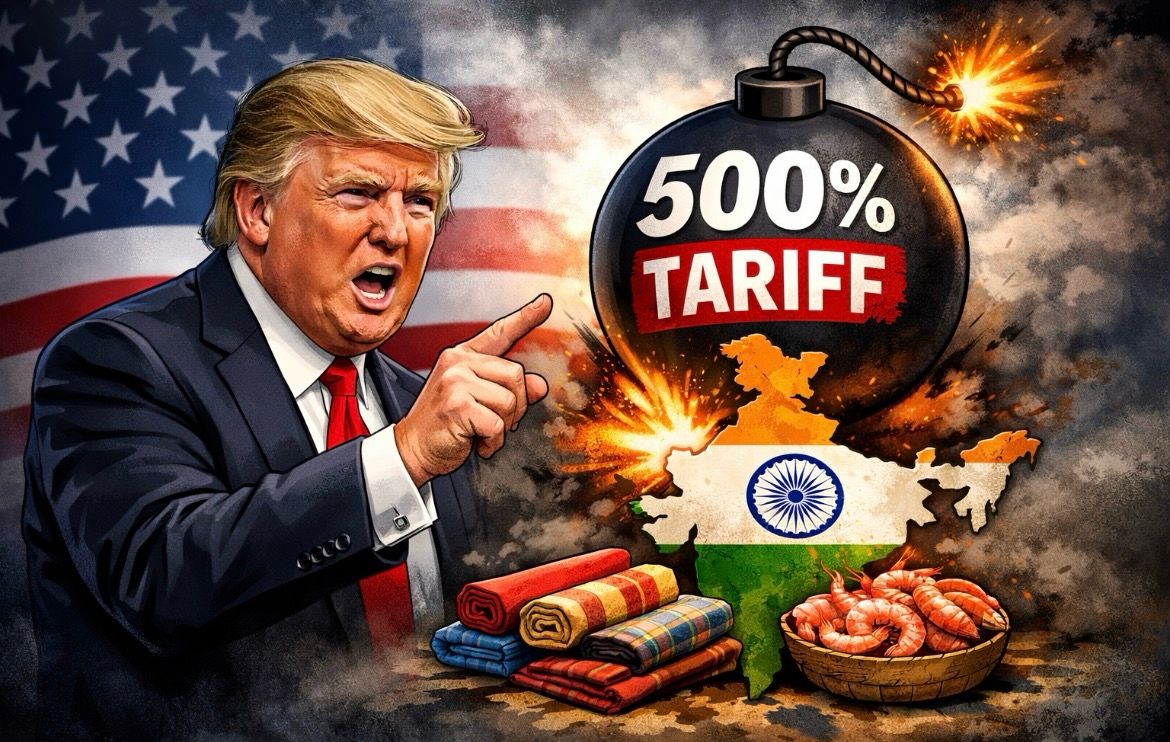
Table of Contents
500% TARIFF = INDIA–USA TRADE EARTHQUAKE
Bill Threatening 500% Tariff on India for Russian Oil Trade Gets Trump’s Nod. A major escalation risk has emerged in global trade and geopolitics. US President Donald Trump has “greenlit” the bipartisan Graham–Blumenthal Russia Sanctions Bill, which if passed could allow the U.S. to impose tariffs up to 500% on countries that continue purchasing Russian oil, gas, or uranium. This includes India, China, and Brazil.
What’s the 500% Tariff Proposal?
- If enacted, the legislation would Authorise the U.S. president to impose secondary sanctions and tariffs up to 500%. Target countries that “knowingly purchase Russian energy and fuel Russia’s war machine”. Aim to financially cripple Moscow, even as peace talks with Ukraine continue. Senator Lindsey Graham has indicated a Senate vote could come as early as next week, subject to legislative scheduling.
- Sanctioning Russia Act of 2025, co-sponsored by Senators Lindsey Graham and Richard Blumenthal and approved by President Trump, authorizes the U.S. to impose at least a 500% tariff on imports from countries that knowingly trade in Russian-origin petroleum, uranium, or gas.
- It empowers the President to escalate duties on countries (like India) that continue to purchase Russian energy, aiming to squeeze Russia’s war finances.
- The proposed U.S. sanctions framework imposing up to 500% tariffs on countries purchasing Russian oil & gas is not merely geopolitical posturing. For India, it represents a direct systemic risk to exports, employment, and FX stability.
WHY INDIA IS HIGHLY EXPOSED
India & USA exports (FY24): $77–80 billion. The U.S. is India’s largest export destination. Any tariff shock here is macro-critical, not sectoral.
Why India Is a Primary Target
- India has been one of the largest buyers of discounted Russian crude, at times accounting for 35–40% of total Indian oil imports—up from negligible levels pre-war. As a result, the U.S. already imposed 50% tariffs on Indian exports (25% standard + 25% oil-related) in August 2025.
- Unlike with China which supplies critical rare earths, the U.S. perceives India as having far less strategic leverage, making India more vulnerable to punitive measures.
- India has sharply increased Russian oil imports post-Ukraine war due to Energy security needs, Deep discounts versus global crude prices, Inflation and current account considerations. However The U.S. is India’s largest export market (~$77–80 bn annually). A tariff weapon of this magnitude would not hit oil. It would hit textiles, seafood, MSMEs, and labour-intensive exports. This is secondary sanctions via trade, not diplomacy.Strategic Contradiction
- India’s oil purchases are economic, not ideological
- Tariffs punish exporters, workers, farmers, MSMEs — not policymakers
- Neutral countries are being forced into political alignment through trade pressure
This bill marks a shift from: Rules-based free trade. Politically aligned trade enforcement. Energy policy is becoming a trade weapon.
SECTORS IN THE LINE OF FIRE
TEXTILES & APPAREL
- Exports to U.S.: $10–11 billion annually
- ~28–30% of India’s total textile exports go to the U.S.
- Net margins: 3–6%
A 500% tariff = immediate commercial extinction. No hedging. No pricing power. No recovery window.
SHRIMP & SEAFOOD
- Exports to U.S.: $6–7 billion annually
- 70%+ of India’s shrimp exports depend on the U.S.
- India supplies ~40% of total U.S. shrimp imports
Even 25–50% tariffs are destabilizing. 500% would collapse the sector
ENGINEERING GOODS | CHEMICALS | LEATHER | GEMS & JEWELLERY:
- Combined exposure: $20+ billion
- Highly price-elastic, globally competitive categories
- Zero tolerance for punitive tariffs
THE REAL IMPACT — NUMBERS DON’T LIE
- Export prices jump 5× overnight
- Orders migrate to Vietnam, Bangladesh, Mexico
- Millions of MSME & labor-intensive jobs at risk
- FX inflows shrink | Trade deficit widens
Potential Impact if Enacted
- Trade Shock : A 500% tariff would effectively render Indian goods noncompetitive, acting as a de facto trade embargo. An estimated $120 billion in exports to the U.S. could be at risk—especially in textiles, gems & jewelry, leather, fisheries, and engineering goods.
- Employment & SME Impact: Labour-intensive sectors—textiles, footwear, seafood—face potential collapse, risking widespread job losses and capacity shutdowns, especially among SMEs.
- Economic & Financial Ripples: Possible $15–25 billion FPI outflows, a 2–3% rupee depreciation, and a rise in bond yields of 30–50 bps, tightening corporate borrowing. Loss of cheap Russian crude would increase import bills by $8–12 billion annually, worsening the current account and dampening GDP growth by 0.2–0.4%.
- Strategic Pressure & Diplomatic Strain: The U.S. would wield the tariff as diplomatic leverage linking India’s oil imports directly to U.S. trade terms. Slaps on the same tariff structure already contributed to stalled India–U.S. trade deal negotiations. India has signaled willingness to diversify energy sources, and its ambassador has sought relief, but no firm U.S. reprieve is guaranteed.
THE CORE CONTRADICTION:
India imports Russian oil for energy security, not geopolitics. Tariffs punish workers, MSMEs, farmers & exporters not policymakers & This is secondary sanctions enforced via trade. Global trade is moving from Free Trade Principles & Politically Aligned Trade Blocs. Neutrality is no longer neutral.
Wider Perspective
- The U.S. frames this as a measure to deprive Russia of war finance, but the targeted use against India—despite China being another major buyer reflects a selective approach.
- Economically, if enacted, it could severely hamper India’s growing global supply chains, devastate exports, and challenge its energy security balance.
- A 500% tariff is not a trade remedy. It is an economic nuclear option.If this bill moves forward:
- India–U.S. trade equations will be stress-tested
- Exporters must model worst-case scenarios now
- Supply chains, sourcing, and market diversification become urgent—not optional
- It’s a live geopolitical risk businesses and policymakers must prepare for.
Bottom Line
- A 500% tariff is not a trade measure: It is an economic nuclear option. If enforced, it could reshape India–U.S. trade relations, destroy margins in textiles & seafood, permanently alter global sourcing strategies. This is not theoretical. This is a scenario businesses must model, hedge, and plan for NOW.
- The measure is a legislative escalator, not automatic but with strong political backing.
- If triggered, it would devastate India–U.S. trade, halt key exports, and deliver a major blow to employment.
Beyond trade, it’s a strategic lever to influence India’s energy policy—but it could backfire, affecting both economies and diplomatic trust.
**********************************************************
If this article has helped you in any way, i would appreciate if you could share/like it or leave a comment. Thank you for visiting my blog.
Legal Disclaimer:
The information / articles & any relies to the comments on this blog are provided purely for informational and educational purposes only & are purely based on my understanding / knowledge. They do noy constitute legal advice or legal opinions. The information / articles and any replies to the comments are intended but not promised or guaranteed to be current, complete, or up-to-date and should in no way be taken as a legal advice or an indication of future results. Therefore, i can not take any responsibility for the results or consequences of any attempt to use or adopt any of the information presented on this blog. You are advised not to act or rely on any information / articles contained without first seeking the advice of a practicing professional.