How to Correct Mistakes in MCA Forms MGT‑7 or AOC‑4
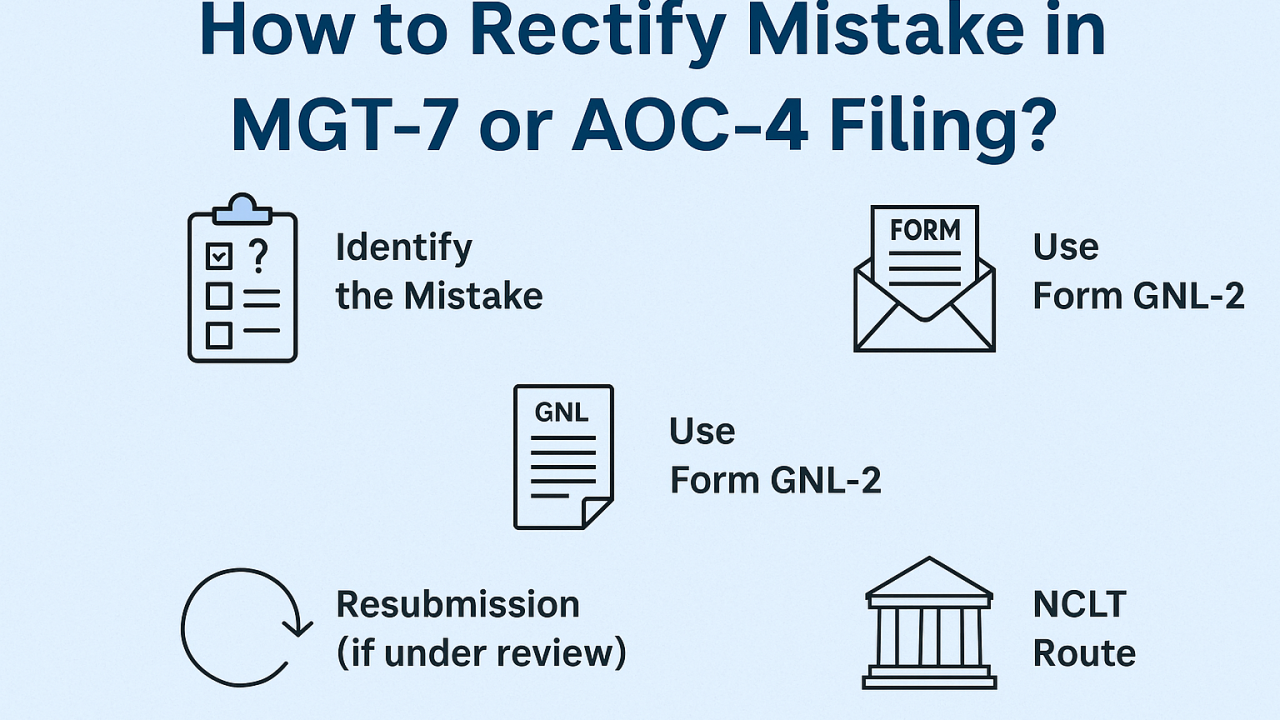
Table of Contents
How to Correct Mistakes in MCA Forms MGT‑7 or AOC‑4
The MCA does not allow direct editing or revision of an already approved form. However, corrections are possible depending on the form’s status and the nature of the error.
Form MGT-7 (Annual Return)
Registrar of Companies Form MGT-7 (Annual Return) Filed under Section 92 of the Companies Act, 2013:
When Can It Be Corrected?:
If Form is under processing, then log in to Ministry of Corporate Affairs portal and Check “Track SRN Status,” and If still pending → you may be able to withdraw and re-file
If Form is already approved, there is no direct “revision” option in Ministry of Corporate Affairs for MGT-7. Correction methods
- File Revised MGT-7 : Prepare correct annual return. Attach an explanatory note stating the SRN of the original filing, then the nature of the mistake, and the reason for correction. (Used for clerical errors, wrong shareholding data, incorrect director details, etc.)
- File Compounding Application (If Major Error) : If error involves wrong paid-up capital, incorrect shareholding pattern, non-disclosure of directors, incorrect compliance reporting. Then file an application under Section 441 for compounding, which may involve a penalty.
Form AOC-4 (Financial Statements)
Form AOC-4 (Financial Statements) Filed under Section 137 of the Companies Act, 2013. Correction Options: A. If Still Under Processing then Withdraw (if allowed) and Re-file corrected form
Form AOC-4 (Financial Statements) Filed under Section 137 of the Companies Act, 2013. If Already Approved : There is NO direct revision facility in Ministry of Corporate Affairs. There is correction options available:
- File Revised Financial Statements (Section 131) : Applicable if financial statements contain errors, the Board’s Report has mistakes, and incorrect figures are filed. Procedure Forms MGT‑7 or AOC‑4 in this case: Apply to the National Company Law Tribunal (NCLT), obtain approval for revision, and file the revised AOC-4 and attach the NCLT order. it is to be noted that mandatory NCLT approval is required.
- File Clarification Letter (Minor Clerical Errors) If typographical mistakes, attachment errors, and minor rounding differences. Then upload clarification via GNL-2, attach the board resolution, and mention the original SRN, which is filed earlier with the Ministry of Corporate Affairs.
Below is an accurate step-by-step procedure based on vetted sources.
Step 1: Identify the Type of Error
Errors are broadly two types:
- Minor – Typographical and formatting issues
- Major – Wrong financials, shareholding, director details, Annual General Meeting date, attachments, etc.
Step 2. Check the Current Status of the Filed Form
If the form is “Under Processing” / “Sent for Resubmission”: You can simply correct and resubmit the same form within the timeline.
If the form is “Approved”: You cannot revise it directly. Different rules apply:
- MGT‑7 / MGT‑7A can be revised by filing a new MGT‑7 / MGT‑7A with a fresh SRN. (The latest version filed will be considered.)
- AOC‑4 / AOC‑4 CFS cannot be revised. : Only Registrar of Companies can deactivate/cancel the original AOC‑4, after which a fresh AOC‑4 can be filed.
Step 3. Write to the Jurisdictional Registrar of Companies
If the form is already approved or data mismatch prevents refiling: You must:
- Write an application to Registrar of Companies
- Explain the error clearly
- Request permission to file corrected documents
- Attach supporting documents—Board Resolution, corrected statements, proof
(For certain issues like wrong Annual General Meeting date mismatch between MGT‑7A and AOC‑4, Registrar of Companies manual intervention is mandatory.)
Step 4. Use Form GNL‑2 if Registrar of Companies Approves:
The Registrar of Companies may allow you to file corrected documents via Form GNL‑2. You must attach a cover letter, a corrected MGT‑7 or AOC‑4 (PDF), and a board resolution. It is to be noted that GNL‑2 is not a replacement for the original filing. It is a supplemental correction record.
Step 5. Re‑file MGT‑7A / MGT‑7 (if applicable):
If correction is allowed then Upload updated shareholder list, director details, corrected disclosures, and lastly, a new SRN is generated and replaces the earlier version
Step 6. When the Registrar of Companies Must Intervene (Examples): Some errors cannot be corrected by the company alone. Examples:
- The wrong Annual General Meeting date in MGT‑7A → AOC‑4 keeps rejecting
- Must contact Registrar of Companies to update backend data
- Wrong consolidation selection in AOC‑4
- Only Registrar of Companies can allow refiling
Step 7. Updated MCA V3 Considerations: With the migration to MCA V3, remember:
- Forms are web‑based and real‑time validated
- Previous-year data auto‑populates
- Any change requires compulsory justification
- This reduces common errors but increases rejections for mismatches.
Step 8. Documents Usually Required for Correction
- Original form copy
- Corrected financial statements
- Board Resolution approving correction
- Explanation letter / Affidavit
- Proof supporting correction (e.g., minutes, CA certificate)
- Annual General Meeting notice & minutes (if date‑related)
What are the Documents Generally Required for Correction in MCA Forms MGT‑7 or AOC‑4
- Copy of original filed form
- Corrected financial statements
- Board Resolution approving correction
- Explanation letter
- Supporting proof (CA certificate / Minutes)
- Annual General Meeting Notice & Minutes (if Annual General Meeting issue)
When Registrar of Companies Intervention Is Mandatory:
Following are examples of when the Registrar of Companies’ intervention is mandatory:
- The wrong Annual General Meeting date in MGT-7 causing AOC-4 rejection
- Backend capital mismatch
- Incorrect consolidation selection
- The company alone cannot correct it—the Registrar of Companies must unlock/update the system.
Time Sensitivity in Forms MGT‑7 or AOC‑4
If a mistake affects paid-up capital, director data, shareholding, and financial figures. Correct immediately to avoid a penalty under Sec 92 / 137, director disqualification risk, and future Registrar of Companies notices.
Before correction in Ministry of Corporate Affairs Forms MGT‑7 or AOC‑4:
The company must check whether the error impacts other filings, verify whether ADT-1 / DIR-12 / PAS-3 also need correction, and maintain a Board Resolution record.
Pre-Correction Checklist
Before proceeding, check impact on ADT-1, verify DIR-12 details, Review PAS-3 filings, cross-check the Annual General Meeting dates, Pass proper Board Resolution, Maintain documentary trail
Summary of What You Should Do (Simple Version)
| Situation | What You Can Do |
| Form is under resubmission | Re-upload corrected form |
| MGT‑7 / MGT‑7A approved | Re-file revised MGT‑7/MGT‑7A (new SRN) |
| AOC‑4 approved | Request Registrar of Companies → Registrar of Companies cancels → File new AOC‑4 |
| Wrong data mismatch between AOC‑4 & MGT‑7A | Approach Registrar of Companies for manual correction |
| Major errors | Registrar of Companies letter → approval → file GNL‑2 attachments |
Important Compliance Points
| Type of Error | MGT-7 | AOC-4 |
| Typographical | Re-file with note | GNL-2 |
| Shareholding error | Revised filing | NCLT if financial impact |
| Financial figure error | Not applicable | Section 131 required |
| Non-filing of info | Compounding | Compounding |
Conclusion: Correcting Ministry of Corporate Affairs Errors in MGT-7 & AOC-4
Errors in MGT-7 / MGT-7A (Annual Return) or AOC-4 (Financial Statements) filings may result in technical non-compliance, penalties under Sections 92 and 137 of the Companies Act, 2013, and future scrutiny from the Ministry of Corporate Affairs or jurisdictional Registrar of Companies. However, the Ministry of Corporate Affairs framework does provide structured mechanisms for rectification, depending on the nature of the error (minor vs major), the status of the form (under processing vs approved), whether financial statements require formal revision, and whether backend Registrar of Companies intervention is necessary.
Companies can mitigate exposure by:
- Promptly identifying discrepancies
- Filing fresh MGT-7/MGT-7A where permissible
- Approaching the Registrar of Companies for backend correction
- Filing clarification through GNL-2 for minor issues
- Seeking approval from the National Company Law Tribunal where revision under Section 131 is required
- Maintaining proper Board Resolutions and documentation trail
Timely corrective action demonstrates bona fide intent, reduces litigation risk, and preserves corporate governance credibility. Ignoring discrepancies, on the other hand, may escalate into compounding proceedings, adjudication notices, or qualification in secretarial audit.
**********************************************************
If this article has helped you in any way, i would appreciate if you could share/like it or leave a comment. Thank you for visiting my blog.
Legal Disclaimer:
The information / articles & any relies to the comments on this blog are provided purely for informational and educational purposes only & are purely based on my understanding / knowledge. They do noy constitute legal advice or legal opinions. The information / articles and any replies to the comments are intended but not promised or guaranteed to be current, complete, or up-to-date and should in no way be taken as a legal advice or an indication of future results. Therefore, i can not take any responsibility for the results or consequences of any attempt to use or adopt any of the information presented on this blog. You are advised not to act or rely on any information / articles contained without first seeking the advice of a practicing professional.