CBDT’s Warning Fraudulent Deduction Claims on Donations

Table of Contents
Overview of CBDT’s Warning Fraudulent Deduction Claims on Donations
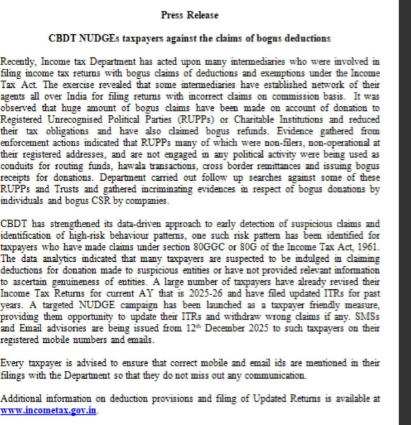
CBDT has launched a press release as part of an awareness campaign to combat fraudulent deduction claims in income tax returns, particularly those u/s 80GGC (donations to political parties) and 80G (donations to charitable institutions). This targets bogus claims filed through intermediaries who issue fake receipts for commissions, often linked to hawala, fund routing, or cross-border activities. Key Issues Identified by CBDT
- Bogus Entities: Many claims involve donations to Registered Unrecognized Political Parties or charitable institutions that are non-filers, non-operational, or not genuinely engaged in political/charitable work. Intermediaries file returns with incorrect deductions on a commission basis, using suspicious receipts. The Central Board of Direct Taxes has flagged taxpayers claiming deductions without verifying recipient legitimacy.
- The Income Tax Department has identified and taken action against intermediaries who were filing ITRs with bogus deductions and exemptions on a commission basis.
- A significant number of false claims were made in the name of donations to Registered Unrecognized Political Parties, and Certain Charitable Institutions. Investigations reveal that many such political parties were non-filers, non-operational, and not engaged in genuine political activities.
- Use of Fake Donation Receipts like Evidence suggests the issuance of bogus donation receipts for Routing of funds and Hawala transactions Cross-border remittances & Artificially inflating deductions to reduce tax liability
Actions Taken by The Central Board of Direct Taxes
- The Income Tax Department is acting against intermediaries and scrutinizing high-risk claims. NUDGE Campaign: Starting December 12, 2025, targeted advisory messages urge accurate filing. Taxpayers can ensure your mobile number & email are updated in your e-filing profile to receive them. Taxpayer can check deduction rules & options for updated returns at www.incometax.gov.in.
- CBDT Advisory for Taxpayers that Taxpayers should Claim deductions only for genuine donations, Verify the registration, compliance status, and authenticity of the recipient entity, Avoid engaging intermediaries offering assured refunds or inflated deductions & Rectify errors promptly to avoid penalties, interest, and prosecution
- Taxpayers should verify 80G/80GGC eligibility via the department’s portal before claiming. This campaign aims to promote compliance and deter fraud.
CBDT NUDGEs Taxpayers Against Claim of Bogus Deductions
Central Board of Direct Taxes has issued a warning and awareness press release cautioning taxpayers against claiming bogus deductions in their Income Tax Returns . The initiative forms part of a targeted “NUDGE” compliance campaign, aimed at discouraging fraudulent claims and promoting voluntary tax compliance.
The campaign primarily focuses on incorrect deduction claims related to donations u/s 80G & 80GGC of the Income Tax Act, which have been widely misused through non-genuine entities and intermediaries operating on a commission basis. Details of the press release are mentioned hereunder:
Data-Driven NUDGE Campaign – AY 2025–26
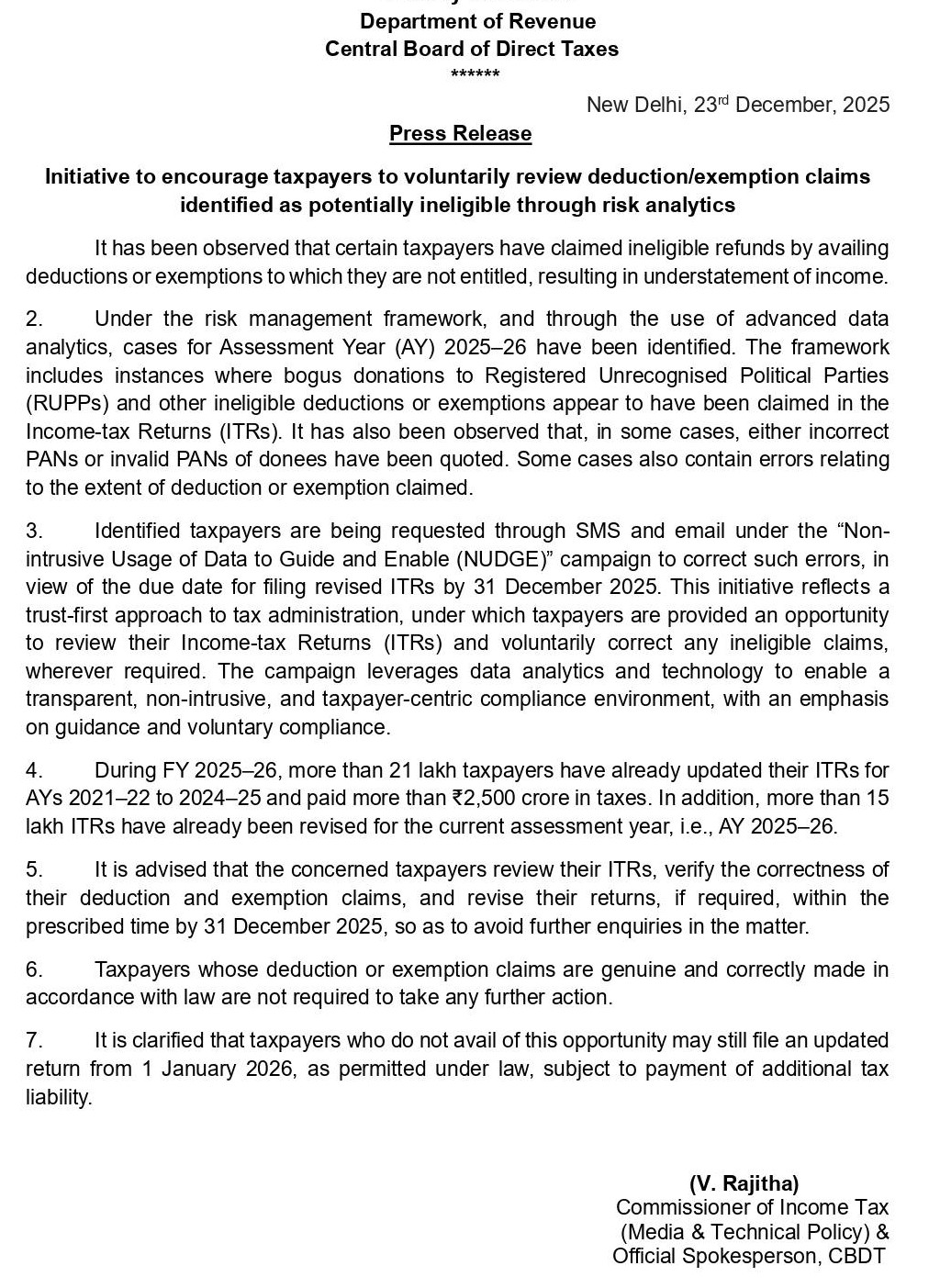
The Income Tax Dept. has announced the launch of a data-driven NUDGE campaign to encourage taxpayers to voluntarily review and correct deduction or exemption claims that have been identified as potentially ineligible through advanced risk analytics. This initiative is advisory in nature and reflects a trust-first, non-adversarial approach to compliance.
What is a “NUDGE” Campaign?
A NUDGE is not a notice, not a scrutiny, not an assessment, & not a penalty trigger. It is an informational reminder sent to taxpayers where system analytics indicate a possible mismatch, excess claim, or risk marker. The objective is self-correction, not coercion.
Nature of Outreach : As clarified in the press release, communication is advisory, language is non-threatening, there is no immediate consequence for receiving the message, the taxpayer is free to accept or reject the suggestion, and voluntary correction is encouraged “wherever required.” This is consistent with the Department’s recent shift away from blanket scrutiny.
his campaign signals that The Department prefers early correction over litigation Data quality has reached a level where silent errors are visible & taxpayers are being given a grace window before enforcement. It also aligns with the expanded scope of updated returns, Reduced penalties for voluntary compliance, & the litigation decongestion strategy
Key Areas Likely to Be Nudged
Based on past campaigns and analytics trends, House property interest deductions, Chapter VI-A deductions (80C, 80D, 80G, etc.), exempt allowances, capital gains exemptions, set-off of losses & inconsistent regime selection (old vs. new). NUDGE is a courtesy knock, not a raid. Fixing an error now is far cheaper than explaining it later. & This is compliance by conversation, not confrontation.
Why This Matters for AY 2025–26
This campaign signals that the department prefers early correction over litigation, data quality has reached a level where silent errors are visible, & taxpayers are being given a grace window before enforcement. It also aligns with the expanded scope of updated returns, Reduced penalties for voluntary compliance, & the litigation decongestion strategy. Details in the Press Release:
- You may also review the following blogs:
**********************************************************
If this article has helped you in any way, i would appreciate if you could share/like it or leave a comment. Thank you for visiting my blog.
Legal Disclaimer:
The information / articles & any relies to the comments on this blog are provided purely for informational and educational purposes only & are purely based on my understanding / knowledge. They do noy constitute legal advice or legal opinions. The information / articles and any replies to the comments are intended but not promised or guaranteed to be current, complete, or up-to-date and should in no way be taken as a legal advice or an indication of future results. Therefore, i can not take any responsibility for the results or consequences of any attempt to use or adopt any of the information presented on this blog. You are advised not to act or rely on any information / articles contained without first seeking the advice of a practicing professional.