How the New Rule Stops Fake Rent Claims
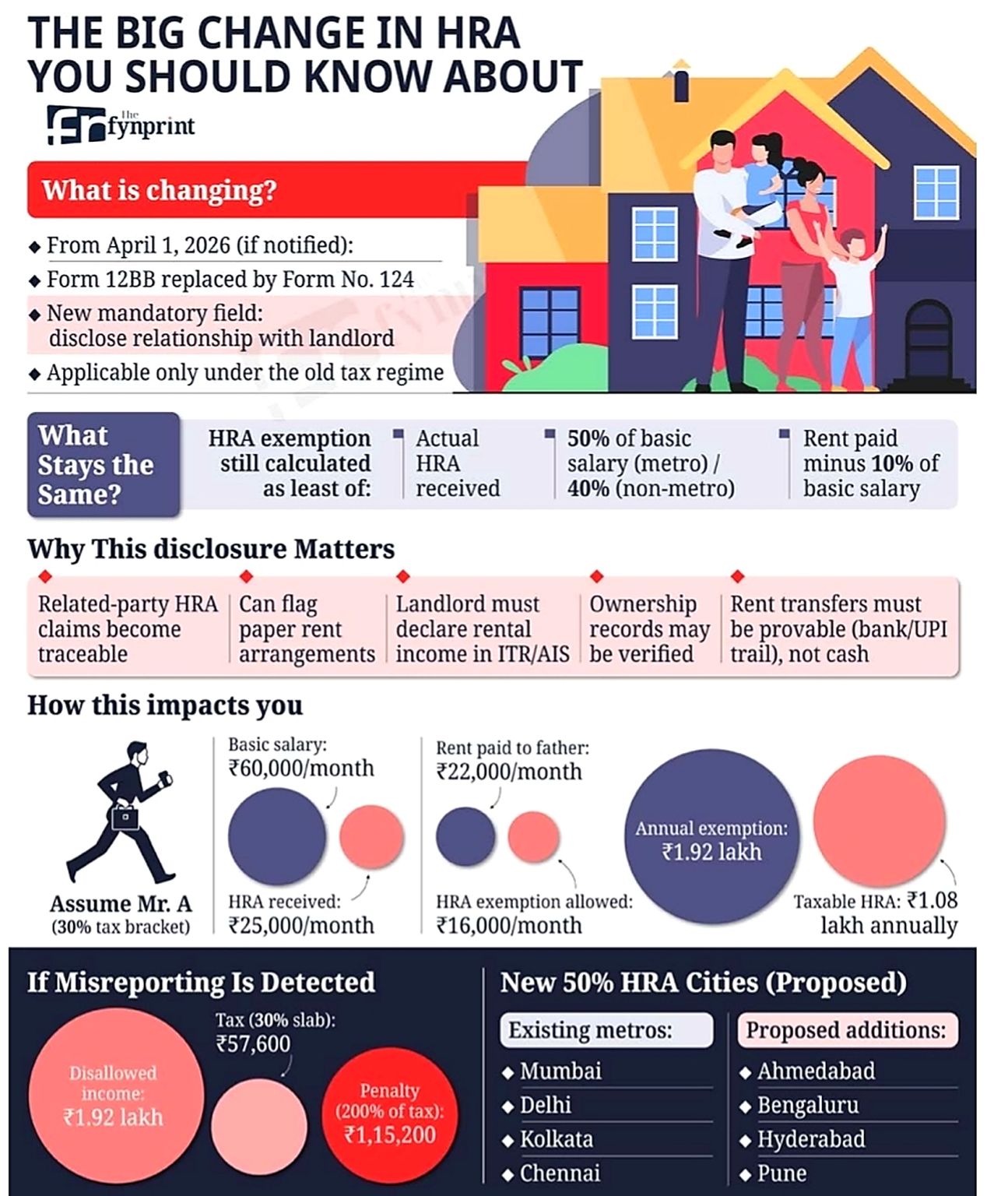
Table of Contents
Why Paying Fake Rent to Parents Will Become Very Difficult Now
Mandatory Relationship Disclosure (New Form 124)
Under the Draft Income‑Tax Rules, 2026, the Income Tax Department has introduced a new requirement for claiming House Rent Allowance (HRA): Taxpayers must now disclose their “relationship with the landlord” in the new Form 124. This looks like a small change, but it completely changes how HRA claims are verified. “Relationship with the landlord, if any.” This applies where annual rent exceeds ₹1 lakh. Why this matters If you mention “Parent”, “spouse,” “sibling,” etc., the system treats it as a high‑risk claim. And intra‑family rent arrangements become directly identifiable. This disclosure converts HRA from a self‑declared deduction to a data‑verified deduction.
What Problem Is the Government Trying to Solve?
Many taxpayers claim HRA by showing rent paid to parents, spouses, siblings, relatives, or even fake landlords. Often the rent is not actually paid, or the money is returned in cash, or the landlord does not declare rental income. The Income Tax Department has been tracking widespread use of fake rent receipts for tax savings.
The government is closing the loophole used for years: “Show rent paid to your parents → claim HRA → parents don’t show income.” From April 2026, this will be very difficult because Relationship must be declared, the system automatically matches both parties’ tax data, Fake arrangements will be caught instantly and Heavy penalties will apply
Taxpayers cannot claim HRA if they live in his own house and show rent to parents. The rent is “paper rent” returned in cash; Parents do not report rental income and Fake rent receipts are created
How the New Rule Stops Fake Rent Claims :
- Stricter Documentation Requirements : Taxpayers now need like bank transfer evidence, not cash payments; a formal rental agreement; and the landlord’s PAN/Aadhaar (mandatory where applicable). The new form (Form 124) asks for the landlord’s name, address, PAN / Aadhaar, rent amount, and relationship with the landlord (mandatory). Once this relationship is disclosed, the tax department will automatically cross-check multiple data points using analytics:
- TDS Requirement : If rent > ₹50,000/month, you must deduct 2% TDS. Failure to do so alerts the system. (Supported by general IT Act rules + scrutiny insights from search results.) These rules ensure “paper rent receipts” are no longer sufficient.
- Ownership Verification by Tax Department : The new system checks whether the parent actually owns the property. You cannot claim HRA if The parent is not the legal owner or you are a co-owner and trying to pay rent to claim HRA. Ownership mismatch = instant red flag.
AI‑Driven Cross‑Verification (CPC 2.0 System) :
The Income Tax Department now uses AI, analytics, and PAN‑based matching to validate HRA claims. These are automatically cross‑checked. The following are Automated Cross‑Verification
- Landlords’ ITR—Did they report rental income?
- Property ownership records – Do they actually own the house?
- Banking trail – → Was rent really transferred through bank/UPI?
- AIS/PAN-based data – Do taxpayer claims match their data?
- If anything does not match, the system can instantly flag it, even without human scrutiny.
- Property ownership records → Do parents actually own the house?
- If the taxpayer claims rent but parents fail to show rental income, the system flags the mismatch and issues a notice.
Is paying rent to parents still allowed?
Yes, but only if the arrangement is genuine. Taxpayers can claim HRA for rent paid to parents if ALL these conditions are true: parents own the property, the taxpayer actually lives there, the taxpayer transfers rent via bank, and the taxpayer’s parents declare the rental income in their ITR. The taxpayer must ensure parents own the house, the taxpayer actually lives there, rent is paid via bank every month, and parents declare the rental income in their ITR. Fake or circular rent payments will be caught. Cash rent returned secretly, rent claimed for your own property, parents not reporting rental income, and created rent receipts without real payment. All these will trigger AI-driven scrutiny.
Penalty for Fake Rent Claims – Non-genuine cases attract up to a 200% penalty.
From 1 April 2026, fake HRA claims involving payments to parents or relatives will be nearly impossible because a relationship with the landlord is mandatory to disclose; AI automatically matches your claim with the landlord’s ITR, property data, and bank trail. strict documentation is required. If the Income Tax Department detects misreporting or fake HRA claims, the penalty can be up to 200% of the tax evaded. This is because the new disclosure removes the “I didn’t know” defense. So HRA claims involving parents will only work if they are 100% genuine, documented, bank‑recorded, and reported in both ITRs. Fake or “paper-only” arrangements will be caught instantly.
**********************************************************
If this article has helped you in any way, i would appreciate if you could share/like it or leave a comment. Thank you for visiting my blog.
Legal Disclaimer:
The information / articles & any relies to the comments on this blog are provided purely for informational and educational purposes only & are purely based on my understanding / knowledge. They do noy constitute legal advice or legal opinions. The information / articles and any replies to the comments are intended but not promised or guaranteed to be current, complete, or up-to-date and should in no way be taken as a legal advice or an indication of future results. Therefore, i can not take any responsibility for the results or consequences of any attempt to use or adopt any of the information presented on this blog. You are advised not to act or rely on any information / articles contained without first seeking the advice of a practicing professional.