FCRA Amendment Rules 2026: Compliance Guide for NGOs
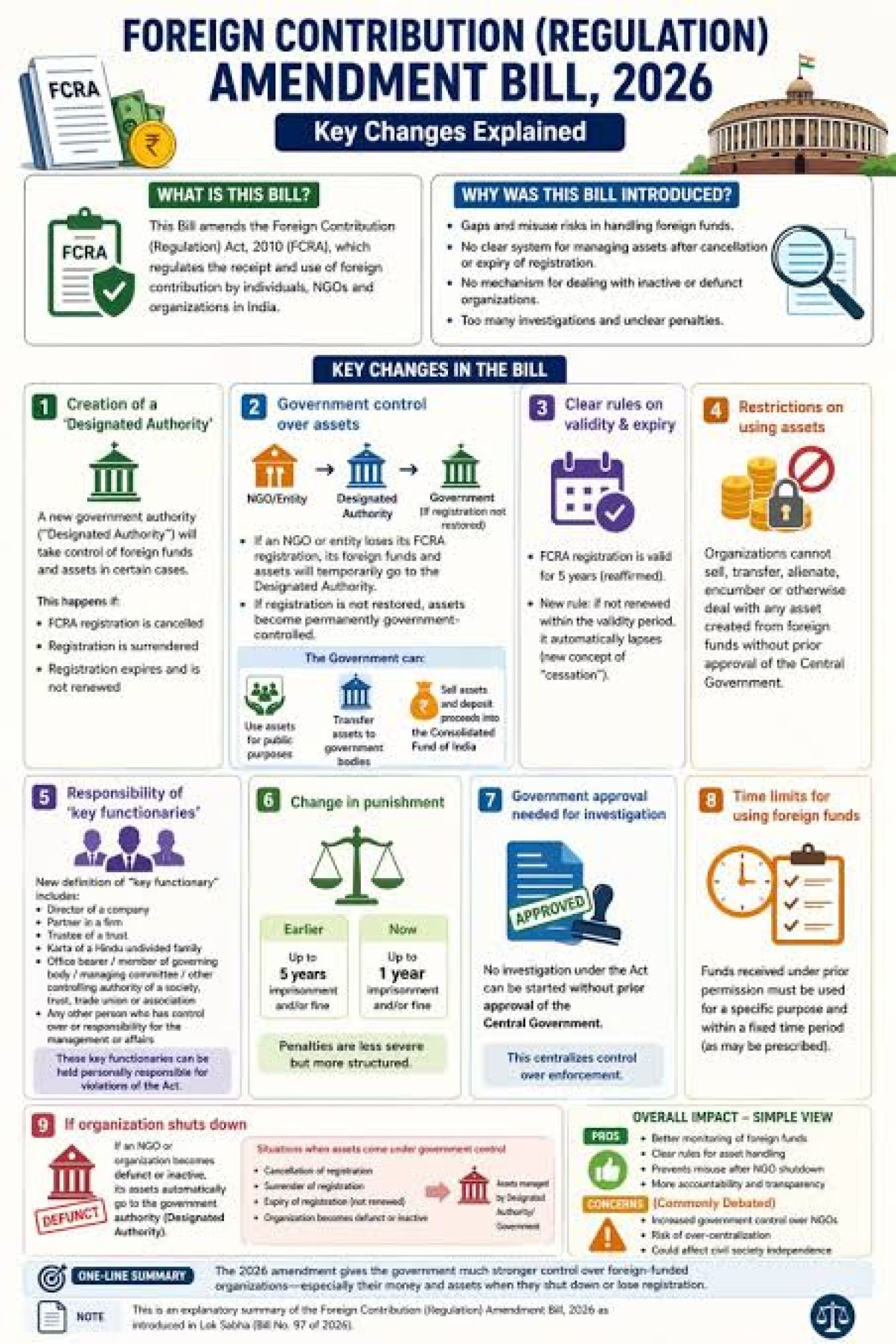
Table of Contents
FCRA Amendment Rules, 2026 Explained: Major Compliance Changes Every NGO Must Know
The Ministry of Home Affairs has notified the Foreign Contribution (Regulation) Amendment Rules, 2026, introducing comprehensive changes to the regulatory framework governing the receipt and utilization of foreign contributions by NGOs, trusts, societies, educational institutions, religious bodies, and other associations across India. Effective immediately upon notification, these amendments constitute one of the most significant reforms to the Foreign Contribution (Regulation) Act (FCRA) compliance regime in recent years.
The amendments are aimed at enhancing transparency, accountability, traceability, and regulatory oversight of foreign-funded activities. They seek to ensure that foreign contributions are received, managed, and utilized strictly in accordance with approved objectives and designated geographical areas, while strengthening monitoring mechanisms to prevent misuse and improve compliance with FCRA requirements.
Understanding FCRA
The Foreign Contribution (Regulation) Act, 2010 (FCRA) governs the acceptance, management, and utilization of foreign contributions by organizations and entities operating in India. Its primary objective is to ensure that foreign funding does not compromise the nation’s sovereignty, integrity, security, public interest, democratic processes, or policy framework.
Through the latest amendments, the government has introduced a more robust and technology-driven compliance framework, emphasizing greater transparency, real-time monitoring, and activity-specific reporting. The revised regime aims to enhance regulatory oversight of foreign-funded activities, strengthen accountability in the utilization of foreign contributions, and ensure stricter adherence to approved purposes and regulatory requirements.
Purpose-Specific and Geography-Specific Registration
One of the most significant reforms introduced by the 2026 Rules is the requirement for organizations to obtain registration based on specific purposes and specific geographical areas.
Under the new framework:
- The Foreign Contribution (Regulation) Act, 2010 registration certificates will mention the exact purpose for which foreign funds can be received.
- The FCRA registration will also specify the state(s) or union territory(ies) where activities can be undertaken.
- Organizations must select their activities from a government-prescribed schedule containing more than 100 approved activities across various sectors.
The approved activities are broadly classified as religious, cultural, educational, economic, and social sectors’ impact on existing NGOs.
Existing The Foreign Contribution (Regulation) Act, 2010 (FCRA) registered organizations are required to file Form FC-6F within one year of the notification and specify activities they wish to continue undertaking. and states and union territories where they intend to operate.
Any future expansion into new activities or new territories will require fresh approval from the government. FCRA-registered NGOs can no longer operate across India under a broad registration certificate. Their activities will now be closely linked to approved purposes and approved geographical jurisdictions
Additional Fees for Multiple Purposes and States
The government has introduced a structured fee system linked to the scope of operations. The basic registration fee covers one activity/purpose. and one state or union territory. Moreover, that FCRA-registered NGO also faces additional charges of INR 300 per additional purpose. And INR 300 per additional State/UT.
Impact of NGOs Facing the Additional Fees for Multiple Purposes and States
Organizations working in multiple sectors such as education, healthcare, and livelihood programs across several states will face higher registration and compliance costs. This encourages NGOs to carefully define their operational objectives and geographical spread before seeking registration.
New 75% Utilisation Requirement Before Release of Subsequent Installments
The amendment introduces an important financial discipline mechanism. For organizations receiving foreign funds through prior permission, subsequent installments of approved foreign contribution will be released only after:
- At least 75% of the previous installment has been utilized.
- Verification through field inquiry, wherever required.
- Filing of prescribed Form FC-3BB.
Why did the Foreign Contribution (Regulation) Act, 2010 (FCRA) change?
The government intends to prevent the accumulation of unused funds and ensure timely implementation of projects funded through foreign contributions. This will particularly affect project-based grants released in installments.
Minimum Utilisation Requirement of INR 10 Lakh
A new benchmark has been introduced for renewal and continued registration. Organizations seeking renewal must demonstrate that they have undertaken meaningful activities using foreign contributions by spending a minimum amount of funds.
Under the amended framework:
At least INR 10 lakh of foreign contribution should have been utilized during the preceding two financial years.
Significance This provision targets inactive organizations that hold FCRA registration but undertake little or no substantive activity. The intention is to ensure that only genuinely active organizations continue to enjoy FCRA registration privileges.
Expanded Definition of “Key Functionary”
The Amendment Rules introduce a comprehensive definition of “Key Functionary.” The term now includes:
- Directors of companies.
- Partners of firms.
- Trustees of trusts.
- Karta of Hindu Undivided Families (HUFs).
- Office bearers.
- Members of governing bodies or management committees.
- Any person exercising management or decision-making powers.
Important Consequence in Case of change in definition of “Key Functionary”
Foreign nationals (other than persons of Indian origin in specified circumstances) acting as key functionaries may face restrictions in obtaining registration unless specifically approved by the government.
The broader definition significantly increases accountability and personal responsibility for compliance failures.
Mandatory Disclosure of Websites, Social Media and Publications
The compliance framework under FCRA has become more transparent and technology-driven. Organizations are now required to disclose official websites, social media platforms, and accounts. Publications issued during the year. and books, magazines, reports, or articles published by the organization or its functionaries.
Annual filings must also include detailed activity reports and information regarding ultimate donors and funding sources. The basic purpose of mandatory disclosure is that the government seeks greater visibility into how organizations communicate, influence, and utilize foreign-funded resources.
Detailed Religious Activities Schedule and Ban on Proselytisation
The Amendment Rules introduce a dedicated schedule defining permissible religious activities. These include:
- Construction and maintenance of places of worship.
- Preservation of scriptures.
- Pilgrim facilities.
- Langars and community kitchens.
- Faith-based welfare and charitable activities.
However, the rules explicitly exclude proselytization or religious conversion activities.
Impact of the the Foreign Contribution (Regulation) Act Amendment Rules, 2026: Introduce a dedicated schedule defining permissible religious activities when religious organizations receiving foreign contributions must ensure that their activities remain strictly within the approved categories and avoid any activity that may be interpreted as religious conversion.
FCRA 2.0: Complete Digital Transformation
The government has substantially upgraded the Foreign Contribution (Regulation) Act Amendment Rules, 2026, compliance infrastructure. The new digital ecosystem includes:
- Aadhaar authentication.
- e-Sign integration.
- OCR-based document verification.
- PAN integration.
- Aadhaar verification.
- OCI database verification.
- NGO Darpan integration.
- UDIN-based validation mechanisms.
Expected Benefits
- Faster approvals.
- Reduced paperwork.
- Better fraud detection.
- Enhanced due diligence.
- Improved transparency and monitoring.
Tighter Reporting and Real-Time Audit Access
The Foreign Contribution (Regulation) Act Amendment Rules, 2026, reforms significantly strengthen monitoring mechanisms. Key changes include:
- Enhanced periodic reporting requirements.
- Greater audit access for authorities.
- Increased monitoring of fund utilization through designated FCRA bank accounts.
- Closer scrutiny of fund transfers and sub-account operations.
Implications
NGOs must ensure accurate bookkeeping, timely submission of compliance reports, and Proper documentation of every foreign-fund transaction. and compliance lapses may now be detected much more quickly than under the earlier regime.
Stricter Penalties and Asset Management Controls
The amended framework introduces tougher consequences for violations. Areas attracting enhanced enforcement include:
- Excess administrative expenditure.
- Diversion of foreign funds.
- Utilization outside approved purposes.
- Activities outside approved geographical areas.
Additionally, the proposed legislative framework introduces a mechanism through which authorities may supervise or manage assets and unutilized foreign contributions where registration is cancelled or ceases to exist. This represents a major shift from simple cancellation of registration to active oversight of remaining foreign-funded assets.
Why These Amendments Matter
According to the The Foreign Contribution (Regulation) Act Amendment Rules, 2026 Online portal, India currently has approximately 14,000+ active FCRA-registered organizations, while thousands of registrations have been cancelled or allowed to expire over the years. The Government has stated that the amendments are aimed at:
- Improving transparency.
- Enhancing accountability.
- Preventing misuse of foreign funding.
- Ensuring purpose-based utilization.
- Strengthening regulatory oversight through technology.
Action Points for Existing NGOs
Every existing FCRA-registered organization should immediately undertake the following:
- File Form FC-6F : Declare approved purposes and geographical jurisdictions within one year from the date of notification.
- Review Governance Structures: Identify all “key functionaries” and ensure disclosures are updated.
- Update Digital Disclosures: Declare websites, social media accounts, and publications.
- Check Utilisation Levels: Ensure at least INR 10 lakh of foreign contribution has been utilized in the preceding two financial years for renewal purposes.
- Strengthen Internal Controls: Improve documentation, reporting, fund monitoring, and audit readiness.
Conclusion
The Foreign Contribution (Regulation) Act Amendment Rules, 2026 mark a paradigm shift from broad-based registration to a purpose-driven, location-specific, technology-enabled compliance framework. NGOs, trusts, societies, educational institutions, and religious organizations receiving foreign contributions must now operate under far greater scrutiny and transparency standards. While these reforms may increase compliance obligations, they also create a more structured and accountable ecosystem for foreign-funded activities in India. Organizations that proactively adapt to the new regime will be better positioned for smooth regulatory compliance and uninterrupted receipt of foreign contributions
**********************************************************
If this article has helped you in any way, i would appreciate if you could share/like it or leave a comment. Thank you for visiting my blog.
Legal Disclaimer:
The information / articles & any relies to the comments on this blog are provided purely for informational and educational purposes only & are purely based on my understanding / knowledge. They do noy constitute legal advice or legal opinions. The information / articles and any replies to the comments are intended but not promised or guaranteed to be current, complete, or up-to-date and should in no way be taken as a legal advice or an indication of future results. Therefore, i can not take any responsibility for the results or consequences of any attempt to use or adopt any of the information presented on this blog. You are advised not to act or rely on any information / articles contained without first seeking the advice of a practicing professional.