Skip to content

India Financial Consultancy

  • Home
  • About Us
  • Media
    • Publications
    • Press Releases
    • Newsletters
    • Archives
  • Contact Us
February 13, 2026 / GST Compliance

Is GST E-invoicing limit going to be can be decreased to INR 1.5?
GST E-invoicing limit decreased to INR 1.5

Table of Contents

  • Is the GST e-invoicing limit going to be can be decreased to INR 1.5?
  • Who Must Generate e‑Invoices? (Turnover-based Phases)
    • Exemptions from e‑Invoicing under GST law 
    • Time Limit for Reporting e‑Invoices under GST 
    • How e‑Invoicing Helps Prevent Tax Evasion under GST

Is the GST e-invoicing limit going to be can be decreased to INR 1.5?

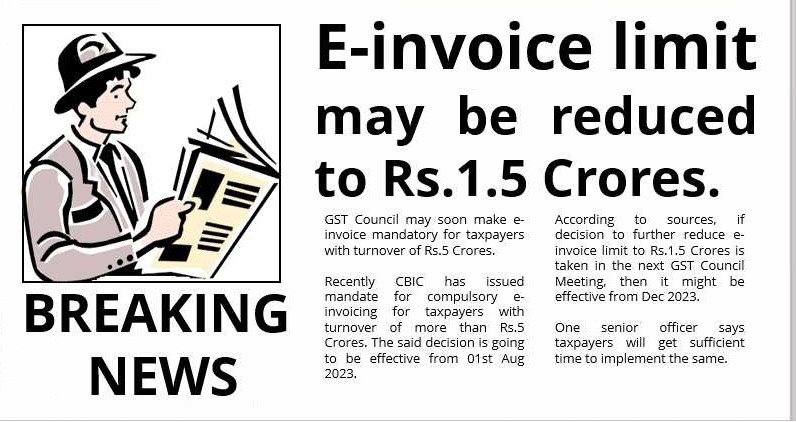
  • The Goods and Services Tax Council may soon make e-invoicing compulsory for Goods and Services Tax taxpayers with a turnover of INR 50,000,000.
  • Now the Central Board of Indirect Taxes and Customs has issued recommendations for mandatory new e-invoicing for Goods and Services Tax taxpayers with sales of more than INR 5,00,00,000.  The above decision is going to be implemented with effect from 1.08.2023.
  • As per sources, in the above case, the decision was to further decrease the e-invoice threshold limit to INR 1,50,00,000/-.  is taken in the upcoming Goods and Services Tax Council Meeting, then it might be effective from 1st December 2023.
  • One senior GST officer says Goods and Services Tax taxpayers will get sufficient time to implement the same.

Who Must Generate e‑Invoices? (Turnover-based Phases)

Phase Applicable to taxpayers with AATO > Effective From Notification
I ₹500 crore 01‑10‑2020 61/2020, 70/2020
II ₹100 crore 01‑01‑2021 88/2020
III ₹50 crore 01‑04‑2021 05/2021
IV ₹20 crore 01‑04‑2022 01/2022
V ₹10 crore 01‑10‑2022 17/2022
VI ₹5 crore 01‑08‑2023 10/2023

If turnover crosses the threshold in the current financial year, e‑invoicing applies from the next financial year.

Exemptions from e‑Invoicing under GST law 

Regardless of turnover, the following entities are exempt:

  • Notified Businesses : Insurers, Banks/Financial Institutions/NBFCs, Goods Transport Agencies (GTA), Passenger transport service providers, Cinema exhibition service providers (multiplex), SEZ units, Government departments & local authorities, and OIDAR service providers
  • Documents/Transactions excluded : B2C supplies, Exempt/Nil-rated B2B or B2G supplies, Imports, High-seas/bonded warehouse transactions, FTWZ transactions and Reverse charge under section 9(4)

Time Limit for Reporting e‑Invoices under GST 

  • As per the advisory of 5 November 2024, the mandatory 30-day GST reporting time limit applies to AATO ≥ ₹100 crore. and extended to AATO ≥ ₹10 crore from 1 April 2025.

How e‑Invoicing Helps Prevent Tax Evasion under GST

  • Real‑time reporting = immediate visibility of transactions
  • No gap to manipulate invoices post-transaction
  • Fake ITC becomes difficult due to system matching
  • Audit trail improves transparency

Mandatory Fields of an e‑Invoice

The e‑invoice schema contains 12 sections + 6 annexures (total 138 fields), 5 mandatory sections like Basic details, Supplier details, Recipient details Invoice item details, Document total, and 30 mandatory fields, including Document type (INV/CRN/DBN), Supplier legal name & GSTIN, Address & State code, Invoice number & date, Item details, Tax amounts, and Original invoice reference (in case of amendments)

From 1 June 2025: IRP will treat invoice numbers as case‑insensitive and convert them to uppercase automatically.
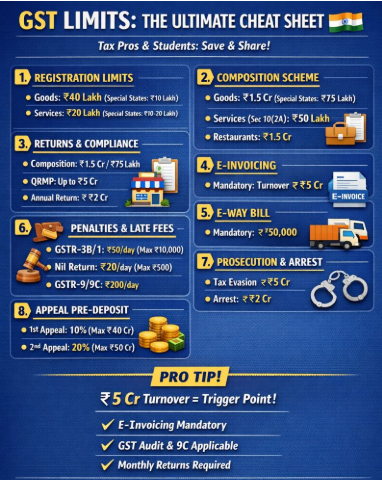
GST limits

**********************************************************

If this article has helped you in any way, i would appreciate if you could share/like it or leave a comment. Thank you for visiting my blog.

Legal Disclaimer:
The information / articles & any relies to the comments on this blog are provided purely for informational and educational purposes only & are purely based on my understanding / knowledge. They do noy constitute legal advice or legal opinions. The information / articles and any replies to the comments are intended but not promised or guaranteed to be current, complete, or up-to-date and should in no way be taken as a legal advice or an indication of future results. Therefore, i can not take any responsibility for the results or consequences of any attempt to use or adopt any of the information presented on this blog. You are advised not to act or rely on any information / articles contained without first seeking the advice of a practicing professional.

Post navigation

Previous Post:

How differentiates PAN, TAN, & TIN?

Next Post:

Deductions U/S 80C under Schedule VI of Income Tax

Enquire Now

    About IFCCL

    India Financial Consultancy Corporation Pvt. Ltd. is one of the leading providers of financial and business advisory, internal audit, statutory audit, corporate governance, and tax and regulatory services. With a global approach to service delivery, we are responds to clients' complex business challenges with a broad range of services across industry sectors and national boundaries. The Company has been set up by a group of young, enthusiastic, highly skilled and motivated professionals who have taken experience from top consulting companies and are extensively experienced in their chosen fields has providing a wide array of Accounting, Auditing, Assurance, Risk, Taxation, & Business advisory services to various clients and their stakeholders...
    Read More...

    Contact Info

    P-6/90 Connaught Circus,
    Connaught Place,
    New Delhi - 110001, India

    Landline: 011-43520194
    Email: singh@caindelhiindia.com

    RCS Recent Posts

    • Defaulted? Don’t Worry MCA Gives You a 2nd Chance March 2, 2026
    • Top Crypto Experts in India February 27, 2026
    • Best Way to Settle Credit Card Debt Legally in India February 20, 2026
    • How SIP Calculators Assist Investors February 15, 2026
    • How to Plan Your EMIs with a Personal Loan EMI Calculator? February 13, 2026
    • How to Correct Mistakes in MCA Forms MGT‑7 or AOC‑4 February 13, 2026
    • CBDT Releases Navigator for Income-tax Rules, 2026 February 10, 2026
    • Union Budget 2026 – Direct Tax Changes Explained February 7, 2026

    Archives

    • 2026 (24)
    • 2025 (189)
    • 2024 (154)
    • 2023 (113)
    • 2022 (121)
    • 2021 (92)
    • 2020 (16)
    • 2017 (5)
    • 2016 (181)
    • 2015 (179)
    • 2014 (1)

    Categories

    • Accounting Services (26)
    • Audit (43)
    • Business Consultancy (39)
    • Business Registration Services (15)
    • Business Services (14)
    • Business Set Up in India (30)
    • Business Set Up Outside India (7)
    • Business Strategy (43)
    • CA (6)
    • CBDT (33)
    • Certification (1)
    • CFO Services (12)
    • Chartered Accountant (30)
    • Company Law Compliances (232)
    • Company Registration (7)
    • compliance calendar (11)
    • CORPORATE AND PROFESSIONAL UPDATE (8)
    • Corporate Updates (17)
    • Cryptocurrency (16)
    • DGFT (5)
    • Digital Signature Certificate (1)
    • Direct Tax (102)
      • ITR (30)
    • DTAA (15)
    • FCRA (7)
    • FDI (9)
    • FIU-IND (2)
    • Fixed Asset Register Related Services (4)
    • Foreign Exchange Management Act (56)
    • GST (125)
    • GST advisory (1)
    • GST Compliance (71)
    • GST Registration (15)
    • IBC (38)
    • IEC (4)
    • INCOME TAX (310)
    • Indirect Tax (215)
    • Insolvency and Bankruptcy Code (2)
    • Intellectual Property Rights (5)
    • Knowledge Management (58)
    • NBFC (5)
    • NGO (15)
    • NRI (26)
    • NRI income tax filing India (1)
    • Others (10)
    • PAN TAN Aadhar (1)
    • Project Finance (26)
    • RBI Consultancy (11)
    • SEBI Compliances (38)
    • SEZ (2)
    • Social Auditor (1)
    • Tax Notice (1)
    • TDS (39)
    • Transfer Pricing (4)
    • Uncategorized (87)
    • Virtual Office Facility (4)
    • XBRL Data Conversion Services (2)

    Follow Us On

    Follow us on Facebook Follow us on Twitter Join us on Linkedin Blogger Google Plus

    © 2026 India Financial Consultancy