New PAN Quoting Limits from 1 April 2026 – Compliance Guide
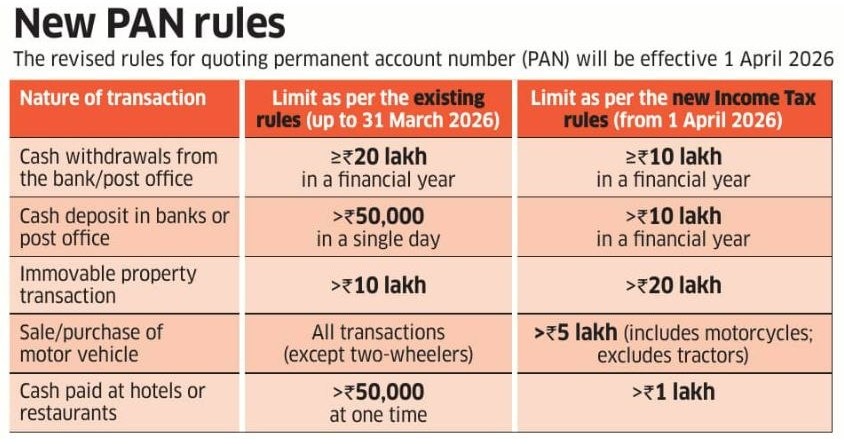
Table of Contents
New permanent account number Quoting Rules (From 1 April 2026)
These new permanent account number quoting rules specify when a permanent account number must be quoted for certain financial transactions. above compares old limits vs revised limits.
Cash Withdrawals (Bank/Post Office)
| Old Rule | New Rule |
| INR 20 lakh (FY basis) | INR 10 lakh (FY basis) |
Meaning: If total cash withdrawal exceeds INR 10 lakh in a financial year, quoting permanent account number becomes mandatory. This permanent account number limit impacts that Lower threshold → more monitoring of cash withdrawals
Cash Deposits (Bank/Post Office)
| Old Rule | New Rule |
| INR 50,000 (single day) | INR 10 lakh (FY basis) |
Meaning: Aggregate deposits beyond INR 10 lakh/year require a permanent account number Banks already report high-value transactions under SFT. →A permanent account number linkage ensures traceability
Immovable Property Transactions
| Old Rule | New Rule |
| INR 10 lakh | INR 20 lakh |
Meaning: permanent account number required if property value exceeds INR 20 lakh that Relaxation compared to old rule
Motor Vehicle Purchase/Sale
| Old Rule | New Rule |
| All vehicles (except 2-wheelers) | INR 5 lakh threshold |
Meaning permanent account number required only if transaction exceeds INR 5 lakh, Includes motorcycles; excludes tractors and Brings clarity + threshold-based approach
Cash Payment at Hotels/Restaurants
| Old Rule | New Rule |
| INR 50,000 (single transaction) | INR 1 lakh |
Meaning: permanent account number required only if payment exceeds INR 1 lakh. It Ease for individuals (limit increased)
PAN Policy objective
These changes reflect a broader policy objective:
- Increased Reporting Visibility More transactions will be tracked through PAN-based reporting
- Stronger Anti-Tax Evasion Framework: Limits on high-value transactions aim to curb unaccounted money
- Higher Compliance Accountability Applies to both individual taxpayers and businesses
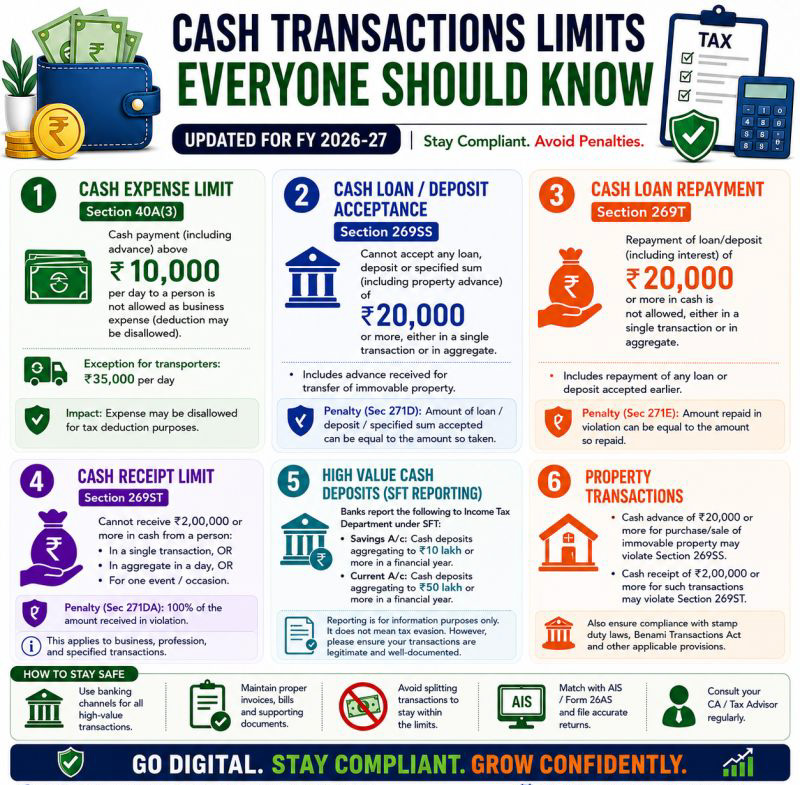
Overall Impact Analysis
- Tightened Controls of cash withdrawal limits reduced (INR 20L → INR 10L) and Better tracking of high cash usage
- Relaxation property threshold increased, hotel payment limit increased, and vehicle transactions were made threshold-based.
- These are permanent account number quoting requirements, NOT prohibition limits. Non-compliance can lead to Transaction reporting issues and Possible scrutiny / notices
- High-risk areas are cash-heavy businesses, real estate transactions, and high-value banking transactions.
In Symmary
From FY 2026–27, a permanent account number is required at lower limits for cash transactions and at revised higher limits for some sectors. The objective is better tracking and reducing black money.”
- For motor vehicles, a permanent account number is needed if the transaction value is more than INR 5 lakh.
- permanent account number is required for transactions involving immovable property that exceed INR 20 lakh.
- Hotel/Event Payments: If the amount exceeds INR 1 lakh, a permanent account number quotation is required.
- Cash Deposits & Withdrawals: If the total amount of cash transactions in a fiscal year exceeds INR 10 lakh, a permanent account number is necessary.
- Insurance Transactions: A permanent account number is required for new account-based relationships.
- The updated permanent account number regulations greatly improve data visibility for tax authorities and are not only procedural. To guarantee smooth compliance, early system and process alignment will be essential.
- we should advise to encouraging clients to use banking channels, ensuring permanent account number and Aadhaar connectivity, and reconciling with AIS/SFT data are all things
- Sharing this blog as a quick compliance reference for businesses, professionals, and salaried individuals.
ITR Filing Changes Checklist – AY 2026-27
**********************************************************
If this article has helped you in any way, i would appreciate if you could share/like it or leave a comment. Thank you for visiting my blog.
Legal Disclaimer:
The information / articles & any relies to the comments on this blog are provided purely for informational and educational purposes only & are purely based on my understanding / knowledge. They do noy constitute legal advice or legal opinions. The information / articles and any replies to the comments are intended but not promised or guaranteed to be current, complete, or up-to-date and should in no way be taken as a legal advice or an indication of future results. Therefore, i can not take any responsibility for the results or consequences of any attempt to use or adopt any of the information presented on this blog. You are advised not to act or rely on any information / articles contained without first seeking the advice of a practicing professional.