SSE: Minimum Initial Disclosure -NPO Issuing ZCZP Instrument
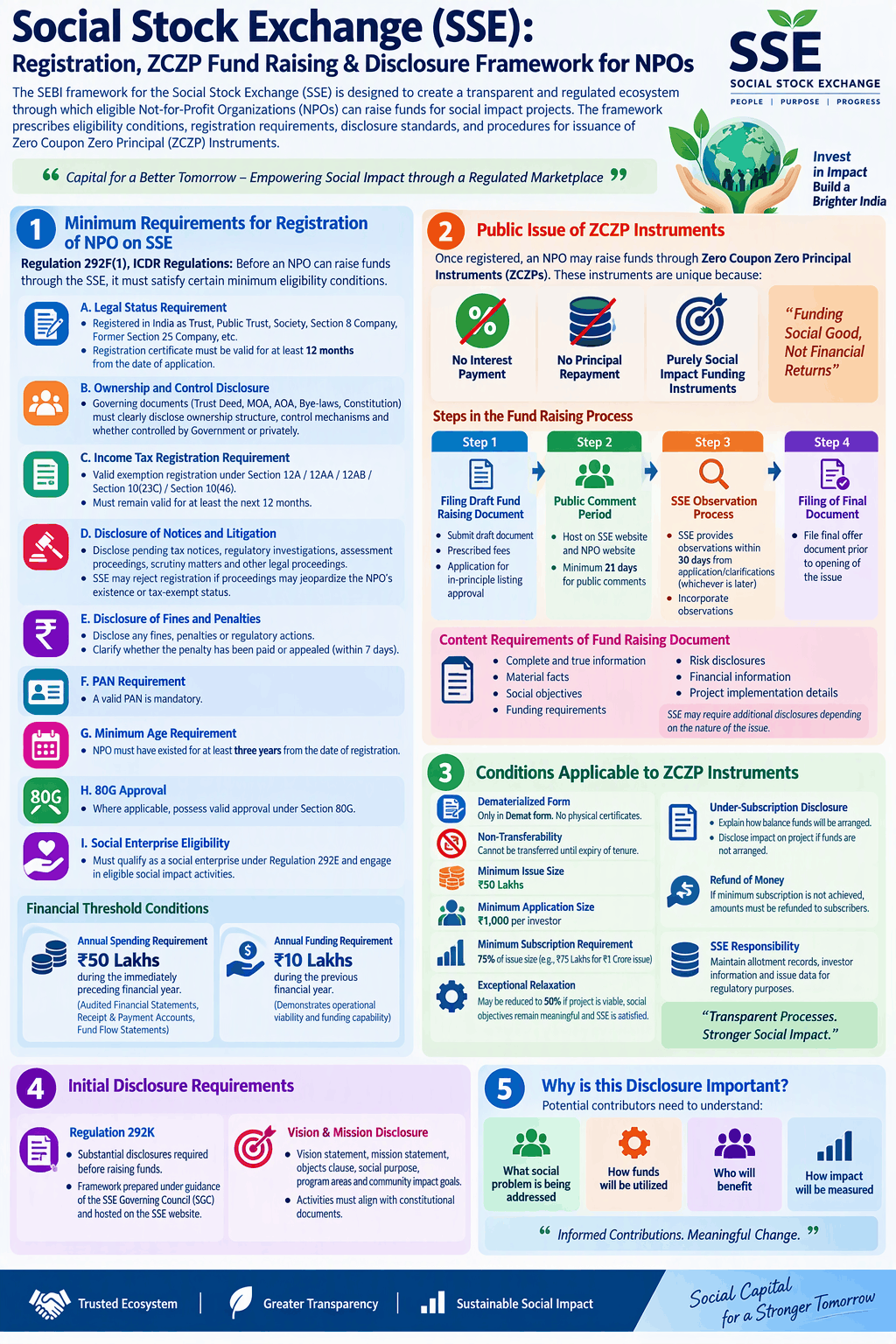
Table of Contents
Minimum Initial Disclosure for NPOs Issuing ZCZP Instruments on the Social Stock Exchange (SSE)
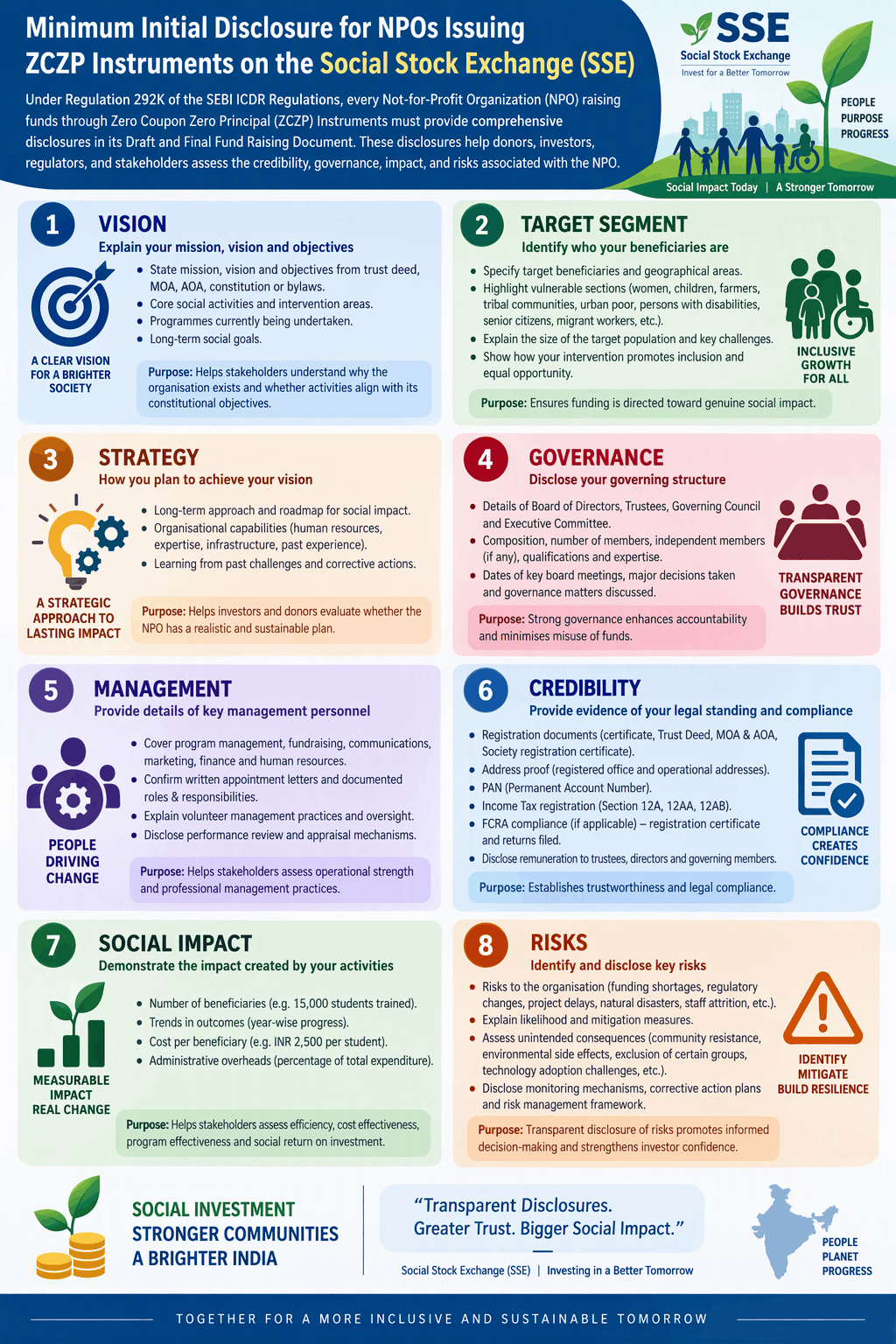
Under Regulation 292K of the SEBI ICDR Regulations, every Not-for-Profit Organization (NPO) raising funds through Zero Coupon Zero Principal (ZCZP) Instruments must provide comprehensive disclosures in its Draft and Final Fund Raising Document. These disclosures help donors, investors, regulators, and stakeholders assess the credibility, governance, impact, and risks associated with the NPO.
-
Vision :
The NPO must clearly explain its mission and vision and objectives contained in its trust deed, MOA, AOA, constitution, or bylaws. Core social activities and intervention areas, programmes currently being undertaken, Long-term social goals.
-
- Purpose: This disclosure helps stakeholders understand why the organisation exists, what social problems it intends to solve and whether the activities align with its constitutional objectives.
- Example : An NPO working in rural education should explain Its vision of improving literacy, educational programmes conducted, number of schools covered, and expected long-term impact on communities.
-
Target Segment
-
- The NPO must identify who its beneficiaries are, which geographical areas are covered, Which vulnerable sections of society are being served, Examples of Target Segments: Women and girls, children from economically weaker sections, farmers and agricultural workers, tribal communities, urban poor, persons with disabilities, senior citizens and migrant workers.
- Required Disclosure: The NPO must explain the size of the target population, existing challenges faced by them, how the organisation’s intervention addresses those challenges and how the project promotes inclusion and equal opportunity.
- Purpose: This ensures that funding is directed toward genuine social impact rather than generalised or vague initiatives.
-
Strategy :
The NPO must disclose its strategy for achieving its vision. The disclosure should cover:
-
- Long-Term Approach: How the organisation plans to create social impact. The roadmap for achieving desired outcomes.
- Organisational Capabilities: Human resources, technical expertise, infrastructure and past experience.
- Learning from Challenges: The NPO must demonstrate challenges previously encountered, lessons learned and corrective actions implemented.
- Purpose: Investors and donors can evaluate whether the NPO has a realistic and sustainable plan for achieving its objectives.
-
Governance
The NPO must disclose information regarding its governing structure.
-
- Governing Body Details: This includes the Board of Directors, Trustees, and Governing Council. And Executive Committee.
- Composition: The NPO should disclose the number of members, Independent members (if any) and qualifications and expertise.
- Board Meetings: The disclosure should include dates of important board meetings, major decisions taken and key governance matters discussed.
- Purpose: Strong governance enhances accountability and minimises misuse of funds.
-
Management
The NPO must provide details of key management personnel responsible for day-to-day operations.
-
- Areas Covered: Program Management, Fundraising, Communications, Marketing, Finance. And Human Resources.
- Role Definition: The NPO should confirm whether written appointment letters have been issued and Roles and responsibilities are formally documented.
- Volunteers: The organisation should explain volunteer management practices and oversight mechanisms.
- Performance Management: The NPO should disclose whether employee performance is periodically reviewed, appraisals are conducted and accountability systems exist.
- Purpose : This helps stakeholders assess operational strength and professional management practices.
-
Credibility
This is one of the most important sections. The NPO must provide documentary evidence supporting its legal standing and compliance.
-
- Registration Documents : Registration certificate, Trust Deed, MOA & AOA and Society registration certificate.
- Address Proof : Registered office and operational addresses.
- PAN : Permanent Account Number.
- Income Tax Registration: Section 12A, Section 12AA. And Section 12AB.
- FCRA Compliance: If the organization receives foreign donations FCRA Registration Certificate, FCRA Returns filed.
- Remuneration Disclosure : The NPO must disclose Payments made to trustees, Compensation to directors and Benefits provided to governing members.
- Purpose : These disclosures help establish trustworthiness and legal compliance.
-
Social Impact :
The NPO must demonstrate the actual impact created by its activities.
Impact Metrics : The disclosure should include:
-
- Number of Beneficiaries : Example 15,000 students trained and 5,000 households provided safe drinking water.
- Trends in Outcomes : Year-wise progress in social indicators.
- Cost Per Beneficiary : Amount spent per beneficiary. Example: INR 2,500 per student educated, INR 1,200 per family assisted
- Administrative Overheads : Percentage of expenditure spent on administration versus actual program implementation.
- Purpose : Stakeholders can assess Efficiency, Cost effectiveness, Program effectiveness. And Social return on investment.
-
Risks :
The NPO must identify significant risks associated with its operations and projects.
- Risks to the Organization : Examples Funding shortages, Regulatory changes, Project delays, Natural disasters and Staff attrition. The NPO must explain Likelihood of occurrence, Mitigation measures.
- Unintended Consequences : The organization should also assess possible adverse social outcomes. Examples Community resistance, Environmental side effects, Exclusion of certain groups and Technology adoption challenges. The disclosure should explain Monitoring mechanisms, Corrective action plans and Risk management framework.
- Purpose: Transparent disclosure of risks promotes informed decision-making and strengthens investor confidence.
Why These Disclosures Matter
- The SSE framework follows a disclosure-based model similar to capital markets, but instead of evaluating financial returns, stakeholders evaluate Social impact potential, Governance quality, Operational capability, Compliance standards and Long-term sustainability.
- These disclosures ensure that funds raised through ZCZP Instruments are directed toward credible, transparent, and impact-oriented organizations, thereby strengthening trust in India’s Social Stock Exchange ecosystem.
Key Takeaways – Minimum Initial Disclosure -NPO Issuing ZCZP Instrument
- NPOs must satisfy legal, tax, governance, age, and financial thresholds before SSE registration.
- Minimum annual expenditure should be INR 50 lakh and minimum annual funding should be INR 10 lakh.
- Registration as an SSE NPO is mandatory before issuing ZCZP Instruments.
- ZCZP Instruments are social impact securities with no interest and no principal repayment.
- Minimum issue size is INR 50 lakh and minimum investor application size is INR 1,000.
- Draft fund-raising documents must remain in public domain for 21 days before approval.
- SSE mandates extensive disclosures regarding social mission, project objectives, governance, and fund utilization.
- The overall objective is to create transparency, accountability, and investor confidence in India’s social impact financing ecosystem.
**********************************************************
If this article has helped you in any way, i would appreciate if you could share/like it or leave a comment. Thank you for visiting my blog.
Legal Disclaimer:
The information / articles & any relies to the comments on this blog are provided purely for informational and educational purposes only & are purely based on my understanding / knowledge. They do noy constitute legal advice or legal opinions. The information / articles and any replies to the comments are intended but not promised or guaranteed to be current, complete, or up-to-date and should in no way be taken as a legal advice or an indication of future results. Therefore, i can not take any responsibility for the results or consequences of any attempt to use or adopt any of the information presented on this blog. You are advised not to act or rely on any information / articles contained without first seeking the advice of a practicing professional.