Impact of New Labour Code on Gratuity Liability for Employer
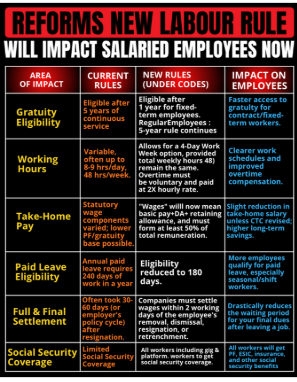
Table of Contents
Impact of New Labour Codes on Gratuity Liability for Employers
The introduction of the new labor codes, particularly the Code on Wages, 2019, and the updated provisions under the Code on Social Security, 2020, is expected to significantly increase gratuity liabilities and compliance responsibilities for employers across India.
- Redefined Wage Structure : One of the most significant changes is the new wage definition. Under the labour codes: Basic Pay + Dearness Allowance must constitute at least 50% of the employee’s total remuneration (CTC). Since gratuity is calculated on last drawn wages (basic + DA), this structural change effectively raises the gratuity liability for many organisations where the basic salary was previously kept lower to reduce statutory payouts.
- Expanded Gratuity Eligibility: Another important reform relates to gratuity eligibility under the Payment of Gratuity Act, 1972, as modified by the new social security framework.
Key change Like fixed-term employees become eligible for gratuity after completing just one year of service, instead of the traditional five-year requirement. This change expands the number of employees entitled to gratuity, increasing the financial obligation for employers.
- Rising Compliance and Financial Impact : Because of these changes, employers may face Higher actuarial gratuity liabilities, Increased provisioning in financial statements, Greater cash-flow planning requirements and Expanded coverage of employees
- Role of an Approved Gratuity Trust : To manage these rising liabilities effectively, many organisations are establishing an Approved Gratuity Trust. Such trusts provide several advantages:
-
- Structured liability management: Employers can fund gratuity obligations periodically instead of making large lump-sum payments when employees exit.
- Risk protection: Once funds are transferred to the trust, they become irrevocable and exclusively dedicated to gratuity payments, ensuring employee benefit security.
- Tax efficiency: Contributions made by the employer to an approved gratuity trust are tax-deductible, and the trust’s income is generally tax-exempt.
- Surplus flexibility : Any excess funds within the trust can be used for future gratuity obligations, reducing long-term funding pressure.
- LIC Group Gratuity Scheme : For many organisations, the LIC Group Gratuity Scheme is a widely adopted and reliable option. It offers actuarial valuation support, systematic funding mechanisms, regulatory compliance, and efficient administration of gratuity payments.
HIGHER GRATUITY LIABILITY UNDER THE NEW LABOUR CODES
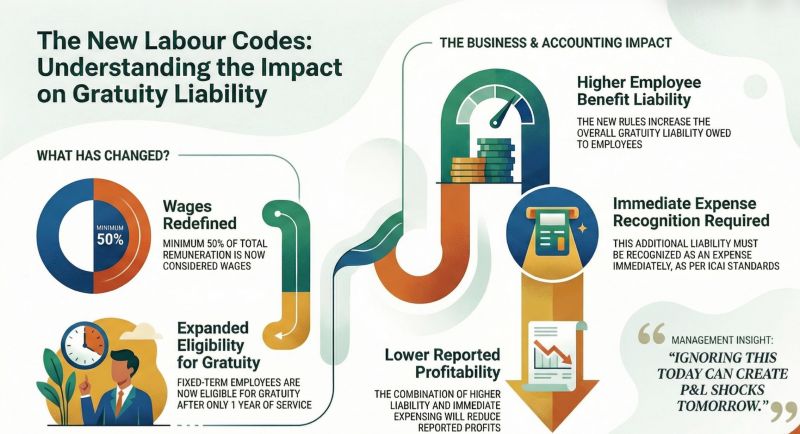
WHAT HAS CHANGED?
- Wages Redefined: At least 50% of total remuneration must now qualify as “wages”, significantly increasing the base used for gratuity calculations.
- Gratuity on Last Drawn Wages: Gratuity will be calculated on the revised last‑drawn wage structure, not earlier payroll definitions.
- Fixed‑Term Employees Included: Employees hired on a fixed‑term contract will now be eligible for gratuity after 1 year of service (previously 5 years).
ACCOUNTING & COMPLIANCE IMPACT
- Past Service Cost Recognition : The increase in gratuity obligation (due to wage restructuring) must be treated as past service cost.
- ICAI Guidance (Ind AS 19 / AS 15) : Immediate recognition of increased liability is mandatory. No deferral or phased recognition is permitted.
- Interim Financial Reporting : Companies must recognise the revised gratuity provision in Q3 (Dec) financials.
DIRECT BUSINESS IMPACT
- Higher employee benefit liability
- Reduction in reported profitability
- Increase in actuarial valuation & provisioning
- Immediate payroll restructuring required
MANAGEMENT INSIGHT : Failing to align payroll and gratuity provisioning now can lead to significant P&L volatility once the Labour Codes go live. Early planning is no longer optional—it’s a financial safeguard.
With the implementation of the new labour codes, gratuity obligations are set to increase significantly. Establishing an approved gratuity trust, particularly through structured schemes like LIC’s Group Gratuity Plan, can help organisations manage liabilities efficiently while ensuring compliance and financial stability.
**********************************************************
If this article has helped you in any way, i would appreciate if you could share/like it or leave a comment. Thank you for visiting my blog.
Legal Disclaimer:
The information / articles & any relies to the comments on this blog are provided purely for informational and educational purposes only & are purely based on my understanding / knowledge. They do noy constitute legal advice or legal opinions. The information / articles and any replies to the comments are intended but not promised or guaranteed to be current, complete, or up-to-date and should in no way be taken as a legal advice or an indication of future results. Therefore, i can not take any responsibility for the results or consequences of any attempt to use or adopt any of the information presented on this blog. You are advised not to act or rely on any information / articles contained without first seeking the advice of a practicing professional.