Top GST Compliance Mistakes That Trigger GST Notice in India
Table of Contents
Top GST Compliance Mistakes That Trigger GST Notice in India
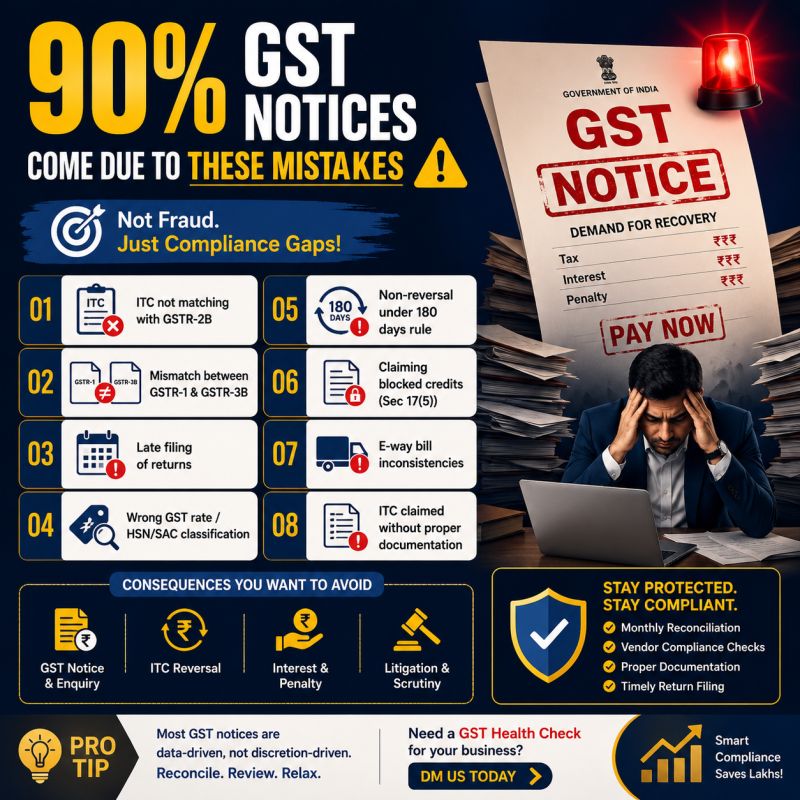
GST Notices are system-driven:
Most Goods and Services Tax notices are not issued because of fraud. They arise due to routine compliance lapses and reconciliation failures. Goods and Services Tax scrutiny is now powered by data analytics, automated reconciliations & risk parameters configured by Goods and Services Tax Identification Number. Today, notices are often triggered not because of fraud but because of mismatches, non-reconciliations, and compliance gaps.
Major Triggers Behind Goods and Services Tax notices like wrong or excess input tax credit claims, GSTR-1 vs GSTR-3B mismatches, input tax credit mismatches with GSTR-2B, non-reversals under the 180-day payment rule, incorrect goods and services tax rates or Harmonized System of Nomenclature classification, claiming blocked credits under Section 17(5), e-way bill inconsistencies, and delayed filing of returns. In detail we can refer to the below.
Common Reasons Why GST Notices Are Issued.
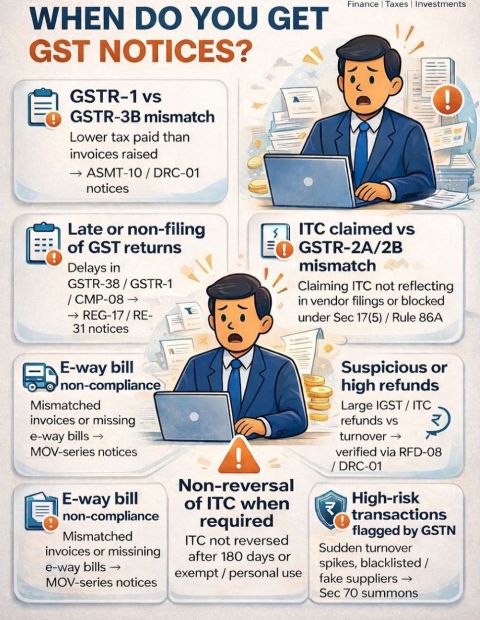
- High-Risk Transactions Flagged by Goods and Services Tax Network : Sudden turnover spikes, transactions with risky vendors, circular trading indicators, and abnormal filing patterns can even trigger Section 70 summons under GST law.
- Late or Non-Filing of Goods and Services Tax Returns: Delays in filing GSTR-1, GSTR-3B, CMP-08, and annual returns may result in notices, penalties, and even cancellation proceedings.
- Suspicious or Excessive Goods and Services Tax Refund Claims: Large Integrated Goods and Services Tax or Input Tax Credit refund claims disproportionate to turnover are closely verified through RFD-08 proceedings.
- GSTR-1 vs GSTR-3B Mismatch: Differences between outward supplies reported in GSTR-1 and tax paid in GSTR-3B can trigger ASMT-10 or DRC-01 notices.
- Input Tax Credit Claimed vs GSTR-2B Mismatch: Claiming Input Tax Credit not reflected by suppliers or availing ineligible credits U/s 17(5) remains one of the biggest scrutiny triggers.
- Non-Reversal of Input Tax Credit: Failure to reverse an input tax credit within 180 days, or credits relating to exempt/personal-use supplies, frequently leads to demand notices.
- E-Way Bill Non-Compliance: Mismatch between invoices, transport details, and e-way bills may lead to MOV-series notices during inspections or verification.
Why This Has Become More Critical:
Goods and Services Tax compliance is now heavily technology- and analytics-driven. Even minor mismatches can automatically trigger System-generated notices, Input Tax Credit reversals, Interest and penalties, and Departmental scrutiny and audits
The scope for manual relaxation or unnoticed discrepancies has reduced significantly. Compliance reality has changed. Goods and Services Tax compliance is no longer limited to filing returns. Authorities now verify complete alignment across Goods and Services Tax Return filings, E-invoices, E-way bills, books of accounts, and vendor compliance data. Even minor inconsistencies can automatically trigger scrutiny.
A disciplined monthly goods and services tax review can help businesses avoid large future tax demands, interest & penalty exposure, prolonged litigation, and departmental proceedings.
GSTR-1 vs GSTR-3B mismatches and ineligible input tax credit claims are currently among the biggest causes of goods and services tax disputes and notices. GSTR-1 vs. GSTR-3B mismatches and ineligible input tax credit claims appear to be the largest litigation triggers.
What are well-compliant businesses doing?
Goods and Services Tax compliance is now system-driven and heavily dependent on data matching, vendor compliance, e-invoice reporting, e-way bill validation & automated risk analytics. Even small inconsistencies can trigger automated scrutiny notices. Most Goods and Services Tax notices today arise from routine compliance gaps, reconciliation failures, and data mismatches, not necessarily fraud. A disciplined monthly review process can significantly reduce notice exposure, interest liabilities, and litigation risks.
Preventive compliance is far less expensive than litigation. Businesses conducting monthly reconciliations, vendor due diligence, internal Goods and Services Tax reviews, and periodic compliance health checks are significantly reducing notice exposure and future tax disputes.
Monthly Prevention Checklist to Avoid Goods and Services Tax Notices
Monthly Goods and Services Tax Compliance Checklist
- Record Transactions Daily: Avoid accounting backlogs. Every invoice, bill, receipt, payment, and journal entry should be recorded on the same day the transaction occurs.
- Reconcile Bank Accounts Monthly: Complete bank reconciliation by the 5th of the following month. Every bank transaction must match with accounting records, bank statements, and supporting documents.
- Verify GSTR-1 Before Filing: Ensure outward supplies reported in GSTR-1: Reconcile with sales registers & match GST liability intended to be reported in GSTR-3B
- Reconcile GSTR-2B with Purchase Register: Download GSTR-2B between 14th–18th of every month and Reconcile vendor invoices carefully and Claim Input Tax Credit only for eligible invoices reflected in GSTR-2B
- Issue Credit Notes Properly: Every Sales return, Discount, rate difference, and price revision Should be supported through properly linked credit notes against original invoices.
- Review Harmonized System of Nomenclature and Services Accounting Codes & Goods and Services Tax Rates: Conduct a periodic review of item masters to ensure correct Harmonized System of Nomenclature and Services Accounting Code classification and updated goods and services tax rates.
- Document Non-Sales Bank Credits: Properly record and support loans, capital introductions, interbank transfers, and other non-sales receipts. Helps avoid unexplained turnover mismatches
- Conduct Pre-Filing Chartered Accountants Review: A short monthly review before filing GSTR-3B helps identify mismatches, input tax credit risks, and reporting errors.
- Other points needed to remember the following practical compliance checks: Every Business to avoid any Goods and Services The tax notice should follow below
- Monthly Goods and Services Tax reconciliations instead of year-end corrections
- Continuous vendor compliance monitoring
- Timely and accurate return Goods and Services Tax Return filing
- Conducting periodic internal Goods and Services Tax reviews
- Maintaining strong documentation and audit trails
**********************************************************
If this article has helped you in any way, i would appreciate if you could share/like it or leave a comment. Thank you for visiting my blog.
Legal Disclaimer:
The information / articles & any relies to the comments on this blog are provided purely for informational and educational purposes only & are purely based on my understanding / knowledge. They do noy constitute legal advice or legal opinions. The information / articles and any replies to the comments are intended but not promised or guaranteed to be current, complete, or up-to-date and should in no way be taken as a legal advice or an indication of future results. Therefore, i can not take any responsibility for the results or consequences of any attempt to use or adopt any of the information presented on this blog. You are advised not to act or rely on any information / articles contained without first seeking the advice of a practicing professional.