Code on Wages Compliance Checklist 2026
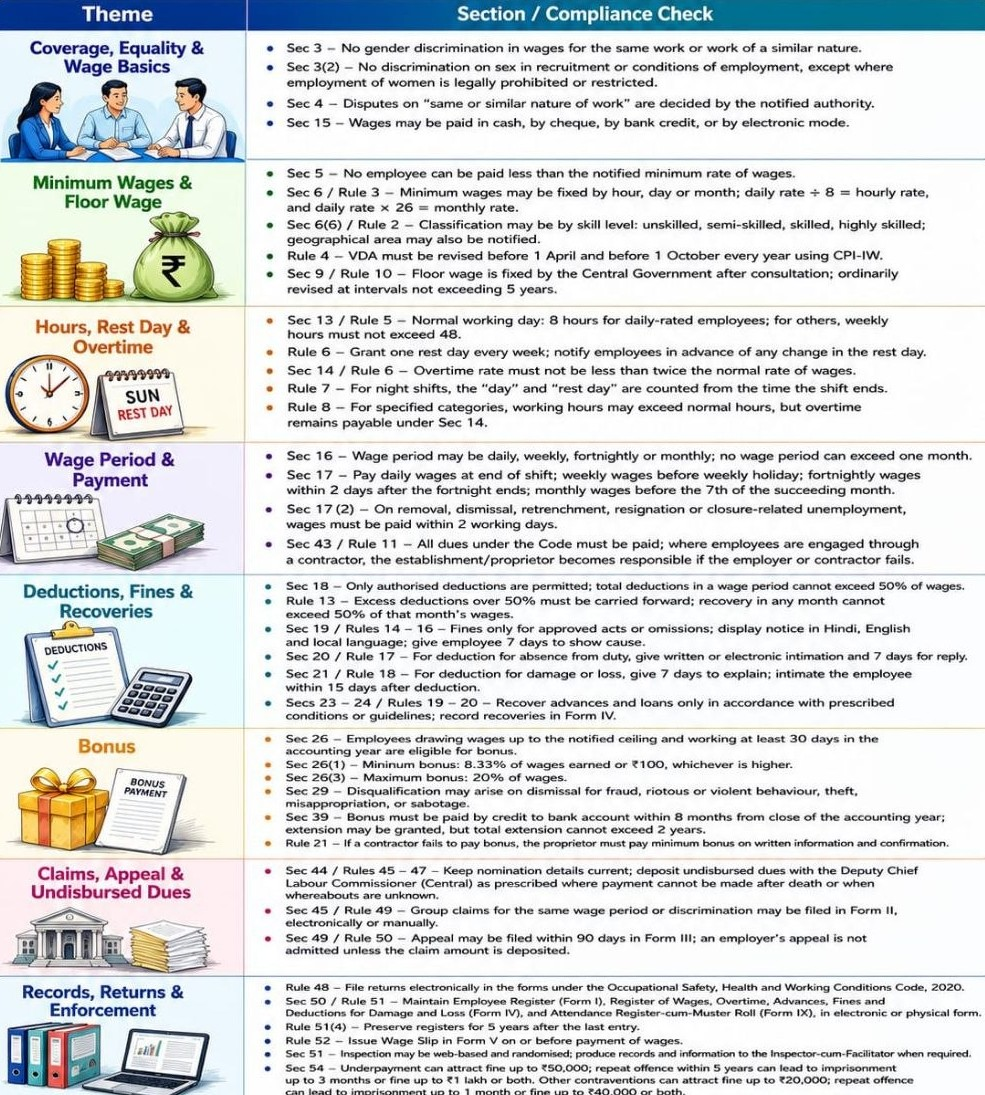
Table of Contents
Code on Wages Compliance Checklist 2026: A Complete Guide for HR, Payroll & Legal Teams
Payroll is no longer just about calculating salaries and processing monthly payments. Under the Code on Wages, 2019, and the Code on Wages (Central) Rules, 2026, wage compliance has evolved into a structured legal obligation requiring employers to maintain records, adhere to statutory timelines, ensure non-discrimination, and comply with minimum wage, overtime, bonus, and documentation requirements. For HR, payroll, compliance, finance, and legal professionals, maintaining a comprehensive wage compliance checklist is essential to avoid penalties, disputes, and operational risks. This article summarizes the key compliance checkpoints every organization should keep readily available.
Why the Code on Wages Checklist Matters
The Code on Wages consolidates and streamlines several wage-related laws while establishing a uniform framework governing:
- Payment of wages
- Minimum wages
- Equal remuneration
- Bonus payments
- Wage records and registers
- Employee claims and appeals
Failure to comply may result in financial penalties, legal proceedings, recovery claims, and in certain cases, prosecution for repeat violations.
Equality and Wage Basics
One of the foundational principles of the Code on Wages is ensuring equal treatment in wage-related matters.
Compliance Checkpoints
- No discrimination in wages for the same work or work of a similar nature.
- Companies should not discriminate based on sex in recruitment, employment conditions, promotions, transfers, or remuneration except where employment restrictions are specifically permitted by law.
- Wage payments may be made through Cash, Cheque, Direct bank transfer or Electronic mode
HR Action Point
Periodically review compensation structures and recruitment practices to identify potential discrimination risks and ensure uniform treatment for similar work categories.
Minimum Wages and Floor Wage Compliance
Employers must ensure that no employee receives wages below the statutory minimum rates notified by the appropriate government.
Compliance Checkpoints
- No employee can be paid below the notified minimum wage.
- Minimum wages may be fixed hourly, daily, or monthly. Daily wage ÷ 8 = Hourly wage.
- Employee classification may be based on Unskilled, Semi-skilled, skilled, or Highly skilled
- Geographical classifications may apply.
- Variable Dearness Allowance (VDA) revisions must be implemented before 1 April or On 1 October
- Floor wages are ordinarily reviewed and revised within five years.
Payroll Action Point
- Regularly monitor government notifications for revisions in Minimum wages, VDA rates or Floor wages
- Any delay can create wage arrears and compliance exposure.
Working Hours, Weekly Rest Days and Overtime
Working time regulations remain a critical area of labour compliance.
Compliance Checkpoints
- Normal working day for daily-rated employees: 8 hours
- Weekly working hours must not exceed 48 hours
- Employees must receive one weekly rest day
- Overtime must be paid at not less than twice the normal wage rate
- For night shifts, the calculation of “day” and “rest day” is determined from the shift-end time.
Common Compliance Risk
Employers often permit overtime without accurately recording overtime hours or paying double-rate wages, resulting in wage claims during inspections or employee disputes.
Wage Period and Payment Timelines
A legally compliant payroll process depends heavily on timely wage payment.
Compliance Checkpoints
- Wage periods may be Daily, Weekly, fortnightly, or Monthly
- No wage period can exceed one month.
Payment Time Limits
Monthly Employees: Wages must be paid before the 7th day of the succeeding month.
Weekly Employees: Payment must occur before the weekly holiday.
Fortnightly Employees: Payment must be made within 2 days after the fortnight ends.
Separation Cases: On removal, dismissal, retrenchment, resignation, or closure-related unemployment. Wages must generally be paid within 2 working days.
Payroll Action Point: Establish exit clearance procedures that prioritize final settlement compliance timelines.
Deductions, Fines, and Recoveries: Not every deduction made by an employer is legally permissible.
Compliance Checkpoints
- Only authorized deductions can be made.
- Total deductions cannot exceed 50% of wages during a wage period.
- Excess deductions must be carried forward to subsequent wage periods.
Fines: Before imposing a fine The act or omission must be approved for imposing fines. or Employees must receive at least 7 days’ opportunity to show cause.
Recoveries: Specific procedures must be followed for absence from duty, damage or loss, and advances or loans.
Compliance Risk: Unauthorized deductions are among the most common causes of wage disputes and recovery claims.
Bonus Compliance: Bonus obligations continue to be a crucial payroll responsibility.
Compliance Checkpoints
- Eligible employees must have worked for at least 30 days during the accounting year.
- Minimum bonus: 8.33% of wages or INR 100, whichever is higher.
- Maximum bonus: 20% of wages.
- Bonus must be credited to employees’ bank accounts within 8 months from the close of the accounting year.
Contractor Workforce Consideration
- If a contractor defaults in payment of a bonus, liability may shift to the principal employer after necessary verification and confirmation.
- HR Action Point: Maintain employee eligibility records and contractor compliance documentation to minimize liability risks.
- Claims, Appeals, and Undisbursed Dues: The Code provides structured mechanisms for employee claims and employer appeals.
Compliance Checkpoints
- Group claims can be filed for Wage-related disputes and Discrimination complaints
- Appeals can generally be filed within 90 days.
- Employer appeals require deposit of the claim amount as prescribed.
- Employee nomination details should remain updated.
Undisbursed Amounts: Employers should maintain procedures to handle
- Unclaimed wages
- Deceased employee dues
- Untraceable employee payments
Compliance Tip: Schedule annual reviews of employee nomination records to ensure payment obligations can be fulfilled without legal complications.
Records, Registers and Enforcement Requirements
Documentation is the foundation of wage compliance.
Mandatory Records: Employers should maintain
- Employee Register
- Wage Register
- Attendance-cum-Muster Roll
- Overtime records
- Advance and recovery records
- Fine and deduction registers
Retention Period : Registers should generally be preserved for 5 years.
Wage Slips: Wage slips must be issued on or before wage payment.
Inspection Requirements
Employers must be prepared to produce records during inspections conducted by relevant authorities.
Consequences of Non-Compliance
- Failure to comply with wage laws can result in Wage recovery orders, Monetary penalties, Labour disputes, Inspection proceedings, Litigation costs or Reputational damage
- Repeated violations may attract stricter consequences, including prosecution where prescribed under law.
- For this reason, payroll compliance must be treated as a legal and governance function rather than merely an accounting activity.
HR & Payroll Compliance Checklist at a Glance
Before every payroll cycle, confirm:
- Minimum wage rates updated
- VDA revisions implemented
- Working hours and overtime verified
- Rest day compliance maintained
- Wage payments scheduled within statutory timelines
- Deductions within permissible limits
- Bonus eligibility reviewed
- Wage slips issued
- Registers updated and preserved
- Nomination records maintained
- Contractor compliance monitored
Overtime (OT) Calculation Made Simple!
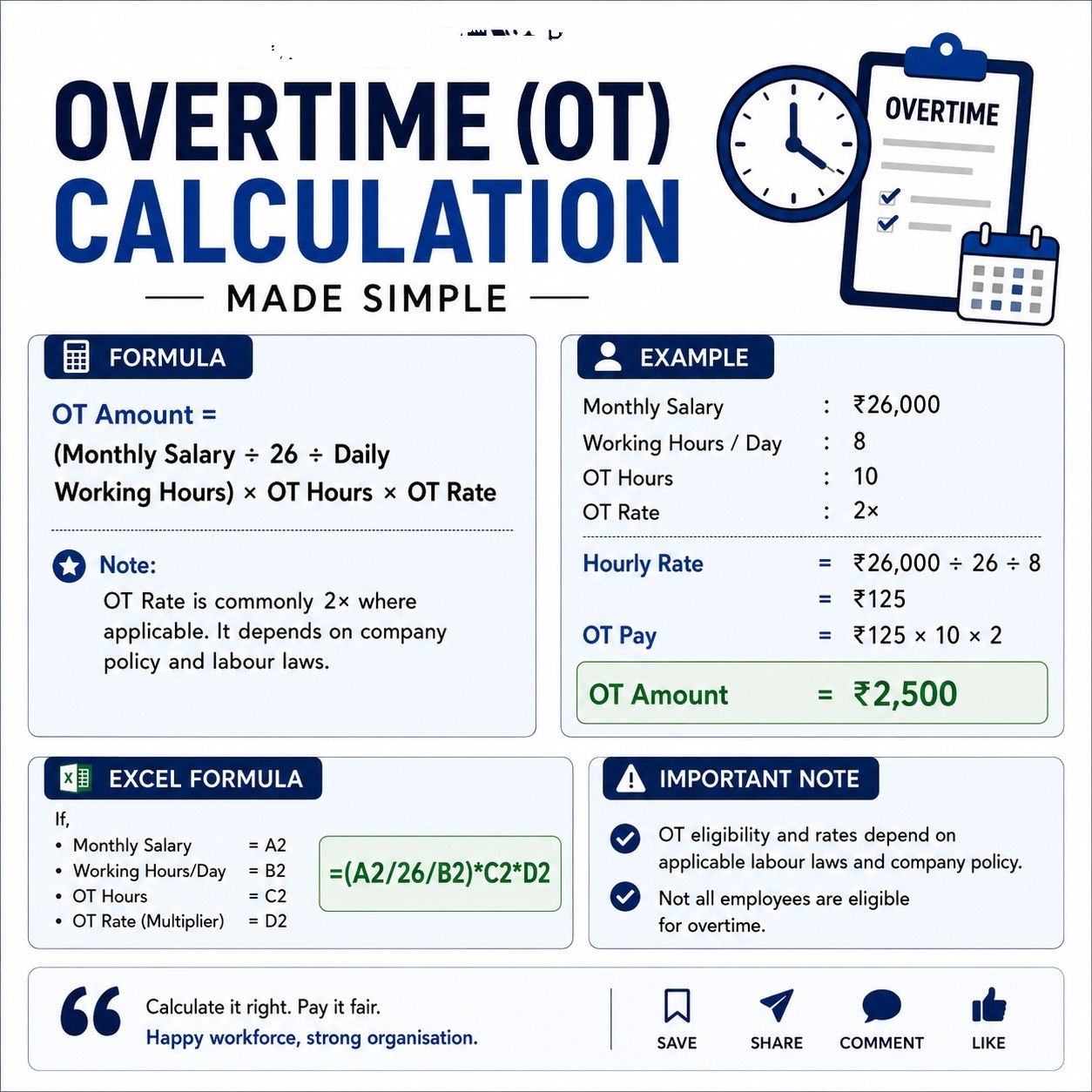
Not sure how overtime pay is calculated? Here’s a quick and easy formula along with a practical example to help you understand it better.
Overtime Calculation Formula = OT Amount = Hourly Rate × Overtime Hours × OT Multiplier
Example
-
- Monthly Salary: INR30,000
- Working Days per Month: 26
- Working Hours per Day: 8
- Overtime Hours Worked: 10
- OT Rate: 2 Times (Double Pay)
Step 1: Calculate Hourly Rate = INR 30,000 ÷ (26 × 8) = INR 144.23 per hour
Step 2: Calculate Overtime Pay = INR 144.23 × 10 × 2 = INR 2,884.60
Overtime Pay Payable: INR 2,885 (Approx.)
Final Takeaway
- The Code on Wages, 2019 places payroll compliance at the heart of labour law governance. Employers can no longer view payroll as a routine salary-processing exercise. Every wage payment, deduction, overtime calculation, bonus disbursement, and statutory record must withstand legal scrutiny.
- The best approach for employers is simple: Maintain a documented wage compliance checklist, review it before every payroll cycle, and ensure that HR, Payroll, Finance, and Legal teams work together to achieve complete compliance.
- A well-maintained payroll system is not just good administration—it is a critical legal safeguard for the organization.
**********************************************************
If this article has helped you in any way, i would appreciate if you could share/like it or leave a comment. Thank you for visiting my blog.
Legal Disclaimer:
The information / articles & any relies to the comments on this blog are provided purely for informational and educational purposes only & are purely based on my understanding / knowledge. They do noy constitute legal advice or legal opinions. The information / articles and any replies to the comments are intended but not promised or guaranteed to be current, complete, or up-to-date and should in no way be taken as a legal advice or an indication of future results. Therefore, i can not take any responsibility for the results or consequences of any attempt to use or adopt any of the information presented on this blog. You are advised not to act or rely on any information / articles contained without first seeking the advice of a practicing professional.