FAQs on Merchant Discount Rate (MDR)
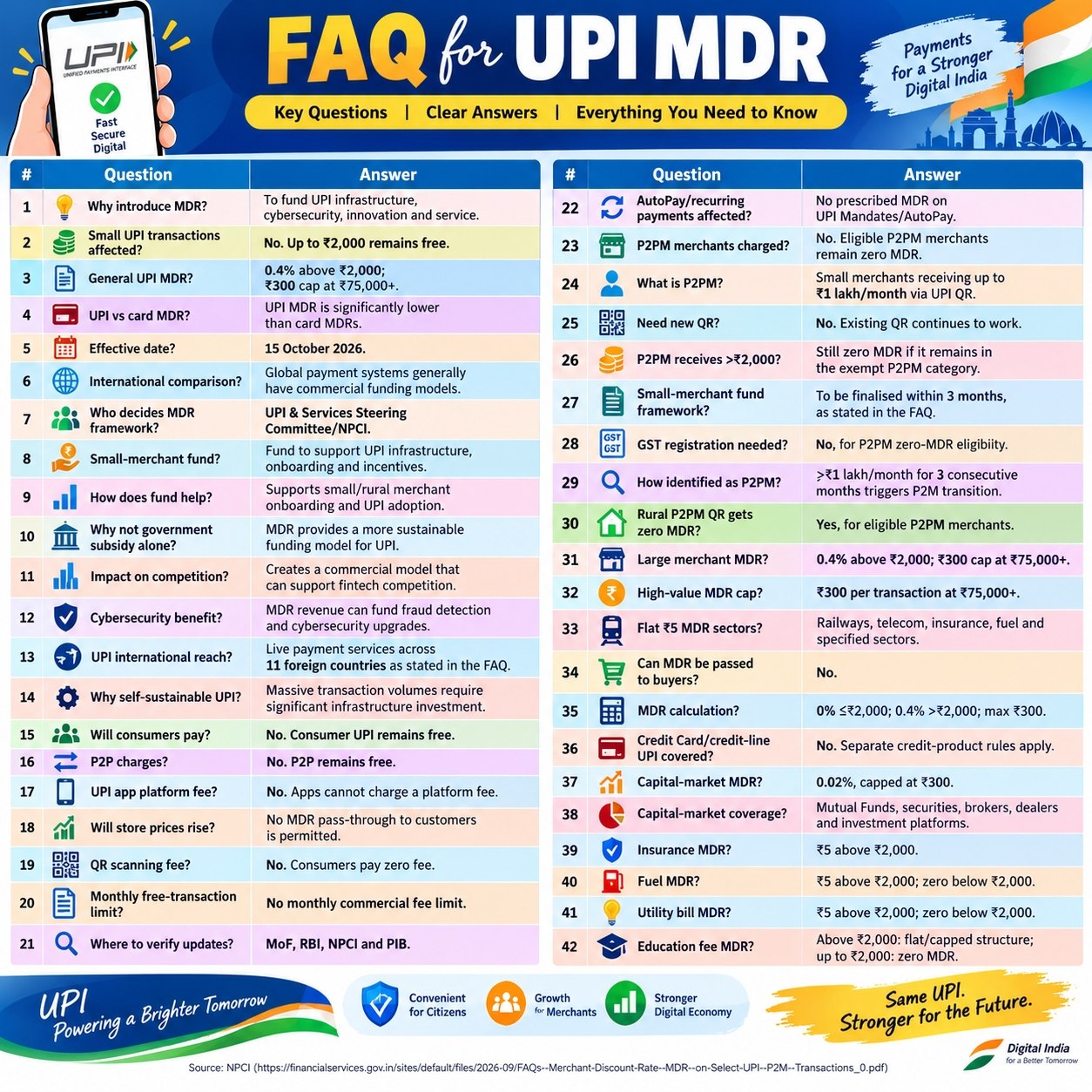
Table of Contents
FAQs on Merchant Discount Rate (MDR)
The FAQ explains the proposed Merchant Discount Rate (MDR) on selected UPI Person-to-Merchant (P2M) transactions and clarifies that consumers will continue to use UPI free of cost.
What is MDR?
MDR (Merchant Discount Rate) is a fee charged to merchants for accepting digital payments. It is generally paid by the merchant to banks/payment service providers. The infographic specifically states that customers do not pay Merchant Discount Rate, and banks are advised not to allow merchants to pass this charge on to customers.
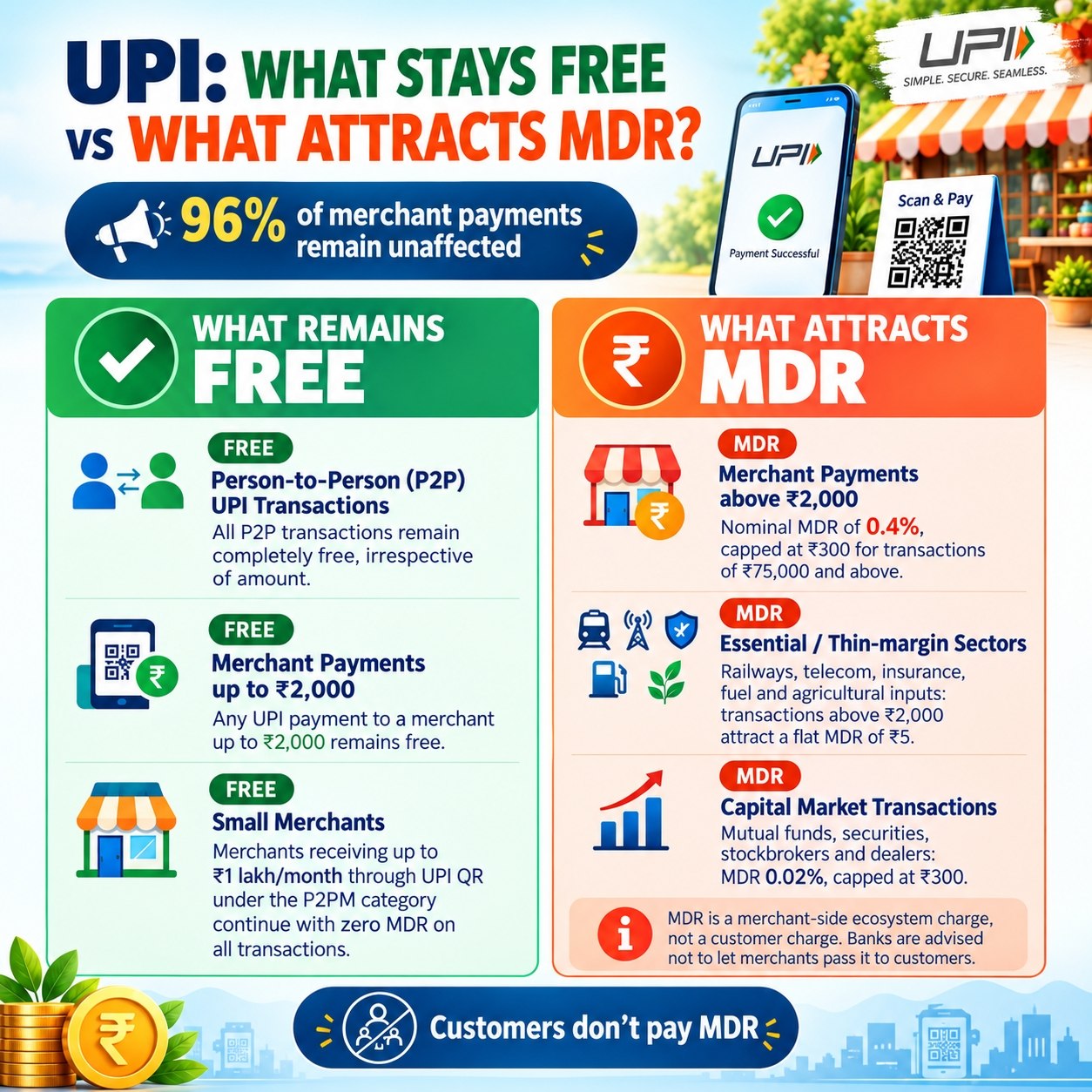
Difference between UPI transactions that remain free and UPI transactions on which MDR (Merchant Discount Rate) may be charged. The key message is that UPI is not becoming chargeable for everyone, and according to the image, 96% of merchant payments remain unaffected.
Why is MDR being introduced?
UPI handles billions of transactions every month. The MDR is proposed to help fund UPI infrastructure, Cybersecurity, Fraud prevention, Customer support and Innovation and technology upgrades. The objective is to make the UPI ecosystem financially sustainable while keeping charges much lower than credit cards and debit cards.
When will MDR apply?
The proposed MDR framework is stated to become effective from 15 October 2026.
Will consumers have to pay anything?
No. The FAQ repeatedly clarifies that UPI remains free for consumers, Person-to-Person (P2P) transfers remain free, QR code scanning remains free. UPI apps cannot charge platform fees and No monthly limits on free consumer transactions. For Example: If you send INR 1,000 to a friend, INR 50,000 to a relative or INR 1 lakh to your own account- No MDR is charged to you.
What is the MDR rate?
- For eligible merchant transactions: Transaction up to INR 2,000, then MDR = Nil,
- Transaction above INR 2,000 : MDR = 0.4%
- Transaction INR 75,000 or more: Maximum MDR = INR 300 per transaction. For Examples
| Payment Amount | MDR |
| INR 2,000 | INR 0 |
| INR 3,000 | INR 12 |
| INR 50,000 | INR 200 |
| INR 1,00,000 | INR 300 (capped) |
What Remains Free?
- Person-to-Person (P2P) UPI Transactions: Free for all amounts For Examples: Sending money to friends or family and Transferring funds between personal bank accounts. According to the infographic, all P2P UPI transactions continue to remain completely free irrespective of the amount.
- Merchant Payments up to INR 2,000: Free: Any UPI payment made to a merchant for an amount up to INR 2,000 remains free from MDR. For example, grocery store payments, restaurant bills, and local shop purchases below INR 2,000
- Small Merchants: Free: Merchants receiving up to INR 1 lakh per month through UPI QR under the P2PM (Person-to-Person Merchant) category continue to enjoy zero MDR on all transactions.
What Attracts Merchant Discount Rate?
- Merchant Payments Above INR 2,000: Merchant Discount Rate may apply on the following
- Nominal Merchant Discount Rate : 0.4%
- Maximum Merchant Discount Rate cap: INR 300
- Applicable for larger merchant transactions
Examples: Electronics purchases, high-value retail payments, and large business transactions
- Essential / Thin-Margin Sectors: Flat MDR of INR 5 : The infographic mentions the following sectors: Railways, Telecom, Insurance, Fuel, and Agricultural Inputs. For transactions above INR 2,000 in these sectors, a flat merchant discount rate of INR 5 may apply.
- Capital Market Transactions: Merchant Discount Rate of 0.02%: Applies to mutual funds, securities, stockbrokers, and market intermediaries. Maximum MDR is capped at INR 300.
Key Takeaways related to MDR (Merchant Discount Rate)
- Sending money to family and friends through UPI remains free.
- Most daily merchant payments remain free.
- Small merchants continue to enjoy a zero merchant discount rate.
- Certain high-value merchant transactions and specific sectors may attract a merchant discount rate.
- Merchant Discount Rate is a merchant-side charge, not a customer charge.
- As highlighted in the image, approximately 96% of merchant UPI transactions remain unaffected.
Practical Example
| Transaction | MDR |
| Sending INR 50,000 to your brother via UPI | Nil |
| Paying INR 1,500 at a grocery store | Nil |
| Paying INR 5,000 for an insurance premium | The merchant discount rate may apply to the merchant. |
| Investing INR 100,000 in a mutual fund through UPI | MDR may apply. |
| Paying INR 3,000 at a fuel station | A flat merchant discount rate may apply to the merchant. |
There is no general UPI charge on ordinary users. Any proposed merchant discount rate is targeted only at certain categories of merchant transactions, while routine person-to-person and most merchant payments continue to remain free.
In simple words, if you are using UPI to transfer money to family, friends, or to make routine purchases, you will continue to pay exactly the same amount as before, with no extra UPI charge
Explanation of the Note: “UPI MDR: FREE ERA ENDS | MONEY TRAIL BEGINS”
This note highlights the proposed shift in the UPI ecosystem from a completely free merchant acceptance model to a revenue-sharing model for selected merchant transactions.
What is changing?
From 15 October 2026, a 0.40% MDR (Merchant Discount Rate) is proposed on UPI Person-to-Merchant (P2M) transactions above INR 2,000, subject to a maximum cap of INR 300 per transaction. Consumer-to-consumer (P2P) transactions and most small merchant transactions remain unaffected.
Example: INR 10,000 UPI Payment
Suppose a customer pays a merchant INR 10,000 via UPI.
MDR = 0.40% of INR 10,000 = INR 40
The post suggests the MDR may be distributed among ecosystem participants as follows:
- Issuer Bank (Customer’s Bank): INR 16 (40%)
- Acquirer Bank (Merchant’s Bank): INR 12 (30%)
- UPI App / Payment App: INR 8 (20%)
- Partner Bank / Settlement Partner: INR 4 (10%)
Until now, most UPI transactions operated under a zero-MDR environment, meaning: Banks earned little or no direct revenue from merchant UPI transactions. Payment apps relied on incentives, cross-selling, and investor funding. Infrastructure costs were largely subsidized or absorbed by ecosystem participants.
The proposed MDR creates a direct revenue stream for banks, payment aggregators, fintech apps, and acquiring institutions. This is why the statement refers to “Money Trail Begins” because payment participants now have a commercial incentive tied to transaction volume.
Cost Comparison with Other Payment Modes
| Payment Mode | Typical MDR |
| UPI Merchant Payment | 0.40% |
| Debit Card | Up to 0.90% |
| Credit Card | 1.5% to 2.5% |
Therefore, even after MDR introduction, UPI remains one of the cheapest digital payment acceptance channels for merchants. Example: For an INR 10,000 sale:
- UPI MDR = INR 40
- Debit Card MDR (0.9%) = INR 90
- Credit Card MDR (2%) = INR 200
So UPI still costs merchants significantly less.
Who Pays the MDR?
Merchant Pays : The FAQ clearly states that MDR is a merchant-side charge. Customer Does Not Pay
- Consumers continue to use UPI free of cost.
- Banks and merchants are not permitted to pass MDR directly to customers.
- UPI apps cannot impose platform fees on consumers.
Who Remains Exempt?
Free Category
- Person-to-Person (P2P) transfers
- UPI AutoPay mandates
- Recurring subscriptions
- Utility bill mandates
- Small merchants under the P2PM framework
- Merchant transactions up to INR 2,000
Special Categories
Certain sectors will have a concessional MDR structure, like insurance, fuel, railways, telecom, utilities, etc. For transactions above INR 2,000, these sectors may pay a flat INR 5 MDR instead of the standard 0.40% charge.
Why is MDR being introduced?
UPI handles billions of transactions every month. The MDR is proposed to help fund UPI infrastructure, cybersecurity, fraud prevention, customer support, and innovation and technology upgrades. The objective is to make the UPI ecosystem financially sustainable while keeping charges much lower than credit cards and debit cards.
When will MDR apply?
The proposed MDR framework is stated to become effective from 15 October 2026.
Will consumers have to pay anything?
No. The FAQ repeatedly clarifies that UPI remains free for consumers, Person-to-Person (P2P) transfers remain free, QR code scanning remains free. UPI apps cannot charge platform fees and have no monthly limits on free consumer transactions. For example: If you send INR 1,000 to a friend, INR 50,000 to a relative, or INR 1 lakh to your own account, no MDR is charged to you.
What is the MDR rate?
- For eligible merchant transactions: Transaction up to INR 2,000, then MDR = Nil,
- Transaction above INR 2,000 : MDR = 0.4%
- Transaction INR 75,000 or more: Maximum MDR = INR 300 per transaction. For Examples
What about small merchants?
- The FAQ gives significant relief to small merchants: P2PM Category
- Small merchants receiving up to INR 1 lakh per month through UPI QR remain under the:
- Zero MDR category: This includes Kirana shops, street vendors, small retailers, and rural merchants. They continue to receive UPI payments without MDR deductions.
What is P2PM?
P2PM means Person-to-Person-Merchant: This category was created for small vendors who receive payments directly into personal bank accounts. If they remain within the INR 1 lakh monthly threshold, MDR remains zero.
What if a small merchant receives more than INR 1 lakh?
The FAQ states If a P2PM merchant receives more than INR 1 lakh per month for three consecutive months, the merchant may be shifted to the regular P2M category, where MDR rules become applicable.
Can merchants collect MDR from customers?
No. The FAQ specifically states merchants cannot pass the MDR charge to buyers, and customers should continue paying only the listed sale price.
Special sectors with a flat MDR of INR 5
Instead of 0.4%, certain sectors will pay only INR 5 per transaction above INR 2,000: These sectors include Railways, Telecom, Insurance, Fuel Stations, and Utility Services. Example: Insurance premium = INR 20,000. Instead of INR 20,000 × 0.4% = INR 80 The MDR will only be INR 5.
Mutual Funds and Stock Market Transactions
For capital market transactions, mutual funds, brokers, securities, and investment platforms. MDR is only 0.02% and Maximum limit: INR 300. This concessional rate is aimed at encouraging investments. Example Mutual Fund Investment = INR 1,00,000 and MDR = INR 20 only.
AutoPay and UPI Mandates
The FAQ confirms: No prescribed MDR : On AutoPay, UPI mandates, Recurring utility payments, OTT subscriptions and SIP mandates
Why not rely only on government subsidies?
The FAQ states that maintaining servers, payment infrastructure, cybersecurity, and banking integrations. costs the ecosystem around INR 20,000 crore annually. Therefore, a sustainable commercial model is proposed instead of relying entirely on government incentives.
Recurring Payments Remain Free
- UPI mandates and AutoPay transactions are exempt from MDR. This means no MDR is prescribed on recurring payments such as electricity, water, and gas bills; OTT subscriptions (Netflix, Amazon Prime, etc.), SIPs and recurring mutual fund investments; insurance premium mandates; and EMI and subscription-based payments Example: If you have set up a monthly SIP of INR 5,000 or an electricity bill AutoPay of INR 3,000 through UPI, no MDR will apply to these recurring transactions.
Consumer Protection Measures
- The FAQ clearly states that consumers will continue to use UPI free of cost, banks and merchants cannot pass MDR charges on to customers, and UPI apps cannot impose platform fees or hidden charges.
- This means that even if a merchant is required to pay MDR, the customer should continue paying only the invoice or listed price. Example: Restaurant bill = INR 4,000, customer pays = INR 4,000, and merchant cannot charge INR 4,016 or add a separate “UPI fee” to recover MDR.
Small-Merchant Fund
- A dedicated Small Merchant Fund is proposed to support the expansion of UPI infrastructure in rural and semi-urban areas, onboarding of small merchants, digital payment awareness and adoption, and incentives for acquiring banks and payment service providers
- The FAQ mentions that a dedicated fund will be created to accelerate digital payment infrastructure and support small merchants, particularly in Tier-3 to Tier-6 cities, rural areas, and government-supported schemes.
Practical Impact: Key Takeaway for Businesses and Consumers
- More QR codes and soundboxes for small shops.
- Better digital payment acceptance in villages and rural markets.
- Financial support for onboarding micro and small businesses onto UPI.
- In simple terms, the proposal seeks to keep UPI free for ordinary users while creating a sustainable funding model for infrastructure, cybersecurity, innovation, and future growth of the UPI network
For Consumers
- UPI remains completely free.
- No charges on sending money.
- No charges on QR payments.
- No platform fees.
For Small Merchants
- Up to INR 1 lakh/month via UPI QR remains zero MDR.
- No need to change QR codes.
- GST registration is not required merely to get zero MDR benefits.
For Large Merchants
- MDR of 0.4% above INR 2,000.
- Maximum INR 300 per transaction.
- Cannot recover MDR from customers.
The proposed framework attempts to balance three objectives:
- Consumers continue to enjoy free UPI services.
- Small merchants remain largely protected through zero MDR and support funds.
- Large merchants contribute a small MDR to help maintain and strengthen the UPI ecosystem.
The FAQ’s core message is that UPI remains free for all consumers and small merchants, while a nominal MDR is proposed only for larger merchant transactions to support the long-term sustainability of the UPI ecosystem.
What does this mean for consumers?
No change for customers. If you use UPI through PhonePe, Google Pay, Paytm, BHIM, and any UPI-enabled banking app. Persons can continue to send money to friends and relatives, pay shopkeepers, and pay utility bills. No additional charge is proposed to be collected from consumers. Example: If you purchase goods worth INR 5,000 and pay through UPI: Amount paid by you = INR 5,000 and Additional charge to you = INR 0. The merchant receives the payment after settlement and may bear the prescribed MDR, if applicable.
What does this mean for merchants?
The proposal primarily affects larger merchants and higher-value transactions.
- Small Merchants: Merchants receiving up to INR 1 lakh per month through UPI continue to enjoy zero MDR. For example, a local grocery shop receiving INR 80,000 per month via UPI. No MDR payable
- Larger Merchants: For eligible merchants: UPI transaction amount above INR 2,000. MDR = 0.4% .
- Example 1: Transaction Value = INR 10,000 and MDR = 0.4% × INR 10,000 = INR 40. Merchants receive approximately INR 9,960 after MDR adjustment.
- Example 2 : Transaction Value = INR 50,000, MDR = 0.4% × INR 50,000 = INR 200. The merchant bears INR 200 as transaction cost.
Why is MDR being discussed?
Banks, payment service providers, and UPI ecosystem participants incur costs relating to technology infrastructure, settlement systems, fraud monitoring, customer support, and cybersecurity. The proposed MDR on select merchant transactions is intended to help support these operational costs while keeping UPI free for consumers and small businesses.
Sector-Specific MDR Structure
The proposal also recognizes the unique characteristics of certain sectors. Essential service sectors such as railways, telecom, insurance, fuel, and other notified categories may attract a flat MDR of ₹5 on eligible transactions above ₹2,000. Meanwhile, capital market transactions involving mutual funds, stockbrokers, securities dealers, and investment platforms are proposed to be subject to a significantly lower MDR of 0.02%, with the same overall cap of ₹300 per transaction.
Impact on Different Stakeholders— Key Business Implication
- Consumers : No charge
- Small Shops and Kirana Stores : Continue with zero MDR (subject to eligibility criteria)
- Large Retailers : May pay 0.4% MDR on transactions exceeding INR 2,000
- E-commerce and Organised Businesses : Likely to be affected on eligible high-value merchant transactions
The real significance is not the INR 40 fee on an INR 10,000 transaction. The bigger development is that UPI is moving from a government-supported payment system to a partially self-sustaining commercial model.
This may improve cybersecurity investment, support infrastructure expansion, encourage innovation by fintech companies, and provide stable revenue to banks and payment providers. Reduce dependence on government subsidies.
GST on MDR (Merchant Discount Rate) in UPI Transactions
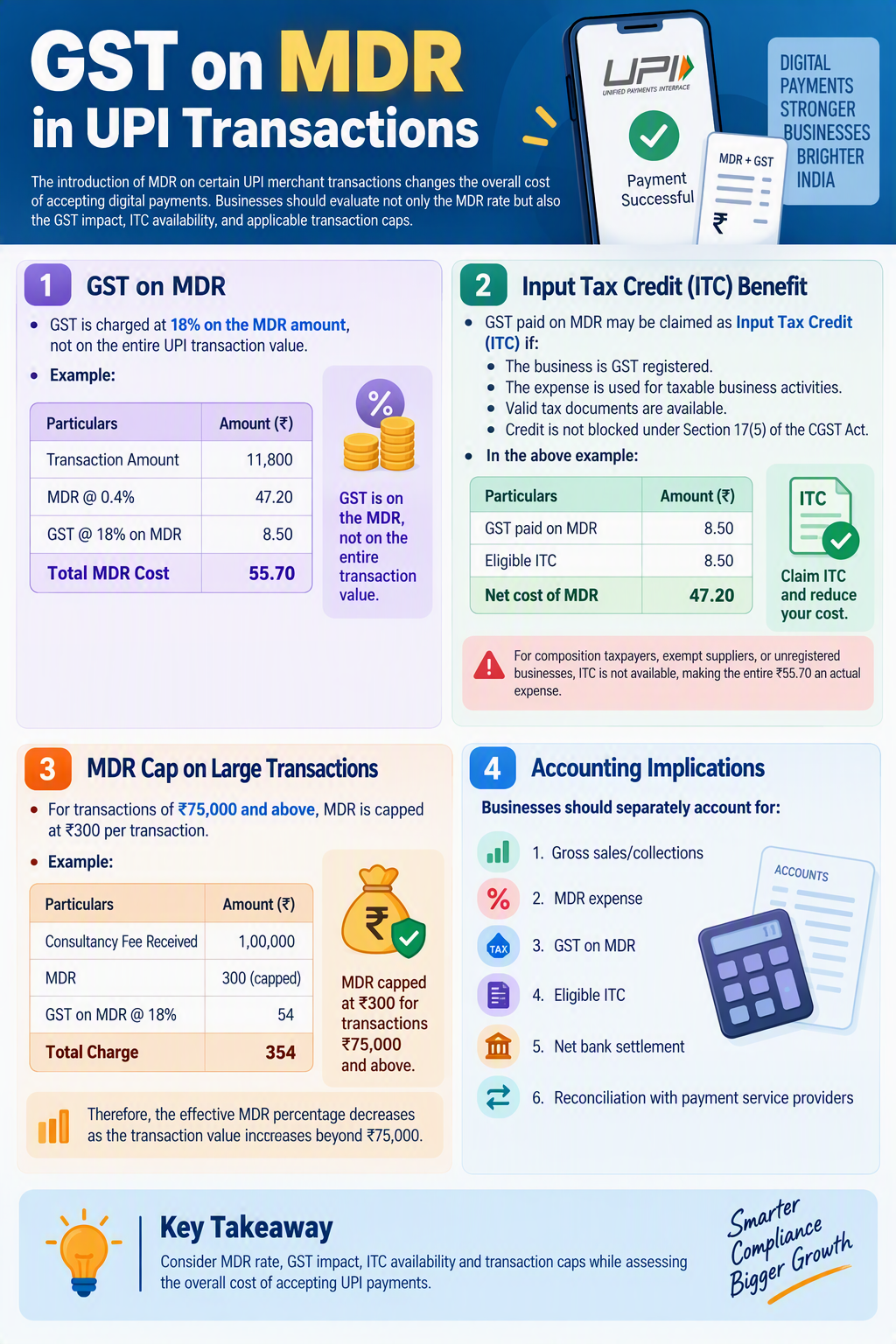
The introduction of MDR on certain UPI merchant transactions changes the overall cost of accepting digital payments. Businesses should evaluate not only the MDR rate but also the GST impact, ITC availability, and applicable transaction caps.
GST on MDR
- GST is charged at 18% on the MDR amount, not on the entire UPI transaction value.
- Example:
- Transaction Amount: INR 11,800
- MDR @ 0.4%: INR 47.20
- GST @ 18% on MDR: INR 8.50
- Total MDR Cost: INR 55.70
Input Tax Credit (ITC) Benefit
- GST paid on MDR may be claimed as Input Tax Credit (ITC) if:
- The business is GST registered.
- The expense is used for taxable business activities.
- Valid tax documents are available.
- Credit is not blocked under Section 17(5) of the CGST Act.
- In the above example:
- GST paid on MDR: INR 8.50
- Eligible ITC: INR 8.50
- Net cost of MDR: INR 47.20
- For composition taxpayers, exempt suppliers, or unregistered businesses, ITC is not available, making the entire INR 55.70 an actual expense.
MDR Cap on Large Transactions
- For transactions of INR 75,000 and above, MDR is capped at INR 300 per transaction. Example:
- Consultancy Fee Received: INR 1,00,000
- MDR: INR 300 (capped)
- GST on MDR: INR 54
- Total Charge: INR 354
- Therefore, the effective MDR percentage decreases as the transaction value increases beyond ₹75,000.
Accounting Implications
Businesses should separately account for Gross sales/collections, MDR expense, GST on MDR, Eligible ITC, Net bank settlement and Reconciliation with payment service providers. Example: Customer pays: INR 11,800, MDR: INR 47.20, GST on MDR: INR 8.50 and Net amount credited to bank: INR 11,744.30. The business should record INR 11,800 as revenue, not INR 11,744.30, and separately record MDR and GST expenses.
Key Takeaway
The narrative that “UPI will become chargeable from October 15” does not accurately reflect the proposal. The framework primarily introduces a targeted merchant-side MDR for specific categories of larger transactions while preserving free access for consumers and protecting small merchants. For the average UPI user, sending money, receiving funds, scanning QR codes, and making everyday payments will continue to remain free.
“UPI remains cheaper than cards, but the era of free UPI is entering a new chapter” means that customers will still enjoy free UPI payments, but larger merchants receiving high-value payments will now contribute a small fee to support the long-term sustainability of India’s digital payment ecosystem
The proposed MDR framework introduces a new cost structure for high-value UPI merchant transactions. While MDR may be charged at 0.4%, the actual business impact depends on:
- GST on MDR,
- Availability of ITC,
- MDR caps for large transactions,
- Nature of the taxpayer’s GST status.
GST on MDR is not GST on the customer’s invoice value again; it is GST on the separate payment processing service provided by the payment ecosystem.
**********************************************************
If this article has helped you in any way, i would appreciate if you could share/like it or leave a comment. Thank you for visiting my blog.
Legal Disclaimer:
The information / articles & any relies to the comments on this blog are provided purely for informational and educational purposes only & are purely based on my understanding / knowledge. They do noy constitute legal advice or legal opinions. The information / articles and any replies to the comments are intended but not promised or guaranteed to be current, complete, or up-to-date and should in no way be taken as a legal advice or an indication of future results. Therefore, i can not take any responsibility for the results or consequences of any attempt to use or adopt any of the information presented on this blog. You are advised not to act or rely on any information / articles contained without first seeking the advice of a practicing professional.