IBC 2026 Amendments & Evolution of India’s Insolvency System
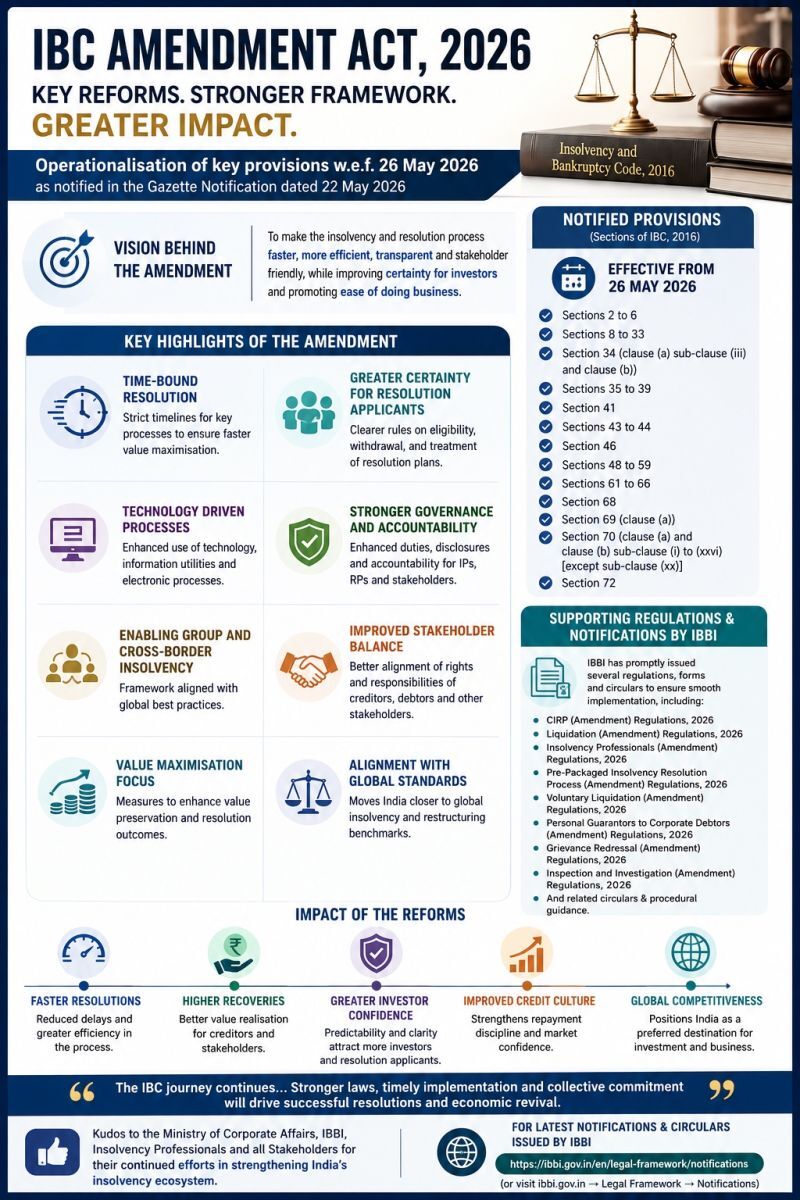
Table of Contents
IBC 2026 Amendments & Evolution of India’s Insolvency Framework
The Insolvency and Bankruptcy Code (IBC) has transformed India’s insolvency ecosystem by shifting the focus from a debtor-in-possession model to a creditor-in-control framework. The core philosophy of the Code remains resolution over recovery and liquidation, with a strong emphasis on value maximization, time-bound resolution, and balancing stakeholder interests.
IBC amendments aim to make the insolvency framework faster, more efficient, and focused on value maximization rather than mere debt recovery. The amendments introduce significant structural changes designed to preserve viable businesses, reduce litigation, and enhance creditor confidence while ensuring timely resolution of distressed companies.
Major Achievements of IBC
- Since its implementation, the IBC has significantly improved India’s credit and insolvency landscape. More than 1,300 companies have been successfully resolved. Creditors have recovered over INR 4.1 lakh crore.
- Over 30,000 matters involving approximately INR 13.78 lakh crore were settled even before admission owing to the deterrent effect of the Code.
- Average recoveries have exceeded liquidation value by nearly 170%, contributing to a sharp decline in banking sector NPAs. Resolved companies witnessed substantial value creation, with market capitalization reportedly increasing from INR 2.8 lakh crore to INR 9 lakh crore over a five-year period.
- The IBC Amendment Act, 2026, represents a major shift from a recovery-centric framework to a value-maximization and resolution-oriented regime.
- Key outcomes expected Faster insolvency resolution, Reduced judicial delays, Stronger creditor protection, enhanced promoter accountability, Simplified liquidation process, better recovery outcomes, greater certainty for investors, and modernized cross-border and group insolvency mechanisms.
Practical Challenges Observed
Despite its success, several challenges emerged during implementation. CIRP timelines often exceeded 700 days despite the statutory limit of 330 days. Significant asset value erosion due to delays. Frequent litigation and procedural appeals. Limited effectiveness of the Pre-Packaged Insolvency Resolution Process.
High percentage of liquidations instead of successful resolutions. Continued disputes regarding distribution under Section 53 Waterfall Mechanism. Lack of a comprehensive framework for group insolvency and cross-border insolvency.
Key Reforms Introduced through the IBC Amendment Act, 2026
-
Introduction of Creditor-Initiated Insolvency Resolution Process (CIIRP)
The most significant reform is the introduction of CIIRP, an out-of-court insolvency initiation mechanism. Key Features: Initiation with approval of 51% financial creditors, resolution timeline of 150 days, extendable by 45 days, No initial NCLT admission required, corporate debtor continues management under RP supervision, resolution plan approval by 66% voting share, withdrawal requires 90% CoC approval. Benefits: Faster commencement of insolvency proceedings, Reduced burden on NCLT, preservation of business continuity and improved value realization.
-
Stricter Timelines:
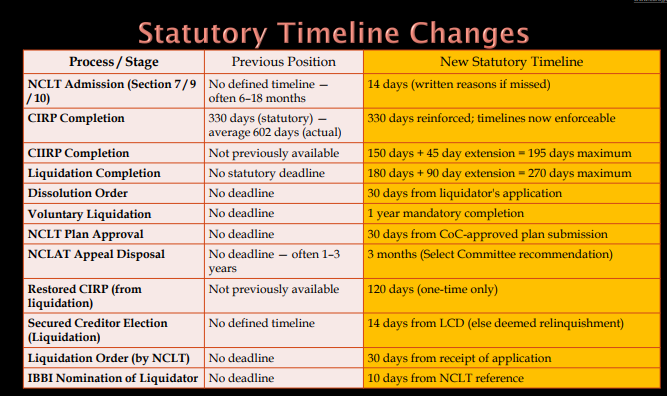
The amendments introduce enforceable timelines throughout the insolvency process.
| Activity | Timeline |
| Admission of Insolvency Application | 14 Days |
| Approval of Resolution Plan by NCLT | 30 Days |
| Disposal of NCLAT Appeals | 3 Months |
| Liquidation Completion | 180 Days + 90 Days Extension |
| CIIRP Completion | 150 Days + 45 Days Extension |
| Voluntary Liquidation | 1 Year |
These timelines aim to reduce delays and prevent value destruction.
-
Group Insolvency Framework
The amendment lays the foundation for a comprehensive Group Insolvency Framework. Potential features include a Common NCLT Bench, a Common Insolvency Professional, a Combined Committee of Creditors, a Coordinated Resolution Process, and Binding Coordination Agreements among Group Entities. This reform is expected to address complex corporate groups and real estate structures more effectively.
-
Cross-Border Insolvency
The government has been empowered to frame rules for cross-border insolvency. The framework is expected to cover recognition of foreign insolvency proceedings, cooperation with foreign courts, coordination among overseas stakeholders, and alignment with international insolvency practices and UNCITRAL principles.
-
Strengthened Avoidance Transaction Framework:
The 2026 amendments significantly expand provisions relating to avoidance transactions.
Types of Avoidance Transactions
-
- Preferential Transactions (Section 43)
- Undervalued Transactions (Section 45)
- Transactions Defrauding Creditors (Section 49)
- Extortionate Credit Transactions (Section 50)
- Fraudulent or Wrongful Trading (Section 66)
New Definition:
The term “Avoidance Transaction” has been formally defined under Section 5(2A). Expanded Powers
- Resolution professionals and liquidators can continue avoidance proceedings.
- Proceedings survive even after CIRP completion or liquidation.
- Creditors can directly approach NCLT if RP fails to initiate action.
- Mandatory disciplinary action against non-reporting RPs.
Summary and Comparative Table of Avoidance Transactions under IBC
| Particulars | Preference Transactions (Sec. 43) | Undervalued Transactions (Sec. 45) | Transactions Defrauding Creditors (Sec. 49) | Extortionate Credit Transactions (Sec. 50) |
|---|---|---|---|---|
| Nature of Transaction | Transfer benefiting a creditor, surety, or guarantor, placing them in a more advantageous position than under Section 53 waterfall | Gift or transfer for no consideration or significantly lower consideration | Undervalued transaction deliberately undertaken to put assets beyond the reach of creditors or adversely affect their interests | Credit transaction involving exorbitant payments or unconscionable/extortionate terms |
| What Needs to be Proved | Transaction has the effect of giving a preference to a creditor, surety, or guarantor. | The corporate debtor transferred assets for inadequate or no consideration. | The transaction was entered into with intent to defraud creditors or prejudice their interests | Terms of the credit transaction are extortionate, unconscionable, or require exorbitant payments. |
| Look-back / Anterior Period | Related Party: 2 Years Unrelated Party: 1 Year | Related Party: 2 Years Unrelated Party: 1 Year | No specific limitation period prescribed | 2 Years |
| Reference Point (Post-2026 Amendment) | From the initiation date and ending on the insolvency commencement date | From the initiation date and ending on the insolvency commencement date | Not applicable | From the initiation date and ending on the insolvency commencement date |
| Presumption | Transactions with related parties presumed not made in good faith | No statutory presumption | No statutory presumption | No statutory presumption |
| Relief / Orders by NCLT | Restore position as if preference had not occurred; vest property back; release security interest; direct repayment of benefit received | Restore position; reverse transfer; release or discharge security interests; direct repayment of benefits received | Restore parties to the original position, protect interests of affected creditors, and reverse transaction consequences. | Set aside or modify transaction terms; restore position; require repayment of excess amounts; set aside all or part of debt |
| Objective | Ensure equitable treatment of creditors. | Prevent dissipation of assets at undervalue | Prevent fraudulent asset stripping. | Protect corporate debtors from predatory lending practices |
-
Significant Changes in Look-Back Period
The amendment changes the reference point from the Insolvency Commencement Date to the Initiation Date. This means transactions occurring between filing and admission are now also subject to review. Look-Back Period
| Transaction Type | Related Party | Others |
| Preferential Transactions | 2 Years | 1 Year |
| Undervalued Transactions | 2 Years | 1 Year |
| Extortionate Transactions | 2 Years | N.A. |
This significantly broadens the scope of scrutiny.
-
Greater Accountability of Promoters and Management:
Section 19 has been expanded. The obligation to cooperate now extends to promoters, former directors, employees, consultants, service providers, and any person associated with management. Failure to cooperate can attract legal consequences.
-
Fraudulent and Wrongful Trading:
Under Section 66, directors may be personally liable where they knew insolvency was unavoidable. Fraudulent business conduct can lead to personal contribution orders.
Liquidators are now empowered to pursue such proceedings after CIRP. This strengthens accountability of promoters and directors.
-
Penalties for Frivolous Proceedings:
New provisions introduce penalties ranging from INR 1 lakh to INR 2 crore for frivolous or vexatious litigation. This reform seeks to discourage procedural abuse and reduce unnecessary delays.
-
Government Dues Clarified:
The amendments provide clarity that government dues do not automatically become secured debt, statutory charges rank according to the waterfall mechanism, and priority treatment is available only where supported by valid security interests. This improves certainty in creditor distributions.
Liquidation Process Reforms:
Major liquidation reforms include:
-
- CoC Supervision: The Committee of Creditors will supervise liquidation, and Key decisions require CoC approval with 66% voting share.
- Avoidance Proceedings Post Liquidation: Avoidance and fraudulent trading proceedings can continue even after CIRP completion, liquidation, and dissolution.
- Not Readily Realizable Assets (NRRA): The scope now includes contingent assets, disputed claims, Avoidance transaction claims, fraudulent trading recoveries,
Key Highlights of the Proposed IBC 2026 Amendments
- One of the most important changes is the introduction of the CIIRP, which replaces the earlier fast-track mechanism. Under this framework, eligible financial creditors can initiate an insolvency process through an out-of-court route, reducing dependence on the NCLT at the initial stage.
- The model follows a “debtor-in-possession, creditor-in-control” approach, allowing the existing management to continue running the business under creditor oversight. This helps maintain business continuity, preserve enterprise value, and improve the chances of a successful turnaround.
- A key objective of the amendments is to ensure strict adherence to timelines. Insolvency applications must be admitted within 14 days once default is established, while the Adjudicating Authority is required to approve or reject resolution plans within 30 days
- Liquidation proceedings are proposed to be completed within 180 days, extendable by a maximum of 90 days, and appeals before the NCLAT must be decided within three months. Additionally, the new out-of-court insolvency process has a compressed timeline of 150 days, ensuring faster resolution and minimizing erosion of asset value.
- The amendments also introduce a comprehensive framework for group insolvency and cross-border insolvency. Group insolvency will enable coordinated resolution of financially interconnected holding companies, subsidiaries, and associate entities.
- Cross-border insolvency mechanism will facilitate the resolution of companies having assets, creditors, or operations in multiple jurisdictions, thereby aligning India’s insolvency regime with global best practices and improving international investor confidence.
- To address delays caused by unnecessary litigation, the Bill proposes stringent deterrents against frivolous and vexatious proceedings. Penalties ranging from INR 1 lakh to INR 2 crore may be imposed on parties filing applications in bad faith.
- The amendments also strengthen provisions relating to fraudulent transactions, wrongful trading, and avoidance transactions, thereby enhancing the integrity and effectiveness of the insolvency process.
- Another significant feature is the continued protection of employees and workmen. Under the insolvency waterfall mechanism, workmen’s dues maintain a high priority ranking, comparable to secured creditors and above government dues and unsecured financial creditors.
- Furthermore, the amendments clarify that statutory or government dues will not be treated as secured debt unless supported by a valid consensual security interest, bringing greater certainty to the distribution framework.
Conclusion
- Overall, the proposed 2026 amendments transform the IBC from a predominantly recovery-oriented legislation into a value-maximization and business-rescue framework. By introducing faster resolution mechanisms, reducing tribunal burdens, strengthening creditor rights, and providing certainty in cross-border and group insolvency matters, the reforms are expected to improve recoveries, preserve viable businesses, enhance investor confidence, and strengthen the stability of India’s financial and banking system.
- The amendments reinforce the original spirit of the IBC: “Resolution First, Liquidation Last.” The introduction of CIIRP, enhanced avoidance provisions, stronger creditor rights, stricter timelines, and improved regulatory oversight marks a significant evolution in India’s insolvency framework.
- For insolvency professionals, resolution professionals, financial creditors, and corporate debtors, the reforms create a more efficient, transparent, and commercially viable insolvency ecosystem.
- IBC Amendment, 2026 significantly strengthens the avoidance transaction framework by shifting the look-back period reference from the Insolvency Commencement Date (ICD) to the Initiation Date, thereby bringing transactions executed during the gap between filing and admission within the scope of scrutiny.
- This enhances creditor protection, prevents asset diversion, and improves the effectiveness of the insolvency resolution process.
Following Comparative Snapshot
| Section | Transaction Type | Look-back Period | Intention Required? | Related Party Presumption? |
|---|---|---|---|---|
| Section 43 | Preference Transaction | 2 Years (Related), 1 Year (Others) | No | Yes |
| Section 45 | Undervalued Transaction | 2 Years (Related), 1 Year (Others) | No | No |
| Section 49 | Defrauding Creditors | No Fixed Period | Yes | No |
| Section 50 | Extortionate Credit Transaction | 2 Years | No |
**********************************************************
If this article has helped you in any way, i would appreciate if you could share/like it or leave a comment. Thank you for visiting my blog.
Legal Disclaimer:
The information / articles & any relies to the comments on this blog are provided purely for informational and educational purposes only & are purely based on my understanding / knowledge. They do noy constitute legal advice or legal opinions. The information / articles and any replies to the comments are intended but not promised or guaranteed to be current, complete, or up-to-date and should in no way be taken as a legal advice or an indication of future results. Therefore, i can not take any responsibility for the results or consequences of any attempt to use or adopt any of the information presented on this blog. You are advised not to act or rely on any information / articles contained without first seeking the advice of a practicing professional.