Undisclosed Foreign Income & Assets(Imposition of Tax)Bill

Table of Contents
SUMMARY OF APPROVED UNDISCLOSED FOREIGN INCOME AND ASSETS (IMPOSITION OF TAX) BILL, 2015.
The Union Cabinet on 17th March, 2015 approved the Undisclosed Foreign Income and Assets (Imposition of Tax) Bill, 2015 to deal with cases relating to black money stashed away in other countries.
Important Provisions of the Bill:
- Concealment of income and assets and evasion of tax in relation to foreign assets will be prosecutable with punishment of rigorous imprisonment up to 10 years.
- Offence of stashing unaccounted money abroad will be made non-compoundable (A non-compoundable offence is one in which the complainant (the government in this instance) does not enter into a compromise with the accused.
- The offenders will not be permitted to approach the Settlement Commission
- Penalty for such concealment of income and assets at the rate of 300% of tax shall be levied.
- The government will give a short window to those stashing black money abroad to declare their wealth, pay taxes and penalty and escape prosecution under the proposed law.
- Non filing of return or filing of return with inadequate disclosure of foreign assets will be liable for prosecution with punishment of rigorous imprisonment up to 7 years.
- Income in relation to any undisclosed foreign asset or undisclosed income from any foreign asset will be taxable at the maximum marginal rate. Exemptions or deductions which may otherwise be applicable in such cases shall not be allowed.
- Beneficial owner or beneficiary of foreign assets will be mandatorily required to file return, even if there is no taxable income.
- Abettors of the above offences, whether individuals, entities, banks or financial institutions will be liable for prosecution and penalty.
- Date of opening of foreign account would be mandatorily required to be specified by the assessee in the return of income.
- The offense of concealment of income or evasion of tax in relation to a foreign asset will be made a predicate offence under the Prevention of Money-Laundering Act, 2002 (PMLA). This provision would enable the enforcement agencies to attach and confiscate unaccounted assets held abroad and launch prosecution against persons indulging in the laundering of black money.
- The definition of proceeds of crime under PMLA is being amended to enable attachment and confiscation of equivalent asset in India where the asset located abroad cannot be forfeited.
The Foreign Exchange Management Act, 1999, will also be amended to the effect that if any foreign exchange, foreign security, or any immovable property situated outside India is held in contravention of the provisions of this Act, then action may be taken for seizure and eventual confiscation of assets of equivalent value situated in India. These contraventions are also being made liable for levy of penalty and prosecution with punishment of imprisonment up to five years.
Goods and Services Tax Act violations will be booked as Prevention of Money Laundering Act offence
Foreign Asset Reporting in ITR – Key Points
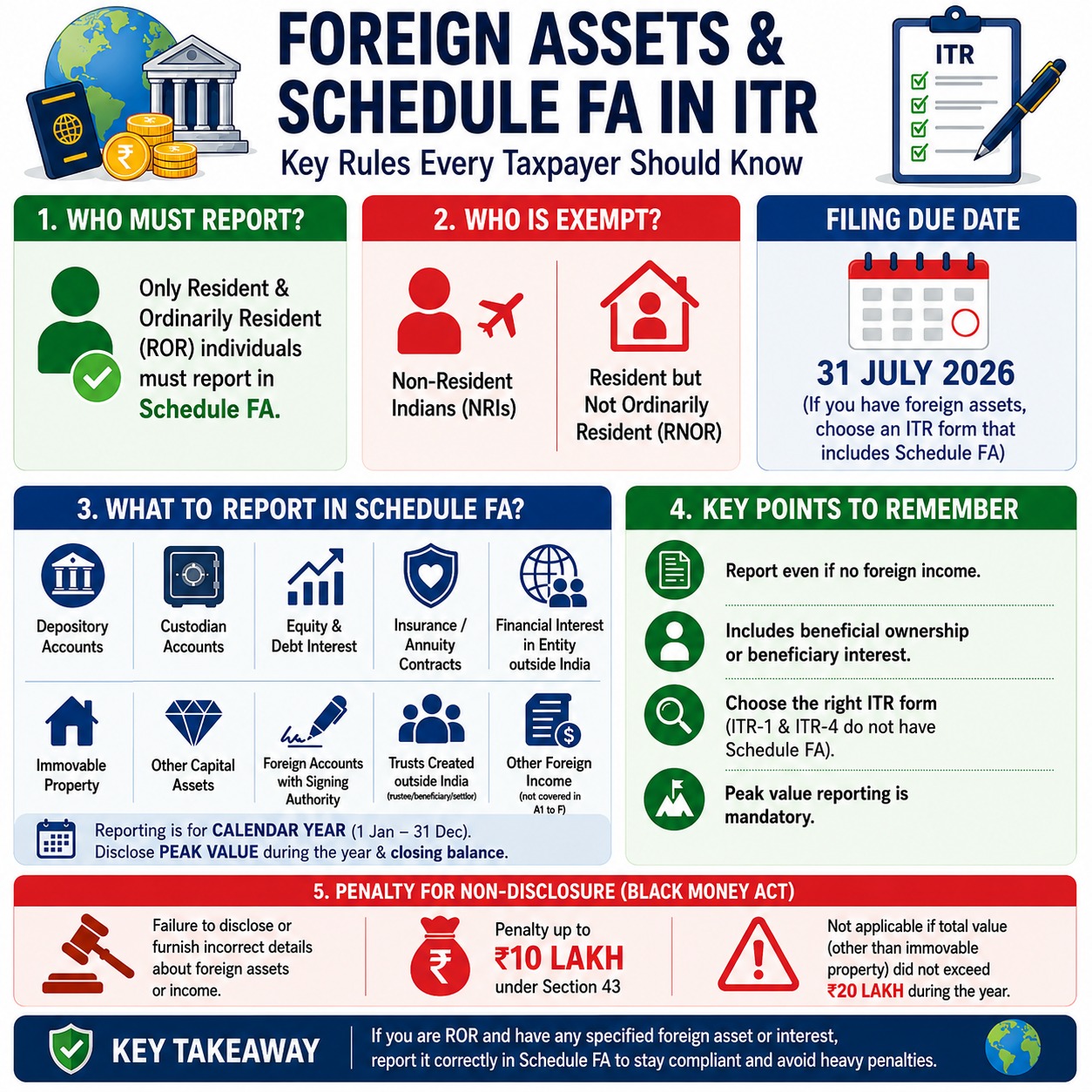
- Only resident and ordinarily resident taxpayers are required to disclose foreign assets in their income tax return. NRIs & RNORs are exempt from reporting foreign assets in Schedule FA.
- Before filing the income tax return always reconcile Schedule FA disclosures with overseas bank statements, brokerage statements, ESOP holdings, foreign retirement accounts, and other overseas investments to avoid reporting omissions.
- Failure to disclose foreign assets correctly may attract stringent consequences under the Black Money (Undisclosed Foreign Income and Assets) and Imposition of Tax Act, 2015, including penalties of up to ₹10 lakh, subject to prescribed exceptions.
- Foreign Asset Reporting Schedule FA is based on the Calendar Year (1 January to 31 December) and not on the Indian FY (1 April to 31 March). The following foreign assets are generally required to be reported:
- Foreign bank accounts
- Depository and custodial accounts
- Foreign equity and debt investments
- Overseas immovable property
- Financial interests in foreign entities
- Trusts where the taxpayer is a settlor, beneficiary, or trustee
- Any other specified foreign assets
Foreign Asset Reporting Disclosure is required even where you are a beneficial owner or beneficiary, and not necessarily the legal owner.
For foreign bank accounts and investments, taxpayers should report the peak balance/value during the relevant calendar year.
Income tax Taxpayers having foreign-source income or foreign assets cannot file ITR-1 or ITR-4 & must use the applicable ITR form containing Schedule FA.
**********************************************************
If this article has helped you in any way, i would appreciate if you could share/like it or leave a comment. Thank you for visiting my blog.
Legal Disclaimer:
The information / articles & any relies to the comments on this blog are provided purely for informational and educational purposes only & are purely based on my understanding / knowledge. They do noy constitute legal advice or legal opinions. The information / articles and any replies to the comments are intended but not promised or guaranteed to be current, complete, or up-to-date and should in no way be taken as a legal advice or an indication of future results. Therefore, i can not take any responsibility for the results or consequences of any attempt to use or adopt any of the information presented on this blog. You are advised not to act or rely on any information / articles contained without first seeking the advice of a practicing professional.