Key Changes Introduced by the FCRA Amendment Rules, 2026
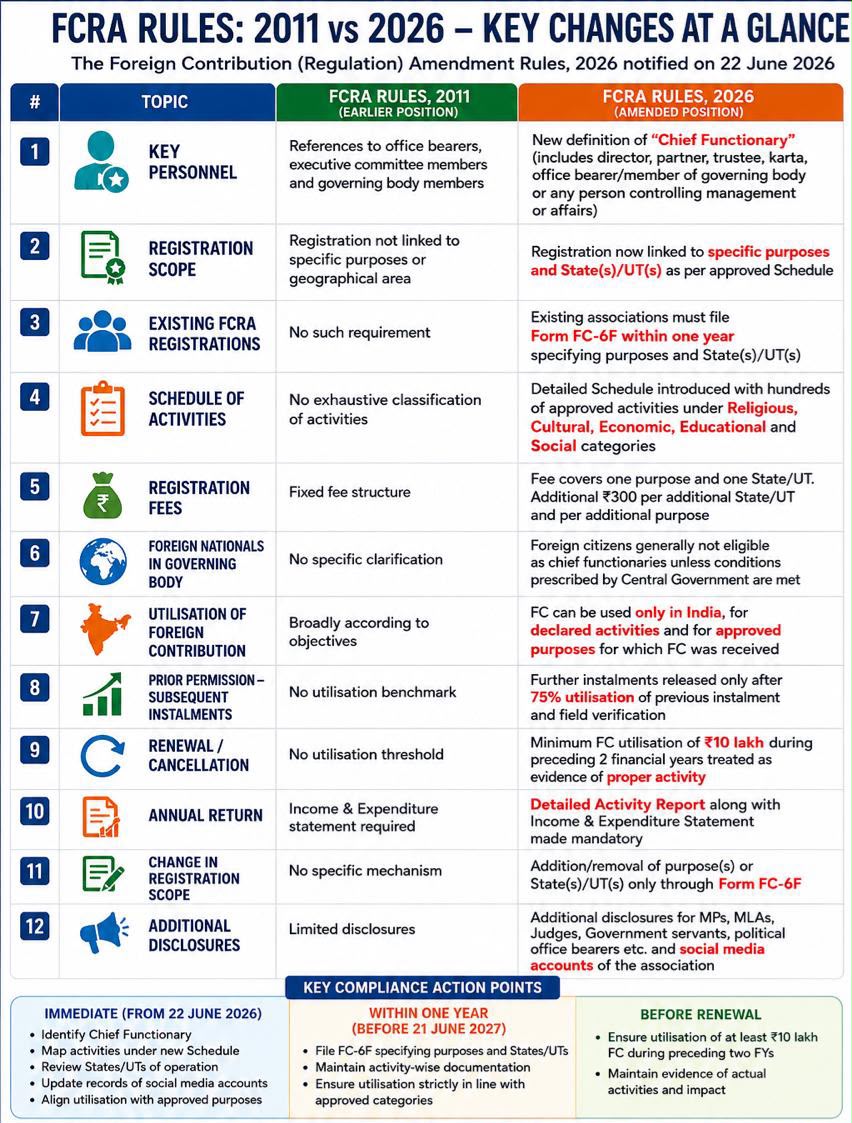
Table of Contents
Why have the rules been the Foreign Contribution (Regulation) Amendment Rules, 2026?
- The Govt. has introduced these changes to strengthen monitoring and ensure that foreign contributions are Utilized only for approved and declared purposes, spent within approved states and union territories, supported by detailed activity-based reporting, protected from misuse for unauthorized or political activities, and subject to greater transparency and accountability. Notably, the 2026 amendment is the tenth amendment to the Foreign Contribution (Regulation) Amendment Rules, 2011, since their original notification.
- Foreign Contribution (Regulation) Amendment Rules Tightened in 2026: NGOs Must Declare Social Media Accounts, Restrict Activities to Approved Purposes, and Avoid Political Content
- The amended rules, effective from 22 June 2026, mark a shift from a broad registration-based regime to a more structured framework based on specific purposes, approved geographical areas, enhanced disclosures, and stricter utilization controls. The amendments apply to NGOs, charitable trusts, societies, Section 8 companies, religious institutions, educational organizations, and other entities receiving foreign funds.
Key Changes Introduced by the FCRA Amendment Rules, 2026
-
Mandatory Disclosure of Social Media Accounts
- One of the most noteworthy changes is the introduction of enhanced disclosure requirements. Associations are now required to provide details of social media accounts operated by the organization. MPs associated with the organization, MLAs associated with the organization, judges associated with the organization, government servants associated with the organization, and political office bearers connected with the organization.
-
Activities Must Be Specifically Declared
- Under the earlier framework, many organizations operated under broad charitable or social objectives. The amended rules now require organizations to clearly identify The purposes for which foreign contributions will be received. The specific activities proposed to be undertaken.
- To support this requirement, the government has introduced a detailed schedule classifying activities into categories such as religious, cultural, educational, economic, and Social activities.
-
Mandatory Declaration of Geographical Scope
- The amended rules also require organizations to declare the States and union territories in which they intend to operate. Going forward, Foreign Contribution (Regulation) Amendment registration certificates will specify approved geographical areas This introduces a location-based compliance framework that did not previously exist.
-
Existing FCRA Registrants Must File Form FC-6F
- The amendments impose a new compliance requirement on all existing Foreign Contribution (Regulation) Amendment registered organizations. Such entities must file the Foreign Contribution (Regulation) Form FC-6F and disclose approved purposes, approved activities, and approved states/UTs of operation.
Timeline
- Since the amended rules came into force on 22 June 2026, existing organizations have been granted a one-year transition period to comply with this requirement. Failure to update registration details within the prescribed time could result in compliance challenges during future regulatory reviews.
-
Greater Scrutiny of Political Activities and Content
- While restrictions on political activities under the Foreign Contribution (Regulation) Amendment are not new, the 2026 amendments substantially strengthen regulatory oversight.
- The new framework Links utilization of foreign contributions to approved activities, requires disclosure of political office bearers, mandates disclosure of social media accounts, and restricts utilization of foreign funds to approved purposes only.
-
Detailed Activity Reporting Becomes Mandatory
- The compliance focus is no longer restricted to financial reporting alone. In addition to income & expenditure statements, organizations must now furnish a detailed activity report describing activities undertaken, beneficiaries served, outcomes achieved, Utilization of foreign contributions, and impact of projects implemented. This change reflects the government’s focus on measuring actual implementation and outcomes rather than merely reviewing financial records.
-
Foreign Contributions Can Be Used Only for Approved Purposes
- Another major reform is the tightening of utilization norms. Foreign contributions may now be used only within India for declared activities, for approved purposes, and within the approved scope of registration. Organizations will therefore have significantly less flexibility in reallocating funds from one project to another unless the relevant approvals are obtained.
Major Impact of FCRA Amendment Rules, 2026 Amendments
- Purpose-Based Registration: Organizations can no longer obtain a broad registration. They must specify the exact nature of activities for which foreign contributions will be received and utilized.
- State/UT-Specific Approval: Operations under Foreign Contribution (Regulation) Amendment Rules 2026 will now be linked to particular states/UTs. Expansion into new states may require modification through FC-6F.
- Enhanced Accountability: The introduction of the Chief Functionary concept creates a clearly identifiable person responsible for Foreign Contribution (Regulation) Amendment Rules, 2026, compliance.
- Stricter Fund Utilisation Monitoring: Foreign contributions must be used only for approved activities and approved locations, reducing flexibility in fund deployment.
- Increased Reporting Requirements: Organizations must maintain activity-wise records and furnish detailed activity reports in annual returns.
Conclusion
-
- Foreign Contribution (Regulation) Amendment Rules, 2011, provided a relatively broad framework for receipt and utilization of foreign contributions.
- The Foreign Contribution (Regulation) Amendment Rules, 2026, transform the compliance landscape by introducing purpose-specific registration, state-specific approvals, mandatory FC-6F filings, enhanced disclosures, activity-based reporting, stricter utilization controls, and greater accountability of management.
- For NGOs, charitable trusts, Section 8 companies, religious institutions, educational societies, and other Foreign Contribution (Regulation) Amendment registered entities, an immediate compliance review is advisable to align operations with the amended regulatory framework
**********************************************************
If this article has helped you in any way, i would appreciate if you could share/like it or leave a comment. Thank you for visiting my blog.
Legal Disclaimer:
The information / articles & any relies to the comments on this blog are provided purely for informational and educational purposes only & are purely based on my understanding / knowledge. They do noy constitute legal advice or legal opinions. The information / articles and any replies to the comments are intended but not promised or guaranteed to be current, complete, or up-to-date and should in no way be taken as a legal advice or an indication of future results. Therefore, i can not take any responsibility for the results or consequences of any attempt to use or adopt any of the information presented on this blog. You are advised not to act or rely on any information / articles contained without first seeking the advice of a practicing professional.