Overall Structure Goods and Services Tax Reconciliation
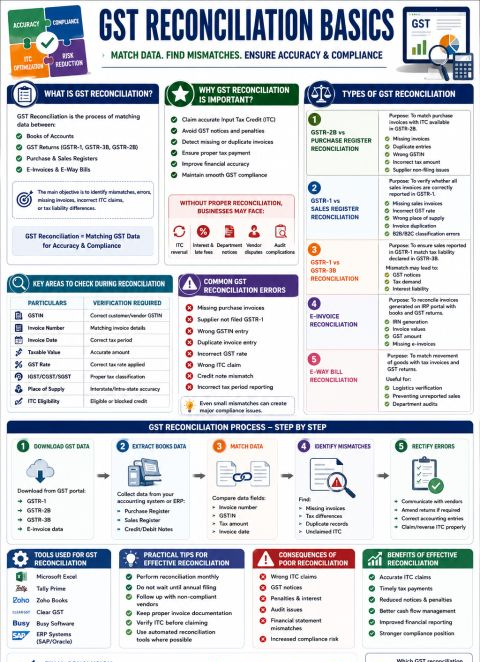
Table of Contents
Overall Structure & Theme Goods and Services Tax Reconciliation
Goods and Services Tax Reconciliation
- Goods and Services Tax reconciliation is essential to ensure accuracy, compliance, cash flow management, and business growth. The main goal is to match data, find mismatches, and ensure accuracy and compliance under the Goods and Services Tax.
- GST reconciliation is defined as matching data between books of accounts, Goods and Services Tax Returns (GSTR‑1, GSTR‑3B, GSTR‑2B), purchase & sales registers, e‑invoices & e‑waybills. The purpose of GST reconciliation is to Identify mismatches, correct input tax credit claims, and ensure accurate tax liability
- Key Areas to Check During Reconciliation: Important verification fields, goods and services tax identification number, invoice number & date, taxable value, Goods and Services Tax rate, tax amount (CGST/SGST/IGST), place of supply, and input tax credit eligibility.
Types of GST Reconciliation: Five major types are explained:
- GSTR‑2B vs Purchase Register: Match purchases with Input Tax Credit available in 2B Identify missing invoices, duplicate entries, and supplier non‑filing issues.
- GSTR‑1 vs Sales Register: Match outward supply data, Detect Missing sales invoices, incorrect values, and Wrong GST classification
- GSTR‑1 vs GSTR‑3B: Compare reported sales vs tax paid. Helps identify under/overreporting and Tax payment mismatches.
- E‑Invoice Reconciliation: Match e‑invoices with books and Goods and Services Tax returns and detect unreported or wrong invoices
- E‑Waybill Reconciliation: Match goods’ movement data with sales. Track Logistic mismatches and Unreported supplies
Step-by-Step Goods and Services Tax Reconciliation Process
A 5-step workflow is shown:
- Step-1: Download GST Data—GSTR‑1, GSTR‑2B, GSTR‑3B, and E‑Invoice data
- Step-2: Extract Books Data: Purchase register, sales register, and ERP/accounting system
- Step-3: Match Data: Key fields Goods and Services Tax Identification Number, Invoice number, Date, Tax amount
- Step 4: Identify Mismatches: Missing entries, duplicate records, and Value mismatches
- Step 5: Rectify Errors: Communicate with vendors, amend returns and Adjust accounting entries
Goods and Services Tax Reconciliation Tools Mentioned: Popular Goods and Services Tax tools GST portal, Microsoft Excel, Tally Prime, Zoho, Clear Goods and Services Tax, Busy Software and SAP/ERP systems
Why is goods and services tax reconciliation important?
- Key benefits listed: claim accurate input tax credit, avoid GST notices and penalties, detect missing or duplicate invoices, improve financial accuracy, and maintain smooth GST compliance.
- Without reconciliation, input tax credit may be denied, Interest & penalties may arise and Audit risks increase
- Common GST Reconciliation Errors: Frequent issues highlighted Missing purchase invoices, the supplier not filing GSTR‑1, incorrect Goods and Services Tax Identification Number entry, wrong Input Tax Credit claims, duplicate invoices, and unreconciled mismatches.
- Consequences of Poor Reconciliation is Wrong ITC claims, GST notices, Penalties & interest, financial misstatements and Increased compliance risk
- Compliance Risks if Ignored : ITC reversal, Interest & penalties, GST notices, audit escalation, and Financial misstatements
Benefits of Effective Reconciliation
- Accurate Input Tax Credit claims
- Timely tax payments
- Reduced notices & penalties
- Improved financial reporting
- Strong compliance system
Practical Tips for Professionals
Reconcile monthly, match GSTR‑1, GSTR 2B GSTR 3B, Maintain centralized invoice register, Track vendor compliance, Automate reconciliation, Document every variance. Review before filing and maintain audit trail; also take care the following:
- Perform reconciliation monthly
- Do not wait until annual filing
- Follow up with non-compliant vendors
- Keep proper documentation
- Verify Input Tax Credit eligibility carefully
**********************************************************
If this article has helped you in any way, i would appreciate if you could share/like it or leave a comment. Thank you for visiting my blog.
Legal Disclaimer:
The information / articles & any relies to the comments on this blog are provided purely for informational and educational purposes only & are purely based on my understanding / knowledge. They do noy constitute legal advice or legal opinions. The information / articles and any replies to the comments are intended but not promised or guaranteed to be current, complete, or up-to-date and should in no way be taken as a legal advice or an indication of future results. Therefore, i can not take any responsibility for the results or consequences of any attempt to use or adopt any of the information presented on this blog. You are advised not to act or rely on any information / articles contained without first seeking the advice of a practicing professional.