Will & Trust as a Tool for Succession Planning
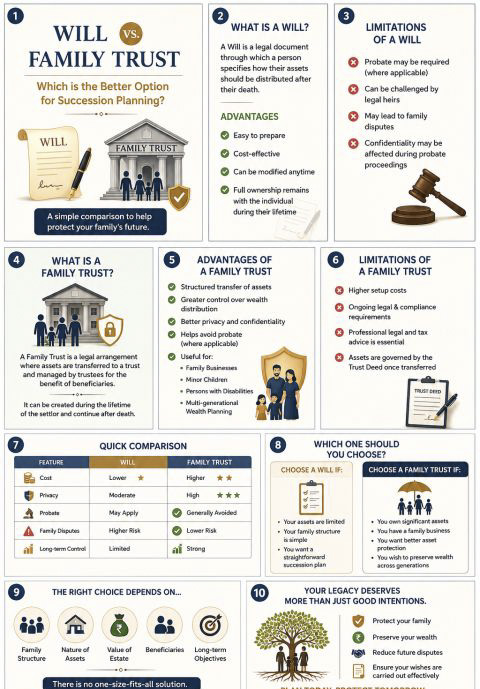
Table of Contents
Will vs. Private Family Trust: A Comprehensive Guide to Succession Planning in India
Introduction
Building wealth is only half the journey. Preserving it and ensuring its seamless transfer across generations is equally important. Unfortunately, many families spend decades accumulating assets but devote very little attention to succession planning. The result is often family disputes, litigation, loss of wealth, and disruption of family businesses.
In this blog we going to explain how a will and a private family trust can serve as powerful tools for succession planning. We emphasizes that succession planning is not merely about transferring assets; it is also about preserving family values, ensuring continuity of legacy, and protecting future generations.
Understanding Succession Planning
Succession planning is the process of systematically transferring:
- Wealth: Business interests, Investments, real estate, and Financial assets
- Values: Family culture, ethical standards, and Principles that built the family’s success
- Legacy: Reputation, family identity, long-term vision and objectives, and a family’s legacy cannot survive merely through the transfer of money. The values behind that wealth must also pass to the next generation.
Why Succession Planning Has Become Crucial in India
India’s wealth landscape is changing rapidly. Two significant factors make succession planning more relevant than ever:
- Growing Population: India has become the world’s most populous nation, resulting in increasingly complex family structures and inheritance situations.
- Rise in Wealth Creation: India has witnessed an unprecedented increase in High Net Worth Individuals (HNIs), Ultra High Net Worth Individuals (UHNIs), and family-owned businesses. With larger asset pools and multi-generational wealth, the need for structured succession planning has become unavoidable.
Objectives of Succession Planning
Emotional Objectives:
Wealth Distribution According to Personal Wishes Every individual may have unique intentions regarding the distribution of assets. For example:
- One child may be actively involved in the family business.
- Another may have already received substantial financial assistance.
A person may therefore wish to allocate assets differently than what statutory succession laws provide.
Prevention of Family Disputes:
Many inheritance disputes arise because intentions were never formally documented. Proper succession planning helps:
- Avoid misunderstandings
- Reduce litigation
- Preserve family harmony
Financial Objectives
- Asset Protection: Proper structures can protect family wealth from family disputes, creditor claims, and external liabilities.
- Estate Duty Preparedness: Although India currently does not levy estate duty, future tax policy changes cannot be ruled out. A well-designed succession structure helps families remain prepared.
Evolution of Succession Laws in India: Historically, inheritance was governed primarily through personal laws.
- Mitakshara School: Under this system: A child acquired rights in ancestral property by birth.
- Dayabhaga School: Under this framework, rights arose only after the death of the property owner. The concept of a modern will gained prominence in India during the British era and became a cornerstone of testamentary succession planning.
Legal Framework Governing Succession Planning
Succession planning involves multiple laws operating simultaneously.
Personal Laws
These determine succession rights and inheritance rules. Examples include the Hindu Succession Act, Indian Succession Act, and Sharia Law. These laws govern the identification of heirs, distribution patterns, and testamentary powers.
Other Relevant Laws :
A succession plan must also consider the Income Tax Act, FEMA, the Transfer of Property Act, stamp duty laws, and registration laws. These provisions influence taxation, documentation requirements, and treatment of domestic and international assets.
Common Tools Used for Succession Planning
Several instruments can be used depending upon family circumstances:
- Gift Deed: Transfer of assets during the lifetime of the owner.
- Hindu Undivided Family (HUF) : A traditional wealth-holding structure under Hindu law.
- Will : Transfer of assets upon death.
- Private Family Trust: Structured wealth holding and succession mechanism.
- Family Constitution: Framework governing family values and business decisions.
- Family Office Structures: Professional administration of family wealth.
Understanding a Will
A will remains one of the simplest and most widely used succession planning tools. Key Features of a Will
- Effective Only After Death: A will has no legal effect during the lifetime of the testator.
- Full Control Remains with the Testator: The owner retains unrestricted ownership and control over assets until death.
- Subject to Applicable Personal Laws: One must ensure that applicable succession laws permit testamentary disposition.
- Fully Revocable: A will can be modified, replaced, or revoked at any point during the lifetime of its maker.
- Legal Definition of a Will : Section 2(h) of the Indian Succession Act defines a will as a legal declaration of the intention of a testator concerning his property, which is intended to take effect after death. In simple words, it records how assets should be distributed when the testator is no longer alive.
Recent Developments in Wills
- Probate Simplification: The presentation highlights developments that may significantly reduce procedural complexities in the administration of wills.
- Video Wills: Courts are increasingly willing to consider electronic evidence supporting testamentary intention. Best practice includes executing a written will and recording a video confirming the contents and intention. This can strengthen evidence in future disputes.
- Joint Wills: Although not expressly codified, judicial precedents have recognized joint wills, especially between spouses.
Essential Ingredients of a Well-Drafted Will:
Every Will should ideally contain:
- Appointment of Executor: An executor ensures implementation of the testator’s wishes.
- Attestation by Witnesses: At least two witnesses should sign the will.
- Revocation Clause: Should expressly cancel all prior wills and codicils.
- Declaration of Sound Mind: Particularly important for elderly individuals.
- Proper Identification: The Will should include PAN, Aadhaar, Address, mobile number, and Email ID
- Guardian for Minor Children: One of the most overlooked but critical clauses.
- Residuary Clause: Ensures assets not specifically mentioned are also distributed.
- Liability Clause: Specifies how debts, taxes, and administrative expenses will be discharged.
- Private Family Trust: A Powerful Succession Tool: For affluent families, trusts often provide a higher level of flexibility and protection than a standalone will.
Why Use a Trust?
- Emotional Benefits: Wealth distribution according to family wishes, Reduced family conflict
- Financial Benefits: Asset protection, Succession continuity, Estate duty preparedness, Long-term governance Private family trusts are globally recognized vehicles for intergenerational wealth preservation.
The Biggest Myth About Trusts
- Many believe that a trust is a separate legal person. This is incorrect. A trust is fundamentally a legal obligation imposed upon ownership. The trustee legally holds assets but must manage them strictly for the benefit of beneficiaries.
Key Participants in a Private Family Trust
- Settlor: the creator of the trust. Responsibilities include Identifying assets, Choosing beneficiaries, Appointing trustees, Expressing wishes and intentions
- Beneficiary: The person for whose benefit the trust is established. Beneficiaries may include individuals, companies, residents, and non-residents. Proper drafting can even accommodate unborn descendants.
- Trustee: The legal owner of trust assets. Responsibilities include Asset management, Compliance with trust deed, Protection of beneficiary interests, Importantly, trustees hold legal ownership but do not enjoy beneficial ownership.
- Protector: A Protector acts as an independent overseer. Typical responsibilities include monitoring trustees, approving major decisions, and ensuring settlor intentions are respected. However, protectors should not effectively control trustees or become shadow decision-makers.
Types of Trusts
- Based on Method of Creation: Oral Trust, Testamentary Trust and Non-Testamentary Trust
- Based on Revocability: Revocable Trust and Irrevocable Trust
- Based on Beneficiary Rights: Specific (Determinate) Trust and Discretionary (Indeterminate) Trust. Each category can have significantly different tax and legal consequences.
- Revocable vs. Irrevocable Trusts: A Critical Distinction One of the most important lessons from the presentation is that a trust may be irrevocable under trust law but revocable under tax law.
For example: A settlor transfers a residential property into a trust but remains a beneficiary. While the trust deed may contain no revocation power, tax laws may still regard the structure as revocable because the settlor continues to enjoy benefits from the trust property.
This distinction highlights the importance of drafting trusts with both legal and tax implications in mind.
Trust Deed and Letter of Wishes
- Trust Deed: The Trust Deed is the primary document creating the trust structure. It generally contains trust objectives, trustee powers, beneficiary rights, and administrative provisions. Interestingly, oral trusts may be legally valid in certain circumstances, though practical challenges often make written documentation essential.
- Letter of Wishes: A Letter of Wishes is a confidential communication from the settlor to trustees. It may contain guidance regarding education expenses, family business succession, lifestyle expectations, and distribution philosophy. Although not legally binding, courts often consider such letters when interpreting settlor intent.
Taxation of Private Family Trusts :
Trust taxation is one of the most complex areas of succession planning. Important factors include:
- Settlement Stage: Capital gains implications and Transfer exemptions
- Trust Operations: Treatment of revocable trusts and Taxation of discretionary trusts
- Distribution Stage: Beneficiary taxation
- Final Sale of Assets: Cost of acquisition and Holding period benefits
Key Tax Lessons from Judicial Decisions—
- Buckeye Trust Case: Drafting flexibility can sometimes destroy tax exemptions. If trustees have power to add non-relative beneficiaries in future, beneficial tax treatment may be denied.
- Jamsetji Tata Trust Case: Maximum Marginal Rate (MMR) does not automatically override concessional tax rates otherwise available under law.
- Araadhya Jain Trust Case: The surcharge should apply based on actual income levels rather than automatically applying the highest surcharge rate.
- CIT v. Kamalini Khatau: Timely income distribution can shift taxation from the trust to beneficiaries, potentially resulting in significant tax savings.
Will or Trust: Which Is Better?
- A Will May Be Suitable When: Family structure is simple, asset protection is not a priority, family relationships are harmonious, and wealth levels are moderate.
- A Private Family Trust May Be Preferable When substantial wealth exists, Multiple generations must be protected. Family business succession is involved, asset protection is important, and long-term governance mechanisms are required.
Conclusion
Succession planning is not merely a legal exercise; it is a strategic process that preserves wealth, relationships, and family legacy. A will remains an effective instrument for straightforward estate transfer. However, for large estates, business families, and those seeking long-term governance and asset protection, a private family trust offers a far more sophisticated and flexible solution.
**********************************************************
If this article has helped you in any way, i would appreciate if you could share/like it or leave a comment. Thank you for visiting my blog.
Legal Disclaimer:
The information / articles & any relies to the comments on this blog are provided purely for informational and educational purposes only & are purely based on my understanding / knowledge. They do noy constitute legal advice or legal opinions. The information / articles and any replies to the comments are intended but not promised or guaranteed to be current, complete, or up-to-date and should in no way be taken as a legal advice or an indication of future results. Therefore, i can not take any responsibility for the results or consequences of any attempt to use or adopt any of the information presented on this blog. You are advised not to act or rely on any information / articles contained without first seeking the advice of a practicing professional.