ITR FILING DEADLINE 2026 AY 2026–27: Are You Ready?
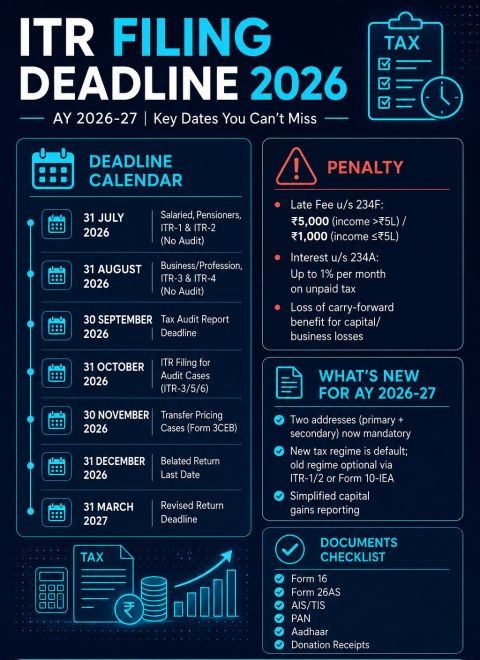
Table of Contents
ITR FILING DEADLINE 2026 AY 2026–27: Are You Ready?
Income Tax Return Filing Deadlines for AY 2026–27 in India. ITR FILING DEADLINE 2026 AY 2026–27..
Deadline Calendar 2026
Key Dates taxpayer Can’t Miss. lists important ITR-related due dates:
| Date | Applicable To |
| 31 July 2026 | Salaried individuals, pensioners, ITR-1 & ITR-2 (No Audit) |
| 31 August 2026 | Business/profession taxpayers, ITR-3 & ITR-4 (No Audit) |
| 30 September 2026 | Tax Audit Report Deadline |
| 31 October 2026 | ITR filing for audit cases (ITR-3/5/6) |
| 30 November 2026 | Transfer Pricing Cases (Form 3CEB) |
| 31 December 2026 | Belated Return – Last Date |
| 31 March 2027 | Revised Return Deadline |
Penalty Section:
Possible consequences of late filing:
- Late Filing Fee (u/s 234F): INR 5,000 if income exceeds INR 5 lakh and INR 1,000 if income is up to INR 5 lakh
- Interest (u/s 234A): Up to 1% per month on unpaid tax
- Other Consequence: Possible loss of carry-forward benefit for capital/business losses
- New tax regime is the default option; old regime can be chosen through ITR-1/2 or Form 10-IEA. Simplified capital gains reporting.
Documents Checklist for ITR Filing (AY 2026–27) – Detailed Guide
Filing your Income Tax Return (ITR) accurately requires collecting the right documents beforehand. Having these documents ready helps avoid mistakes, notices, delayed refunds, and mismatches in reported income.
Form 16 – Salary & TDS Certificate:
Salaried employees and pensioners receiving pensions through employers/banks (where applicable) are kind of taxpayers who require this. What does it contain, like gross salary received during the financial year, exemptions claimed (HRA, LTA, etc.), deductions under Chapter VI-A (80C, 80D, etc.), tax deducted at source (TDS), and net taxable income. Form 16 serves as the primary document for salaried taxpayers when filing ITR-1 or ITR-2. It helps ensure that salary income and TDS details are correctly reported.
Form 26AS – Tax Credit Statement:
Form 26AS is a consolidated tax statement available on the Income Tax Portal. It contains TDS deducted by employers, TDS deducted by banks, TCS (Tax Collected at Source), advance tax paid, self-assessment tax paid, and refund details. Before filing your return, match all TDS entries in Form 16 with Form 26AS. Any mismatch can result in Reduced tax credit, Tax demand notices and Refund delays
AIS (Annual Information Statement):
AIS provides a comprehensive view of a taxpayer’s financial transactions reported to the Income Tax Department. It may contain details of salary income, interest income, dividend income, securities transactions, mutual fund investments, property transactions, foreign remittances, and GST turnover (where applicable). The Income Tax Department uses AIS to cross-check information reported in your ITR. Omitting income appearing in AIS may trigger scrutiny or notices.
TIS (Taxpayer Information Summary)
TIS is a summarized version of AIS. Benefits are easier to understand than AIS, show categorized income details and help reconcile taxable income before filing. TIS provides a quick snapshot of information likely to be auto-populated in ITR forms.
PAN (Permanent Account Number):
PAN serves as the primary identifier for income tax purposes. Uses filing ITR, claiming refunds, matching tax credits, and tracking tax compliance. Ensure the PAN details match the information available on the Income Tax Portal.
Aadhaar Card
Importance of Aadhaar: Required for PAN-Aadhaar linkage, used for e-verification of ITR, and helps in processing refunds and tax-related communications. Before filing, verify the Aadhaar number, Name and date of birth consistency and PAN-Aadhaar linkage status. Any mismatch can cause filing or verification issues.
Donation Receipts
Applicable for taxpayers claiming deductions under Section 80G. Receipts should contain the name of the trust/institution, PAN of the institution (where applicable), registration number, donation amount, and date of donation. Without proper receipts, deduction claims may be disallowed during assessment.
Additional Documents Often Required
Apart from the checklist in the poster, taxpayers should also keep:
- For Bank Interest: Savings account interest certificates, Fixed Deposit (FD) interest certificates
- In case Capital Gains: Share transaction statements, Mutual fund statements and Property purchase and sale documents
- For House Property: Home loan interest certificate, Municipal tax receipts and Rental income records
- In case Business & Professional Income: Books of accounts, GST returns, Profit & loss account, and Balance Sheet
- For Tax Savings Deductions: Life insurance premium receipts, PPF contribution statements, ELSS investment statements, NPS contributions, and health insurance premium receipts.
In summary the following documents Checklist for ITR:
- Documents mentioned Form 16, Form 26AS, AIS/TIS, PAN, Aadhaar, and donation receipts. File Smart, File On Time. Taxpayer may notice that the 31 August 2026 deadline for non-audit business/profession cases differs from the traditional due date structure u/s 139(1). Since due dates can change through Finance Acts, CBDT notifications, or extensions
**********************************************************
If this article has helped you in any way, i would appreciate if you could share/like it or leave a comment. Thank you for visiting my blog.
Legal Disclaimer:
The information / articles & any relies to the comments on this blog are provided purely for informational and educational purposes only & are purely based on my understanding / knowledge. They do noy constitute legal advice or legal opinions. The information / articles and any replies to the comments are intended but not promised or guaranteed to be current, complete, or up-to-date and should in no way be taken as a legal advice or an indication of future results. Therefore, i can not take any responsibility for the results or consequences of any attempt to use or adopt any of the information presented on this blog. You are advised not to act or rely on any information / articles contained without first seeking the advice of a practicing professional.