Net Zero: Corporate Responsibility to Competitive Advantage
Table of Contents
Net Zero: From Corporate Responsibility to Competitive Advantage
Net Zero Is No Longer Optional
Climate change is no longer just an environmental issue; it is a business issue, an investment issue, and increasingly, a compliance issue. Around the world, companies are committing to Net Zero targets as governments, investors, customers, and regulators demand greater climate accountability. But what exactly does “net zero” mean, and why does businesses care?
What Is Net Zero?
Net Zero means that the total greenhouse gas emissions generated by an organization are balanced by an equivalent number of emissions removed, avoided, or offset. In simple terms:
Emissions Produced – Emissions Removed = Net Zero
- This does not mean a company produces absolutely zero emissions. Instead, it means that organizations first reduce emissions as much as possible and then neutralize unavoidable emissions through credible carbon removal or offset mechanisms.
- Global leaders such as Microsoft, Apple, Google, and Amazon have already announced ambitious Net Zero commitments, demonstrating that sustainability has become a mainstream business imperative.
Understanding Emissions: Scopes 1, 2 and 3
A company’s carbon footprint is generally divided into three categories:
Scope 1 – Direct Emissions
These arise from sources owned or controlled by the company, such as Company vehicles, Generators, Fuel combustion and Manufacturing processes
Scope 2 – Indirect Energy Emissions
These result from purchased energy, including Grid electricity, purchased heat, and Purchased cooling
Scope 3 – Value Chain Emissions
These include emissions generated by activities outside the company’s direct control, such as employee travel, supplier operations, product transportation, and customer use of products. For many businesses, Scope 3 emissions represent the largest portion of their carbon footprint.
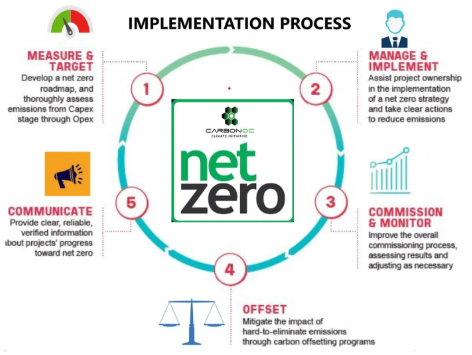
The Four-Step Net Zero Journey
Every successful Net Zero strategy generally follows four key stages:
- Measure: Quantify emissions across Scopes 1, 2, and 3.
- Reduce: Implement energy efficiency measures and switch to cleaner energy sources.
- Neutralize: Offset unavoidable emissions through credible carbon credits and environmental projects.
- Verify: Obtain independent assurance to validate emissions data and climate claims
A structured net-zero journey often involves the following:
- Setting organizational boundaries
- Collecting emissions data
- Calculating carbon footprints
- Independent verification
- Procuring offsets where necessary
- Achieving certification
Why Businesses Should Pursue Net Zero
- Supporting India’s Climate Commitment: India has pledged to achieve Net Zero by 2070, announced at COP26 in Glasgow. Businesses play a critical role in helping the country meet this target.
- Attracting Investors: Environmental, Social, and Governance (ESG) considerations increasingly influence investment decisions. Strong sustainability performance can improve investor confidence and access to capital.
- Building Trust and Brand Value: Consumers, employees, and stakeholders increasingly prefer organizations that demonstrate environmental responsibility.
- Future-Proofing the Business: Companies that act today are better positioned to manage Carbon taxation, Climate regulations, Supply-chain pressures and Cross-border sustainability requirements such as CBAM
Net Zero is no longer merely about compliance, it is about long-term competitiveness and resilience.
The Rise of Science-Based Targets (SBTi)
- The Science Based Targets initiative (SBTi) is widely regarded as the global benchmark for corporate climate target-setting.
- Established in 2015 by leading climate organizations including CDP, the United Nations Global Compact, WRI, and WWF, Science Based Targets initiative evaluates whether corporate climate goals align with the scientific requirements of limiting global warming to 1.5°C.
- Today, thousands of companies worldwide use Science Based Targets initiative validation to demonstrate the credibility of their climate commitments.
Science Based Targets initiative (SBTi) Net Zero Standard 2.0: A Shift Toward Accountability
One of the most significant developments in the sustainability space is the proposed update to the Science Based Targets Initiative Corporate Net Zero Standard. The key message is clear: The future is not about setting ambitious targets, it is about proving delivery
Major Changes Expected
- Accountability Over Ambition: Organizations will be required to demonstrate progress rather than merely announcing goals.
- Separate Targets for Each Scope: Independent targets may be required for Scope 1, Scope 2, and Scope 3 emissions.
- Mandatory Third-Party Assurance: External assurance will become increasingly important in validating emissions disclosures.
- Climate Transition Plans: Businesses will need documented road maps explaining how targets will be achieved. These changes signal a move toward greater transparency, rigor, and stakeholder confidence.
Opportunities for Chartered Accountants and Consultants
The Net Zero transition is creating significant opportunities for finance and consulting professionals.
- Carbon Accounting: Preparing Scope 1, 2, and 3 emission inventories.
- Decarbonization Strategy: Identifying emission hotspots and reduction pathways.
- Assurance and Verification: Supporting ISO 14064 and related sustainability assurance engagements.
- Carbon Credit Advisory: Evaluating, sourcing, and managing carbon offset programs.
- ESG Reporting: Assisting organizations with BRSR, GRI, ISSB, TCFD, and other reporting frameworks.
For chartered accountants, climate reporting is increasingly becoming an extension of financial reporting and governance.
Net Zero Starts at Home
Corporate sustainability is important, but individual actions matter too.
- Reduce Food Waste: Nearly one-third of food produced globally is wasted, creating substantial greenhouse gas emissions. Simple actions include Planning meals, Avoiding unnecessary purchases, Using leftovers efficiently and Composting food scraps
- Make Sustainable Fashion Choices : The fashion industry contributes significantly to global emissions. Practical steps include Buying fewer, higher-quality products, Repairing instead of replacing, Choosing second-hand clothing, washing in cold water and Air-drying garments when possible. Small lifestyle changes, when adopted collectively, can generate meaningful environmental impact.
Conclusion
The transition to Net Zero represents one of the most significant business transformations of our time. Organizations that begin their journey today will be better equipped to meet stakeholder expectations, attract investment, manage regulatory risks, and build long-term resilience.
For business leaders, finance professionals, and consultants alike, Net Zero is not merely an environmental agenda—it is a strategic agenda. The question is no longer whether companies should pursue Net Zero. The question is how quickly they can get there.
**********************************************************
If this article has helped you in any way, i would appreciate if you could share/like it or leave a comment. Thank you for visiting my blog.
Legal Disclaimer:
The information / articles & any relies to the comments on this blog are provided purely for informational and educational purposes only & are purely based on my understanding / knowledge. They do noy constitute legal advice or legal opinions. The information / articles and any replies to the comments are intended but not promised or guaranteed to be current, complete, or up-to-date and should in no way be taken as a legal advice or an indication of future results. Therefore, i can not take any responsibility for the results or consequences of any attempt to use or adopt any of the information presented on this blog. You are advised not to act or rely on any information / articles contained without first seeking the advice of a practicing professional.