Salary up to INR 12.75 Lakh? You May Still Need to Pay Tax
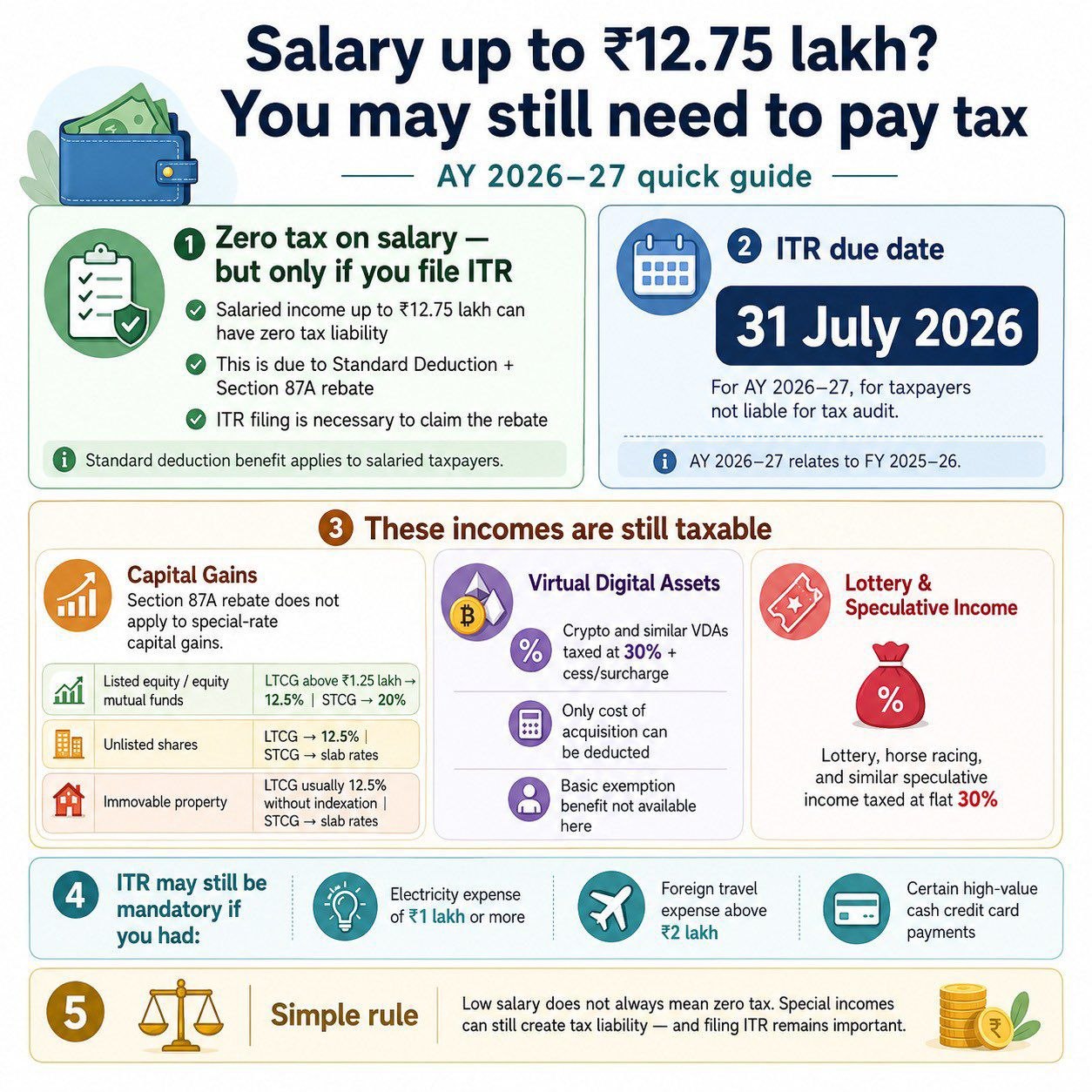
Table of Contents
Salary up to INR 12.75 lakh? You May Still Need to Pay Tax (AY 2026-27)
A salaried person earning up to INR 12.75 lakh may have zero tax liability under the New Tax Regime, but certain types of income can still attract tax.
1. Zero Tax on Salary up to INR 12.75 Lakh (Subject to Conditions)
A salaried taxpayer can effectively have nil tax liability up to INR 12.75 lakh because of the standard deduction, Rebate under Section 87A and benefits available under the applicable tax regime. However, filing the Income Tax Return is necessary to claim the rebate. The benefit is available on eligible salary income.
2. ITR Due Date:
For AY 2026-27 (FY 2025-26): ITR Due Date: 31 July 2026. Applicable to taxpayers who are not liable for tax audits.
3. Some Incomes Remain Taxable Even If Salary Is Below INR 12.75 Lakh
Capital Gains: Section 87A rebate generally does not apply to certain capital gains taxed at special rates. Examples:
Listed Equity Shares / Equity Mutual Funds
- Long-Term Capital Gains exceeding INR 1.25 lakh—Taxable at 12.5%
- Short-term capital gains – Taxable at 20%
Unlisted Shares
- Long-Term Capital Gains – 12.5%
- Short-term capital gains – Taxable at slab rates
Immovable Property
- Long-Term Capital Gains generally taxable at 12.5%
- Short-term capital gains taxable at slab rates
Virtual Digital Assets (Crypto Assets)
Income from cryptocurrency, digital tokens, and similar virtual digital assets (VDAs) is generally taxed at 30% + applicable cess and surcharge. Important points
- Only acquisition cost is allowed as a deduction.
- Basic exemption and rebate benefits are generally restricted for such income.
Lottery and Speculative Income
Income from lottery winnings, horse racing, and similar speculative activities is taxed at a flat 30% (plus applicable cess and surcharge). No normal rebate benefit is available against such special-rate income.
4. ITR May Still Be Mandatory
Even if tax liability is nil, return filing may be compulsory if you have:
- Electricity expenditure of INR 1 lakh or more during the year
- Foreign travel expenditure exceeding INR 2 lakh
- Certain high-value credit card or financial transactions
- Other specified reporting requirements under the Income Tax Act
If tax liability is nil after the Sect 87A rebate, should taxpayer still file a return
- A common misconception is that if your tax liability becomes nil after claiming the Section 87A rebate, you do not need to file an income tax return. However, the rebate only reduces your tax payable—it does not exempt you from filing the return.
- Income tax return filing is still mandatory if your gross total income exceeds the applicable basic exemption limit, and eligibility for the Section 87A rebate is available only after filing the return and claiming it.
- For AY 2026-27, a salaried individual under the new tax regime can have zero tax liability up to INR 12.75 lakh (including the INR 75k standard deduction benefit), but filing the income tax return remains important to claim the rebate, obtain refunds, carry forward losses, and maintain proof of income for loans, visas, and other financial purposes.
- While determining whether return filing is mandatory, the gross total income before claiming deductions u/s 80C, 80D, 80G, etc. is considered. Failure to file a mandatory return may attract a late filing fee u/s 234F, even if the final tax payable is nil.
Normally the deductions allowed for salary person New tax regime (AY 2026-27),
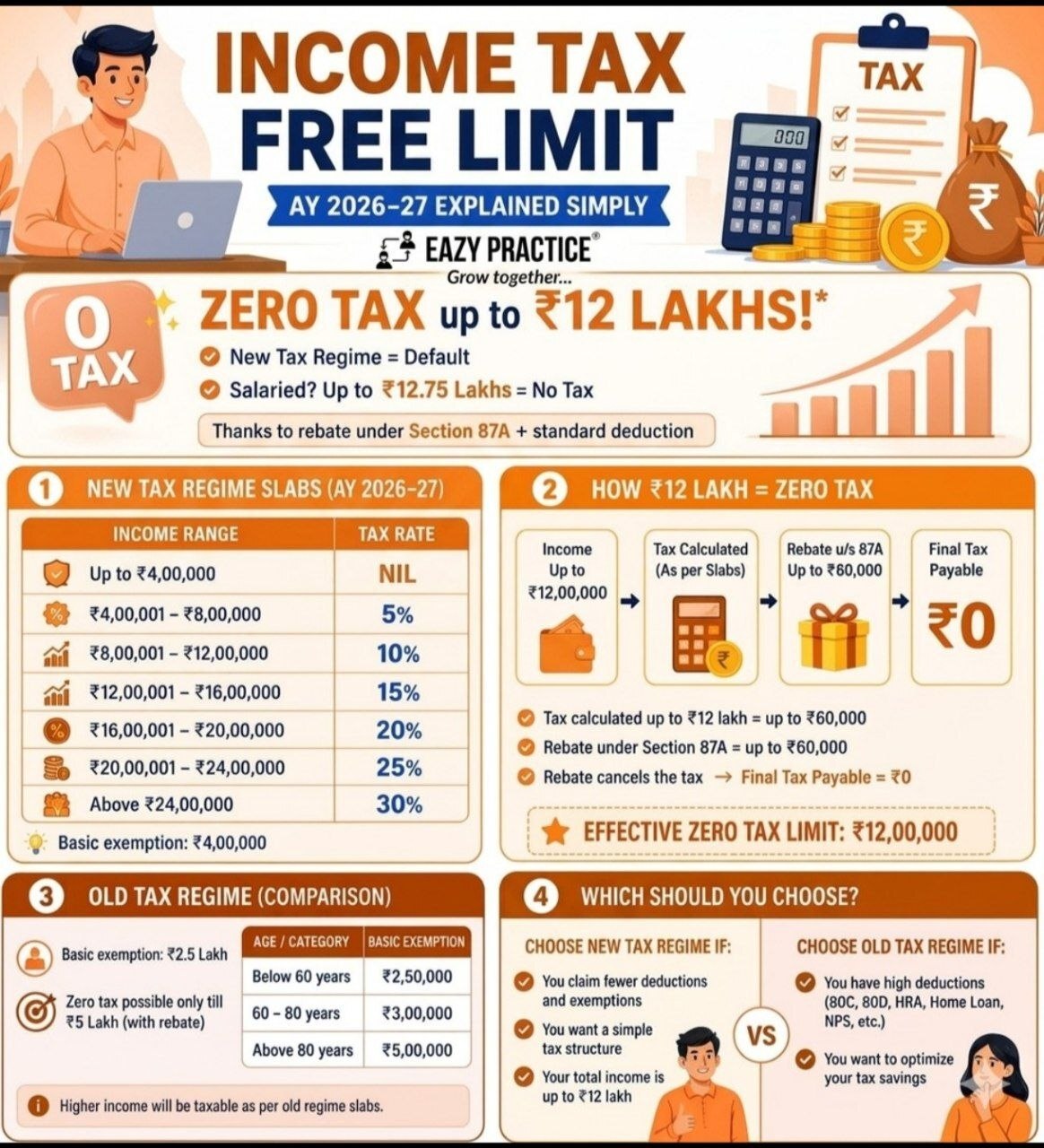
For a salaried employee under the new tax regime (AY 2026-27), the deductions mentioned by you are as follows:
| Particulars | Maximum Deduction/Exemption |
|---|---|
| Standard Deduction | INR 75,000 |
| Employer’s Contribution to NPS [Section 80CCD(2)] | Up to 14% of Salary (Basic + DA) for Central/State Govt and other eligible employees under the new regime |
| Conveyance Allowance for Official Duties | Fully exempt to the extent actually incurred for official duties |
| Daily Allowance for Official Trav | Fully exempt to the extent actually incurred for official travel |
For Conveyance Allowance and Daily Allowance, there is no fixed monetary ceiling prescribed. The exemption is restricted to the amount reasonably incurred and reimbursed for official purposes. Personal expenditure is not exempt.
Summary
Salary below INR 12.75 lakh does not automatically mean zero tax. While salary income may qualify for rebate and result in nil tax liability, incomes such as capital gains, crypto income, lottery winnings, and other special-rate incomes can still be taxable. Therefore, taxpayers should review all sources of income carefully and file their income tax return to claim eligible benefits and remain compliant.
**********************************************************
If this article has helped you in any way, i would appreciate if you could share/like it or leave a comment. Thank you for visiting my blog.
Legal Disclaimer:
The information / articles & any relies to the comments on this blog are provided purely for informational and educational purposes only & are purely based on my understanding / knowledge. They do noy constitute legal advice or legal opinions. The information / articles and any replies to the comments are intended but not promised or guaranteed to be current, complete, or up-to-date and should in no way be taken as a legal advice or an indication of future results. Therefore, i can not take any responsibility for the results or consequences of any attempt to use or adopt any of the information presented on this blog. You are advised not to act or rely on any information / articles contained without first seeking the advice of a practicing professional.