Form 16, Form 26AS & AIS – Which One Should You Rely On?
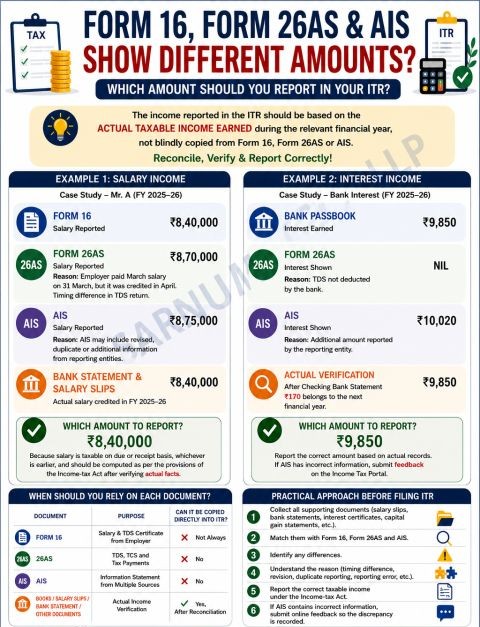
Table of Contents
Form 16, Form 26AS & AIS – Which One Should You Rely On?
One of the most common mistakes taxpayers make while filing ITR is assuming that the figures appearing in Form 16, Form 26AS, or AIS (Annual Information Statement) are always correct and identical. In reality, these documents serve different purposes and often contain different figures due to timing differences, reporting practices, corrections, and additional information sources. The ITR should ultimately be based on the correct taxable income as per the Income Tax Act, not merely on the figures appearing in any one statement.
Understanding the Three Documents
- Form 16 – Certificate Issued by Employer:
- Income tax Form Form 16 is issued by an employer to employees who have salary income and TDS deductions.
- It contains the following: Salary paid during the financial year, Exemptions claimed, Deductions under Chapter VI-A, Tax deducted and deposited by the employer, Form 12BA details, where applicable
- Purpose: Form 16 is primarily a salary and TDS certificate. It is useful for preparing the salary portion of the ITR but should not be treated as the sole source of information.
- Limitations: Form 16 may not reflect Interest income from bank deposits, Capital gains, Rental income, Income from other employers, foreign income, and Income reported after issuance of Form 16
Form 26AS – Tax Credit Statement
- Form 26AS is a consolidated tax credit statement maintained by the Income Tax Department. It contains the following: Tax Deducted at Source by employers, banks, customers, etc.; TCS collected; Advance tax paid, Self-assessment tax paid and Refunds received
- Purpose : Its primary purpose is to verify: Tax credits available, Tax Deducted at Source claimed in ITR, and taxes paid during the year
- Limitations : Form 26AS is not designed to determine your taxable income. Many income items may not appear in Form 26AS if No Tax Deducted at source, Reporting was delayed, Information has not yet been filed by the deductor
AIS (Annual Information Statement) : Annual Information Statement is the most comprehensive information statement available on the Income Tax Portal.
- It captures information from multiple reporting entities, including Salary, Savings bank interest, Fixed deposit interest, Dividend income, Securities transactions, Mutual fund transactions, Property transactions, foreign remittances, and GST turnover information in some cases
- Purpose: Annual Information Statement acts as an information and reconciliation tool. It helps taxpayers identify: Unreported income, Reporting mismatches, Transactions already available with the department
- Limitations : Annual Information Statement may contain duplicate entries, incorrect reporting, transactions belonging to another person, provisional information, and amounts reported on a gross basis rather than taxable basis. Therefore AIS should always be verified before relying on it.
Why Does the Difference Occur?
Common reasons include March salary paid in April, the revised tax deducted at source, return, duplicate reporting, and Reporting by multiple entities within a group
Why Differences Occur Between Form 16, 26AS, and Annual Information Statement
- Timing Differences: Examples: Salary for March paid in April, Interest credited after year-end
- Reporting Delays: Reporting entities may file statements later or revise earlier submissions.
- Revised Returns: Employers and banks often revise Tax Deducted at Source returns, creating variances.
- Additional Information Sources: AIS receives information from banks, registrars, mutual funds, stock exchanges, property registrars, and other reporting entities. Therefore, AIS may contain information absent in Form 16 and Form 26AS.
- Duplicate Reporting: The same transaction can sometimes appear more than once in AIS.
Recommended Approach Before Filing ITR
- Step-1: Collect Source Documents: Gather Salary slips, Form 16, Bank statements, Interest certificates, Capital gains statements, rent records, and Dividend statements
- Step-2: Download Form 16, Form 26AS, and Annual Information Statement: Compare all three with actual records.
- Step-3: Identify Differences: Investigate any mismatch instead of ignoring it.
- Step-4: Understand the Reason: Determine whether the difference arises due to Timing issues, Reporting errors, duplicate entries, and Revised reporting
- Step-5: Compute Correct Taxable Income: Apply the provisions of the Income Tax Act and compute income from salary, house property, business/profession, capital gains, and other sources.
- Step-6: Verify Tax Credits: Ensure Tax Deducted at Source claimed in the ITR matches Form 26AS.
- Step-7: Submit Annual Information Statement Feedback: Where AIS information is inaccurate, submit appropriate feedback on the portal to create a record explaining the discrepancy.
Form 16, Form 26AS, and Annual Information Statement are important reconciliation tools, but none of them independently determines your taxable income. The correct approach is: Reconcile ➝ Verify ➝ Compute ➝ Report
Your ITR should be based on the income that is actually taxable under the Income-tax Act, supported by books, salary records, bank statements, interest certificates, and other relevant documents. Proper reconciliation not only ensures accurate compliance but also significantly reduces the risk of future notices, scrutiny, and tax disputes.
**********************************************************
If this article has helped you in any way, i would appreciate if you could share/like it or leave a comment. Thank you for visiting my blog.
Legal Disclaimer:
The information / articles & any relies to the comments on this blog are provided purely for informational and educational purposes only & are purely based on my understanding / knowledge. They do noy constitute legal advice or legal opinions. The information / articles and any replies to the comments are intended but not promised or guaranteed to be current, complete, or up-to-date and should in no way be taken as a legal advice or an indication of future results. Therefore, i can not take any responsibility for the results or consequences of any attempt to use or adopt any of the information presented on this blog. You are advised not to act or rely on any information / articles contained without first seeking the advice of a practicing professional.