POSH Compliance & Workplace Safety Services
Table of Contents
POSH Compliance & Workplace Safety Services
The POSH Act, 2013 — At a Glance
POSH Act, 2013 was introduced to provide protection against sexual harassment of women at the workplace and for the prevention and redressal of related complaints. The Act came into force on 9th December 2013 and applies to every workplace in India across all sectors, including private companies, startups, government departments, NGOs, hospitals, educational institutions, and domestic workplaces.
The POSH Act stipulates that a woman shall not be subjected to sexual harassment at her workplace. Accordingly, it may be noted that for a woman to claim protection under the Act, the incident of sexual harassment should have taken place at the “workplace.”
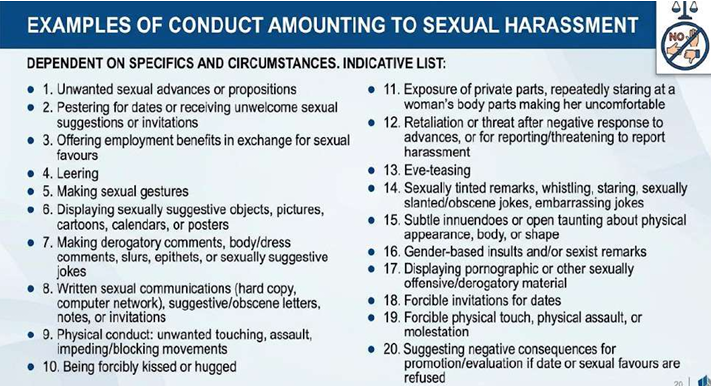
POSH Act defines ‘sexual harassment’ in line with the Supreme Court’s definition in the Vishaka Judgment. As per the Act, ‘sexual harassment’ includes unwelcome sexually tinted behaviour, whether directly or by implication, such as:
- Physical contact and advances;
- Demand or request for sexual favours;
- Making sexually coloured remarks;
- Showing pornography; or
- Any other unwelcome physical, verbal, or non-verbal conduct of a sexual nature.
Definition of ‘sexual harassment’ under Section 2(n) of the Act is wide enough to cover both direct and implied sexual conduct, whether physical, verbal, or written. The Act covers both quid pro quo harassment (where compliance is linked to employment benefits or threats) and hostile work environment harassment (where behaviour creates an intimidating, offensive, or humiliating atmosphere). A single incident can constitute harassment if it meets the statutory threshold.
The POSH Act mandates that all companies with more than 10 employees:
- Constitute the Internal Committee (IC); and
- Conduct POSH awareness among employees through training and by displaying posters on POSH, etc.
Governing Laws & Rules
- Sexual Harassment of Women at Workplace (Prevention, Prohibition & Redressal) Act, 2013 (“POSH Act”) was notified on 23rd April 2013.
- The Sexual Harassment of Women at Workplace (Prevention, Prohibition & Redressal) Rules, 2013 were notified on 9th December 2013.
This Act has three stated objectives — prevention, prohibition, and redressal. Prevention means stopping harassment before it occurs through awareness, policy, and training. Prohibition means enforcing zero tolerance, backed by defined consequences. Redressal means giving employees access to a fair, time-bound complaint mechanism.
Applicability of the POSH Act
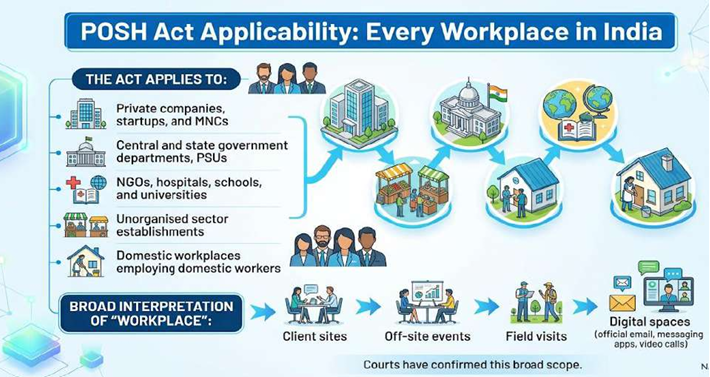
The Act applies broadly across:
- Private companies, startups, and multinational corporations;
- Central and state government departments and public sector undertakings;
- NGOs, hospitals, schools, and universities;
- Unorganised sector establishments; and
- Domestic workplaces employing domestic workers.
Courts have consistently confirmed a broad interpretation of “workplace,” extending it to client sites, off-site events, field visits, and digital spaces such as official e-mail, messaging apps, and video calls.
POSH Compliance & Workplace Safety Advisory
The Sexual Harassment of Women at Workplace (Prevention, Prohibition, and Redressal) Act, 2013 (“POSH Act”), was enacted to provide protection against sexual harassment of women at the workplace and to establish mechanisms for prevention, prohibition, and redressal of complaints. The Act applies to organizations across sectors and places responsibility on employers to maintain a safe, secure, and respectful workplace environment.
Why POSH Compliance Matters
POSH compliance is not merely a legal formality but an essential component of good corporate governance and risk management. Organizations that fail to comply may face regulatory penalties, reputational damage, employee grievances and attrition, litigation and legal exposure, and increased regulatory scrutiny. A robust POSH framework demonstrates an organization’s commitment to dignity, equality, and workplace safety.
Applicability of POSH Act
Compliance Requirements Under the POSH Act, 2013 — In Brief
- Constituting an Internal Complaints Committee (ICC) & Local Complaints Committee (LCC)
Every employer with 10 or more employees must constitute an Internal Complaints Committee (ICC) within the organization to handle complaints of sexual harassment. A Local Complaints Committee (LCC) is set up in each district to hear complaints from institutions with fewer than ten employees or where the complaint is against the employer himself.
Constituting an Internal Complaints Committee
The POSH Act applies to Companies, LLPs, partnership firms, start-ups, educational institutions, hospitals, NGOs, government bodies, and professional organizations. Every organization employing 10 or more employees is required to constitute an Internal Committee (IC).
The POSH Act mandates a minimum of four members for every IC, structured to prevent internal bias, corporate cover-ups, and power imbalances:
| Role | Statutory Requirement | Qualifications & Background |
| Presiding Officer | 1 Senior Female Employee | Must be a woman employed at a senior level at the workplace. If unavailable locally, she may be nominated from another office, division, or organisation of the same employer. |
| Employee Members | Minimum 2 Employees | Nominated from within the organisation, preferably with experience in social work, legal knowledge, or a demonstrated commitment to women’s causes. |
| External Member | 1 Independent Outside Expert | Nominated from an NGO/association committed to women’s rights, a legal practitioner, or a qualified specialist familiar with POSH legal frameworks. |
- Sexual Harassment Policy: The employer needs to prudently draft a sexual harassment policy and secure its approval from the Board of the Company. Basic details required to be captured while drafting a POSH policy include:
-
- ICC composition: names, designation, and contact details of the ICC members;
- Acts that constitute sexual harassment; and
- The process for resolution, settlement, prosecution, inquiry, and trial procedure.
- Committee Meetings: Convening meetings of the Internal Complaints Committee as and when required.
- Creating Awareness: Briefing employees (both male and female) about the Sexual Harassment Act, policy, and consequences thereof via orientation sessions or seminars.
- Filing of Annual Report Under the Act: The Internal/Local Committee, as the case may be, shall prepare an annual report in each calendar year and submit it to the employer and the District Officer.
- Complaints Reporting in the Annual Report : Disclosures regarding compliance with POSH laws are required, along with reporting the number of sexual harassment complaints received in a year, the number disposed of during the year, and cases pending for more than 90 days.
- Investigation of Complaints: Investigation of complaints made to the Committee and submission of a report thereto.
- Assistance by the Company: Assistance to the complainant in filing an FIR or complaint with the police, if required.
- Periodic Monitoring: Periodic monitoring of the performance and functioning of the IC.
- Sensitization Workshops and Seminars : Sensitisation workshops and seminars must be organised periodically to inform employees about their rights.
Complaint Redressal Mechanisms
The main objective of the POSH Act, 2013, is to provide a safe and secure environment to every woman, regardless of her age, designation, religion, or employment status, and to make the employer accountable for any complaint or grievance. By combining universal protection with strict institutional accountability, the POSH Act ensures that safe working conditions are treated not as a workplace perk but as a fundamental, legally protected human right.
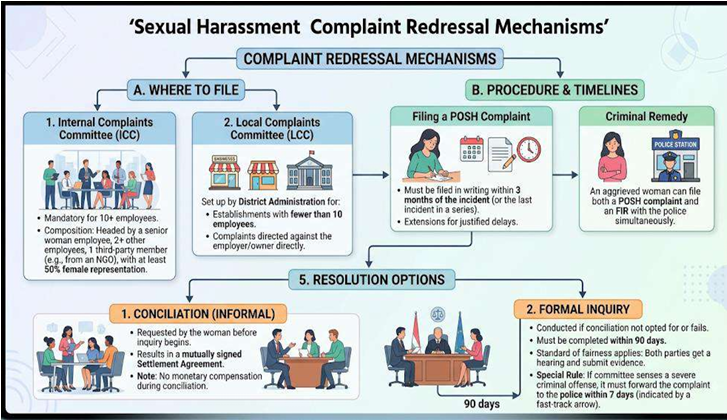
Where to File
-
- Internal Complaints Committee (ICC): Mandatory for any workplace/branch with 10 or more employees. Composition—headed by a senior woman employee, 2+ other employees, and 1 third-party member (e.g., from an NGO), with at least 50% female representation.
- Local Complaints Committee (LCC): Set up by the district administration for establishments with fewer than 10 employees, or complaints directed against the employer/owner directly.
Procedure & Timelines
-
- Filing Window: Must be filed in writing within 3 months of the incident (or the last incident in a series). Extensions are permitted for justified delays.
- Criminal Remedy: An aggrieved woman can file both a POSH complaint with the committee and an FIR with the police simultaneously.
Resolution Options
- Conciliation (Informal): Requested by the woman before an inquiry begins; results in a mutually signed Settlement Agreement. Note—no monetary compensation can be agreed upon during conciliation.
- Formal Inquiry: Conducted if conciliation is not opted for or fails. Must be completed within 90 days. A standard of fairness applies—both parties get a hearing and can submit evidence. If the committee senses a severe criminal offense at the outset, it must forward the complaint to the police within 7 days.
Powers of the Internal Committee & Local Committee
Under the POSH Act, 2013, the Internal Committee and Local Committee are vested with the powers of a Civil Court under the Code of Civil Procedure, 1908, while conducting an inquiry into a complaint of workplace sexual harassment. These judicial powers specifically include:
- Summoning & Attendance: Issuing summons to compel the attendance of any person and examining them under oath.
- Discovery of Evidence: Requiring the production and disclosure of relevant documents, records, or digital evidence.
- Prescribed Legal Matters: Exercising authority over any other legal or procedural matters as prescribed under the POSH Rules.
Punishment and Compensation Under the POSH Act, 2013
- Actions & Penalties Against the Perpetrator : Upon a finding of sexual harassment, the employer may impose penalties on the respondent based on the Internal Committee’s (IC) recommendations:
-
- Under Service Rules: Penalties as defined by the organisation’s existing service rules or disciplinary policy.
- Where No Service Rules Exist: Disciplinary measures including written apology, warning, reprimand, or censure; withholding of promotion, pay rises, or increments; termination from service; or mandatory counselling sessions or community service.
- Financial Deductions: Direct deduction of the compensation amount awarded to the aggrieved woman from the respondent’s salary/wages.
- Determination of Compensation : The Act provides for monetary compensation to the aggrieved woman. The IC determines the amount by evaluating:
-
- Distress & Trauma: Mental trauma, pain, suffering, and emotional distress endured.
- Career Impact: Loss of career or advancement opportunities resulting from the incident.
- Medical Expenses: Expenses incurred for physical or psychiatric treatment.
- Financial Capacity: Income and organisational status of the respondent.
- Payment Terms: Feasibility of payment via lump sum or structured instalments.
- Recovery Mechanism: If the respondent fails or refuses to pay the determined compensation, the IC can forward the recovery order to the concerned District Officer to recover the amount as an arrear of land revenue.
Other Statutes in India Pertaining to the Workplace Sexual Harassment:
Beyond the POSH Act, 2013, several other statutes in India address sexual harassment and related offenses in workplace or professional contexts:
-
The Bharatiya Nyaya Sanhita, 2023 (BNS)—Replaced the Indian Penal Code, 1860
-
- Section 74: Outrages the modesty of a woman using assault or criminal force.
- Under Section 75: Explicitly criminalizes sexual harassment, including unwelcome physical contact, demands for sexual favors, showing pornography against a woman’s will, or making sexually coloured remarks.
- Section 78: Penalizes stalking, including electronic/cyberstalking via e-mail, messaging apps, or social media.
- Under Section 79: Penalizes acts, words, or gestures intended to insult the modesty of a woman.
-
The Information Technology Act, 2000 (IT Act) :
Covers digital misconduct occurring over corporate e-mails, workplace communication tools (Slack, Teams, WhatsApp), or video calls:
-
- Section 66E: Violation of privacy (capturing or transmitting private images without consent).
- Sections 67 & 67A: Publishing or transmitting obscene or sexually explicit material in electronic form.
-
Industrial Employment (Standing Orders) Act, 1946
-
- Mandates that certified Standing Orders in industrial establishments define sexual harassment as a specific form of misconduct.
- Empowers management to initiate formal disciplinary proceedings and termination under service rules.
- Code on Occupational Safety, Health and Working Conditions, 2020 (OSH Code) : Mandates safe working environments for all employees, with specific provisions for women working night shifts (e.g., safe transportation, secure premises, and active POSH compliance).
- State-Specific Shops and Establishments Acts: Various state legislations (e.g., Maharashtra, Karnataka, Delhi) mandate that commercial establishments ensure safety and protection against sexual harassment for female employees, particularly during late-night hours.
- Tort Law & Civil Remedies: Victims may file civil suits claiming damages for emotional distress, loss of reputation, or wrongful termination arising from workplace harassment and employer negligence.
Employer’s Key Responsibilities
Employers are required to:
- Constitute Internal Committee (IC) : The Internal Committee must consist of one senior woman employee as presiding officer, a minimum of two employee members, one external member possessing relevant expertise and At least 50% women members
- Implement POSH Policy: Organizations must adopt and communicate a comprehensive POSH Policy covering the definition of sexual harassment, complaint mechanism, investigation process, confidentiality requirements, and disciplinary measures
- Conduct Awareness Programs: Regular training and sensitization sessions should be conducted for employees, senior management, HR teams, and internal committee members
- Complaint Redressal: Organizations must maintain an effective, impartial, and confidential grievance redressal mechanism.
- Annual Reporting : The Internal Committee is required to prepare and submit annual reports as prescribed under law.
Scope of Sexual Harassment
As defined under the POSH Act, sexual harassment may include Physical contact and advances, requests or demands for sexual favors, sexually colored remarks, display of inappropriate material, and unwelcome verbal, non-verbal, or physical conduct of a sexual nature.
The Act also covers hostile work environment situations and workplace conduct affecting dignity and safety.
POSH Advisory Services Provided by Rajput Jain & Associates
We assist organizations in establishing comprehensive POSH compliance frameworks, including:
- Compliance Review: POSH compliance assessment, gap analysis, risk identification, and compliance health checks
- Internal Committee Support: Assistance in the constitution of the Internal Committee, Review of committee composition, governance framework support, and documentation assistance
- Policy Drafting & Review: POSH policy drafting, policy review and updating, employee handbook integration and standard operating procedures
- Training & Awareness: Employee awareness programs, management workshops, internal committee training, and refresher training sessions
- Compliance Documentation: Annual report preparation support, compliance registers, documentation review, and record maintenance framework
- Investigation Support: Advisory during inquiry proceedings, documentation review, process compliance verification and Natural justice compliance review
Benefits of Effective POSH Compliance: Organizations implementing effective POSH systems benefit through Improved workplace culture, Enhanced employee confidence, Reduced legal exposure, Better governance standards, Stronger corporate reputation, Higher employee retention and improved regulatory compliance
Why Choose Rajput Jain & Associates
Our team provides practical and business-focused compliance support with emphasis on governance and risk management, regulatory compliance, audit and assurance perspective, documentation excellence, process-oriented compliance solutions, and confidential and professional handling.
Confidentiality in POSH Complaints: Best Practices
Operational Safeguards
- Strict Need-to-Know: Limit data access exclusively to authorised inquiry personnel.
- Labelling & Documentation: Mark all e-mails and files as “Strictly Confidential”; mandate signed NDAs for all participants.
- Physical & Digital Security: Conduct proceedings in private rooms, store physical files in locked cabinets/secure rooms, and enforce clean-desk rules.
- Sensitive Counselling: Advise complainants and respondents against public or open discussions regarding the inquiry.
- Offboarding Protocol: Retrieve all case files during exit interviews and re-emphasize ongoing non-disclosure obligations.
Virtual & Data Protection
- Secure Access: Avoid public Wi-Fi; encrypt electronic files and secure them with complex, periodically updated passwords.
- Screen & Device Hygiene: Lock unattended devices, use privacy screen filters, and refrain from working on case documents in public spaces.
- Safe Disposal: Wipe and physically destroy storage drives before retiring old hardware.
Policy & Awareness
- Policy Alignment: Incorporate explicit confidentiality clauses and breach penalties into the organisation’s POSH policy.
- Training: Regularly train IC members and handlers on proper protocols for managing sensitive data.
Why POSH Act Compliance Matters
The POSH Act legally obligates employers in India to establish robust mechanisms to prevent, address, and redress workplace sexual harassment. Non-compliance carries severe legal risks, operational disruptions, financial penalties, and potential cancellation of business licenses. Beyond basic regulatory compliance, an effective POSH training program:
- Promotes workplace safety: Establishes a zero-tolerance culture for inappropriate behavior.
- Encourages speak-up habits: Provides clear, safe, and confidential reporting channels.
- Mitigates organisational risk: Educates employees and management on legal protections and corporate liability.
Rajput Jain & Associates (Chartered Accountants) is a multidisciplinary professional services firm providing audit, assurance, taxation, regulatory compliance, risk management, and corporate advisory services to businesses across India. Office: P-6/90 (2nd Floor), Connaught Circus, Connaught Place, New Delhi – 110001, India Contact: +91-98113 22785, +91-95555 55480 E-mail: info@carajput.com
**********************************************************
If this article has helped you in any way, i would appreciate if you could share/like it or leave a comment. Thank you for visiting my blog.
Legal Disclaimer:
The information / articles & any relies to the comments on this blog are provided purely for informational and educational purposes only & are purely based on my understanding / knowledge. They do noy constitute legal advice or legal opinions. The information / articles and any replies to the comments are intended but not promised or guaranteed to be current, complete, or up-to-date and should in no way be taken as a legal advice or an indication of future results. Therefore, i can not take any responsibility for the results or consequences of any attempt to use or adopt any of the information presented on this blog. You are advised not to act or rely on any information / articles contained without first seeking the advice of a practicing professional.