DTAA Framework Explanation with Practical Understanding
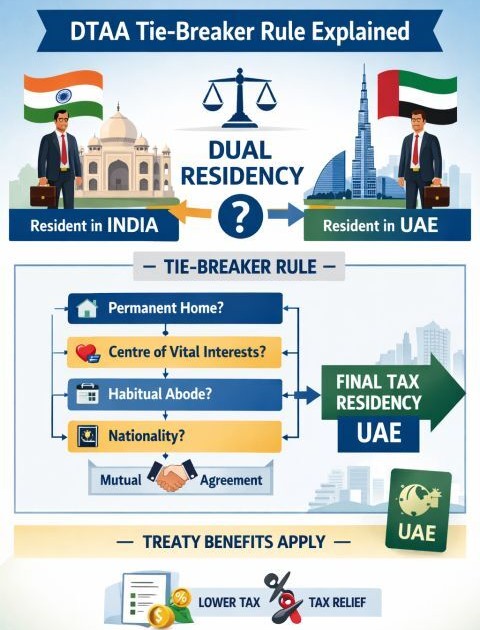
Table of Contents
DTAA Framework – Detailed Explanation with Practical Understanding
Introduction to DTAA:
A Double Taxation Avoidance Agreement (DTAA) is a tax treaty entered into between two countries to determine how income arising from cross-border transactions should be taxed. It ensures that the same income is not taxed twice in the hands of the same taxpayer. A Double Taxation Avoidance Agreement (DTAA) is a bilateral treaty between two countries that determines how income arising from international transactions will be taxed. Its primary purpose is to prevent the same income from being taxed twice in the hands of the same taxpayer.
Why is DTAA required?
In international transactions, two countries may simultaneously claim the right to tax the same income:
- Source Country: The country where income originates.
- Residence Country: The country where the taxpayer resides.
Permanent Establishment (PE)
PE is the backbone of international taxation. Permanent establishment determines whether a foreign company can be taxed in another jurisdiction. A foreign company becomes taxable in another country when it has a PE there.
- Fixed Place PE: Examples: Branch, Office, Factory, and Workshop. Example: A German company establishes an office in Mumbai. The Mumbai office may constitute PE.
- Agency PE: Occurs when a dependent agent habitually concludes contracts. Example : Indian agent signs contracts for a Japanese company. Agency PE may arise.
- Construction PE: Applies to construction projects and installation projects. Threshold: Generally: 6 months under UN Model treaties and 12 months under OECD Model treaties
- Service PE : Occurs when employees render services for a specified period. For example, US consultants stay in India beyond treaty threshold days. Service PE may arise.
Royalty and Fees for Technical Services (FTS):
Royalty: Payment for use of intellectual property.
- Examples: Patent, Copyright, Trademark, Design, Secret Formula, Know-how, and Industrial Equipment
- Example: An Indian company pays a US company for software license use. Such payment may qualify as royalty.
Fees for Technical Services (FTS):
Payments for technical services, consultancy services, and managerial services. Example: An Indian engineering company hires foreign experts. Payment may constitute FTS.
Objectives of DTAA
- Avoid double taxation of income. Avoid Double Taxation: The principal objective is to ensure that income is not taxed twice. An example of a dividend received by an Indian resident from a US company may be taxable in both countries. DTAA provides credit for taxes paid abroad.
- Prevent tax evasion and tax avoidance: Modern treaties include Exchange of Information provisions, Beneficial Ownership conditions, Principal Purpose Test (PPT), and Limitation of Benefits (LOB) clauses. These prevent treaty abuse.
- Promote Foreign Investment: Businesses are more willing to invest internationally when tax liabilities are predictable.
- Encourage International Trade: Cross-border business becomes easier because taxation rules become clear.
- Facilitate Information Exchange: Tax authorities can exchange information regarding offshore assets, foreign bank accounts, and cross-border transactions
- Encourage Economic Cooperation: DTAA promotes technology transfer, foreign collaborations, and international business expansion
Example: Suppose an Indian resident earns interest income from a US bank account:
- The USA may tax the interest because the income originates in the USA.
- India may tax the same interest because the recipient is an Indian resident.
Without a DTAA, the same income could be taxed twice. A DTAA allocates taxing rights and provides credit for taxes paid abroad.
Principles of International Taxation:
International taxation is built upon two fundamental concepts: International taxation is primarily based on two principles:
Source-Based Taxation:
Under this principle, the country where income originates gets the right to tax the income. Examples
| Income | Source Country |
| Salary earned in Dubai | UAE |
| Rent from London property | UK |
| Interest from US bank | USA |
| Royalty received from Indian company | India |
Advantages
- A country contributing to income generation gets revenue.
- Protects taxation rights of developing nations.
- Illustration: A German company earns royalty from India. Since royalty originates in India, India may levy tax on the payment.
Residence-Based Taxation:
Under this principle, a country taxes its residents on their worldwide income regardless of where it is earned. Example: Mr. A is an Indian resident.
| Income Source | Taxability in India |
| Indian Salary | Taxable |
| US Dividend | Taxable |
| UK Rental Income | Taxable |
| Singapore Interest | Taxable |
Since India follows global taxation for residents, all these incomes are generally taxable in India.
Important Concept
- Make Available Test: Applicable in several treaties including USA, UK, Canada, Singapore and Australia.
- Capital Gains under DTAA: Treatment varies across treaties:
- Fully Taxable: USA, UK and Canada
- Grandfathered Exemption: Mauritius, Singapore
- Partial Exemption: Hong Kong, Ireland and Luxembourg
- Participation Exemption: Denmark, Netherlands
Conditions for Treaty Benefits
- Tax Residency Certificate (TRC): Mandatory evidence of treaty residence.
- Beneficial Ownership: Required for concessional treaty rates.
- Principal Purpose Test (PPT): The transaction should have genuine commercial substance and not be primarily tax driven.
Types of Tax Treaties
Comprehensive DTAA: These cover almost all significant income categories. Examples
- India-USA DTAA
- India-UK DTAA
- India-Singapore DTAA
- India-Mauritius DTAA
- Covered Income: Business profits, dividends, interest, royalties, capital gains, salary, and independent services
Limited DTAA: These apply only to particular industries. Examples: Air Transport Agreements, Shipping Agreements, and Specialized Sector Arrangements
Tax Information Exchange Agreements (TIEA): TIEAs focus mainly on the exchange of information. Purpose: Detect tax fraud, track undisclosed assets, identify beneficial ownership, and combat black money. Examples: Cayman Islands and British Virgin Islands
Models of DTAA : Most treaties are based on one of three international models.
OECD Model Convention
Prepared by the Organisation for Economic Cooperation and Development. Features
- Favors residence-country taxation.
- Designed primarily for developed nations.
- Limited taxation rights for source countries.
- Example: Germany and France typically negotiate treaties based on OECD principles.
UN Model Convention
Prepared primarily for developing countries. Features
- Favors source-country taxation.
- Gives more taxing rights to developing countries.
- Most Indian DTAAs are influenced by this model.
- Benefit to India : India can retain greater taxation rights over income earned within India.
US Model Convention:
Used by the United States. Features,
- Strong anti-abuse measures.
- Extensive Limitation of Benefits (LOB) provisions.
- Detailed definitions and compliance requirements.
Eight-Step Framework for Applying DTAA:
This is the practical methodology followed by tax professionals.
- Step-1: Examine Domestic Law: First determine taxability under the Income-tax Act. Example : Royalty income may be deemed to accrue in India under Section 9.
- Step-2: Verify DTAA Availability: Check whether India has entered into a treaty with the relevant country. Examples: USA, UK, Germany, Singapore, Netherlands, and Mauritius
- Step-3: Verify Covered Taxes
- Generally Covered: Income Tax, Corporate Tax
- Generally Not Covered: GST, Customs Duty, Excise Duty,
- Step-4: Verify Treaty Applicability Period. Ensure treaty provisions were in force during the relevant assessment year.
- Step-5: Apply Treaty Definitions: Treaty definitions often differ from domestic law. Example: Software payment may be royalty under Indian law but not royalty under a specific DTAA.
| · Income Type | · DTAA Article |
| · Business Profits | · Article 7 |
| · Dividend | · Article 10 |
| · Interest | · Article 11 |
| · Royalty / FTS | · Article 12 |
| · Capital Gains | · Article 13 |
- Step-6: Identify Relevant Article
- Step-7: Determine Double Taxation Relief: Exemption Method: Income is taxed only in one country. Credit Method: Taxes paid abroad are allowed as credit. Example
- Indian Tax Liability = ₹500,000
- US Tax Paid = ₹2,00,000
- Foreign Tax Credit = ₹200,000
- Balance Tax Payable in India = ₹300,000
- Step-8: Apply Most Beneficial Provision: Section 90(2) provides: The taxpayer can choose whichever is more beneficial between the Income-tax Act and the DTAA. Example: Domestic law tax rate = 20%, DTAA rate = 10%, and the taxpayer can avail 10%.
Important DTAA Articles
- Article-4 – Residence: Determines treaty residency. Treaty benefits generally cannot be claimed without satisfying residence conditions.
- Article-5 – Permanent Establishment (PE) : Defines when a foreign business has sufficient presence in another country. PE is the foundation of international taxation.
- Article-7 – Business Profits: Business profits are taxable only in the residence country unless a PE exists. Example: A UK company supplies goods to India.
- Without PE: Profit taxable in the UK only.
- With PE : Profit attributable to PE is taxable in India.
- Article-10 – Dividends: Prescribes reduced withholding rates for dividend income.
- Article-11 – Interest: Provides concessional rates for interest income. Example:
| Particulars | Rate |
| Domestic Rate | 20% |
| DTAA Rate | 10% |
- Article-12 – Royalty and FTS: Covers Royalty and Fees for Technical Services (FTS). Usually taxed at lower treaty rates.
- Article-23 – Relief from Double Taxation: Provides a credit or exemption mechanism.
- Article-25 – Mutual Agreement Procedure (MAP) : Used for resolving treaty disputes between countries.
Make Available Test:
One of the most important concepts in DTAA interpretation. Applicable in treaties such as USA, UK, Canada, Singapore, and Australia.
Meaning: The service provider must transfer technical knowledge enabling the recipient to use the knowledge independently in the future. Merely performing a service is not enough.
-
- Example 1: Not Make Available: Foreign engineer repairs equipment. After leaving: Machine works and no knowledge is transferred Result: Not FTS under many treaties.
- Example 2: Make Available: Engineers train Indian staff. After training: Staff can undertake repairs independently. Result: Knowledge transferred; may qualify as FTS.
Capital Gains Under DTAA: Different treaties allocate rights differently.
Fully Taxable Regime: Examples are the USA, the UK, and Canada. Capital gains are generally taxable according to treaty provisions. Grandfathering Benefits Countries: Mauritius,
Capital Gains under DTAA:
Different treaties allocate taxing rights differently.
-
- Fully Taxable: USA, UK, and Canada. Capital gains are generally taxable under treaty provisions.
- Grandfathered Exemption: Mauritius, Singapore. Older investments enjoy grandfathering benefits.
- Partial Exemption: Hong Kong, Ireland, and Luxembourg. Certain instruments receive favorable treatment.
- Participation Exemption: Denmark, Netherlands. Exemption available on qualifying shareholdings.
Understanding the Tie-Breaker Rule under DTAA
In international taxation, it is possible for an individual or a company to be regarded as a tax resident in more than one country under the domestic tax laws of those countries. Such dual residency can result in the same income being taxed twice. To eliminate this conflict, Double Taxation Avoidance Agreements contain a tie-breaker rule, which determines the country of treaty residence for the purpose of applying DTAA benefits.
DTAA Tie-Breaker Test :
Where a person is resident in two countries:
- Step-1: Permanent Home
- Step-2: Center of Vital Interests
- Step-3: Habitual Abode
- Step-4: Nationality
- Step-5: Mutual Agreement Procedure (MAP)
These rules determine a single treaty residence for DTAA purposes.
Tie-Breaker Rule for Individuals
Where an individual qualifies as a resident of both contracting states, the DTAA applies a series of tests in a prescribed order to determine a single country of residence:
- Permanent Home Test: The individual is considered a resident of the country where a permanent home is available on a continuous basis.
- Centre of Vital Interests Test : If a permanent home exists in both countries, residency is determined based on where the individual’s personal and economic relationships are closer, such as family ties, employment, business activities, and investments.
- Habitual Abode Test: If the center of vital interests cannot be determined, the country where the individual habitually or more frequently resides is considered.
- Nationality Test: If the individual has a habitual abode in both countries or neither country, nationality becomes the deciding factor.
- Mutual Agreement Procedure (MAP) : Where residency still cannot be determined through the above tests, the competent authorities of both countries will resolve the matter through mutual consultation.
Tie-Breaker Rule for Companies
For entities and companies, modern tax treaties generally rely on the Place of Effective Management (POEM) or similar treaty mechanisms. POEM refers to the location where key management and commercial decisions necessary for conducting the business as a whole are, in substance, made. The country where the effective management is exercised is typically regarded as the company’s treaty residence.
Why Is the Tie-Breaker Rule Important?
- The tie-breaker rule does not alter a person’s residential status under domestic tax laws. Instead, it determines which country will be treated as the taxpayer’s resident state for DTAA purposes and consequently which country will have the primary taxing rights under the treaty. This provision plays a crucial role for Non-Resident Indians (NRIs), expatriates and globally mobile employees, foreign investors, multinational enterprises, and businesses operating across multiple jurisdictions
- A proper understanding of tie-breaker provisions helps taxpayers avoid double taxation, claim treaty benefits correctly, and ensure compliance with international tax regulations.
Conclusion
DTAA is the foundation of international taxation. It allocates taxing rights between countries, prevents double taxation, provides relief through foreign tax credits, regulates taxation of royalties, FTS, dividends, and capital gains, and resolves residency conflicts through tie-breaker rules. For any cross-border transaction, taxpayers should first analyze domestic law, then apply the relevant DTAA and claim whichever provision is more beneficial.
**********************************************************
If this article has helped you in any way, i would appreciate if you could share/like it or leave a comment. Thank you for visiting my blog.
Legal Disclaimer:
The information / articles & any relies to the comments on this blog are provided purely for informational and educational purposes only & are purely based on my understanding / knowledge. They do noy constitute legal advice or legal opinions. The information / articles and any replies to the comments are intended but not promised or guaranteed to be current, complete, or up-to-date and should in no way be taken as a legal advice or an indication of future results. Therefore, i can not take any responsibility for the results or consequences of any attempt to use or adopt any of the information presented on this blog. You are advised not to act or rely on any information / articles contained without first seeking the advice of a practicing professional.