Comparison of Penalty under I Tax Act 1961 vs I Tax Act 2025
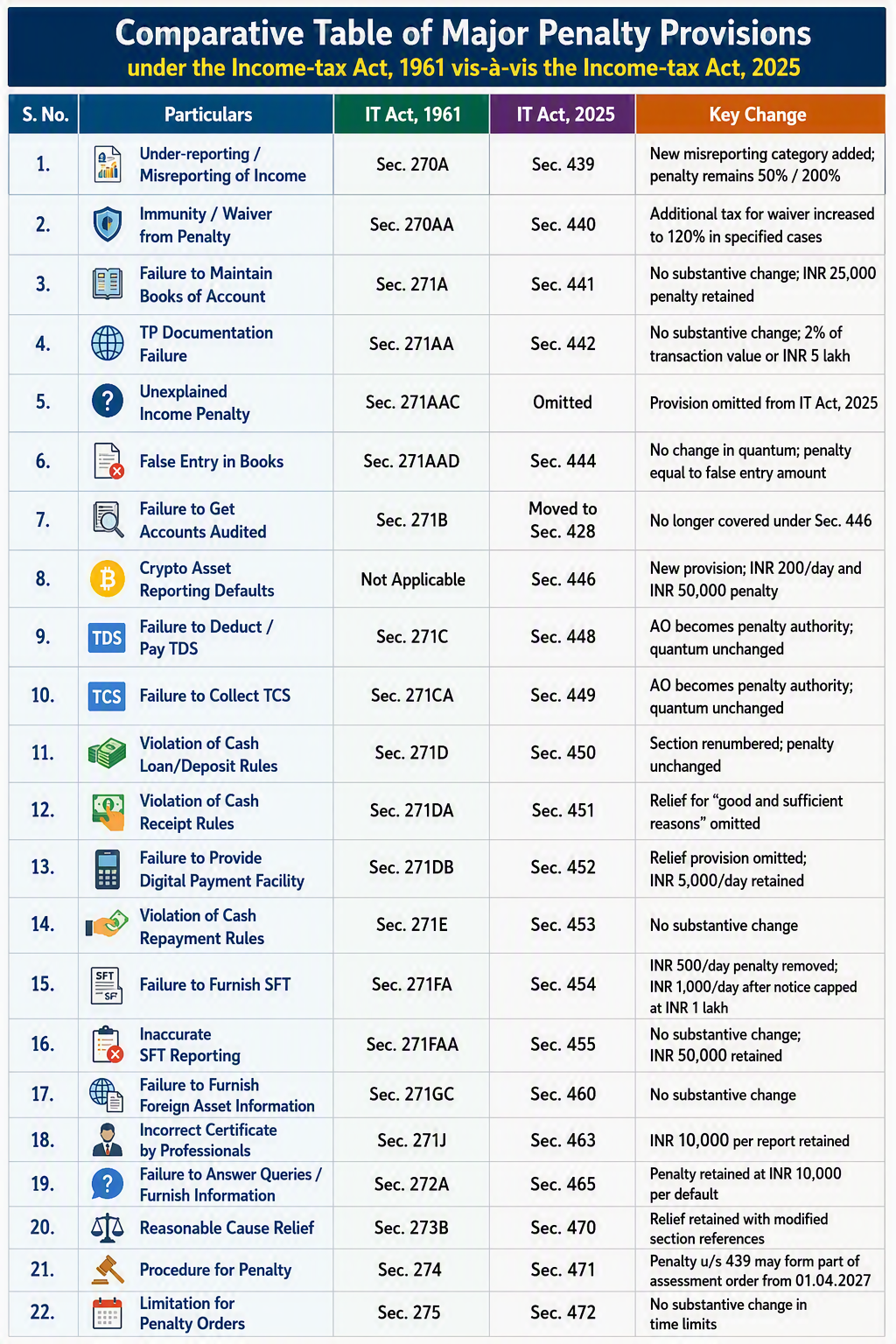
Table of Contents
Comparison of major penalty provisions under the Income-tax Act, 1961, vis-à-vis the Income-tax Act, 2025
The Income-tax Act, 2025 has reorganized and renumbered the penalty framework contained in Chapter XXI of the Income-tax Act, 1961. While most penalty provisions have been retained with minimal substantive changes, certain important modifications have been introduced concerning misreporting of income, waiver of penalties, crypto-asset reporting, SFT compliance, and the authority empowered to levy penalties.
Income Tax Act, 2025 vs. Income Tax Act, 1961
The Income-tax Act, 2025, is primarily a simplification, consolidation, and renumbering exercise. Most penalties are renumbered, not rewritten. Penalty quantum remains broadly unchanged across most provisions. The assessing officer becomes the principal penalty authority in several sections. Crypto-asset reporting emerges as a new compliance area. Reasonable cause protection is withdrawn in certain cash and payment-related defaults. SFT default penalties are rationalized with a maximum cap of INR 1 lakh. Procedural safeguards like hearing opportunity, show-cause notice and limitation periods continue under the new regime. While the penalty architecture broadly mirrors the Income-tax Act, 1961, notable changes have been introduced in misreporting cases, immunity provisions, crypto-asset reporting, SFT compliance, and penalty administration. Following are major changes introduced by the Income Tax Act, 2025
-
Penalty for Under-Reporting and Misreporting of Income
| Particulars | IT Act, 1961 (Sec. 270A) | IT Act, 2025 (Sec. 439) |
| Under-reporting of income | Penalty of 50% of tax payable on under-reported income | Penalty of 50% of tax payable on under-reported income |
| Misreporting of income | Penalty of 200% of tax payable on under-reported income | Penalty of 200% of tax payable on under-reported income |
Detailed Explanation: Section 270A of the 1961 Act introduced a distinction between under-reporting and misreporting of income. Under-reporting generally covers situations where assessed income exceeds returned income, reassessment results in higher income, or losses are reduced. Misreporting includes suppression of facts, false entries, bogus expenses, unrecorded investments, etc.
Under the new Act, Section 439 substantially retains the same penalty structure. However, a new seventh category of misreporting has been introduced by including income covered under Section 195(1)(b). Further, the exclusion available for certain search-related undisclosed income under the old law has been removed. The penalty rates remain unchanged at 50% for under-reporting and 200% for misreporting. Following are Key Takeaway
The compliance burden remains broadly unchanged, but the scope of misreporting has widened under the new law.
-
Immunity / Waiver from Penalty
| Particulars | IT Act, 1961 (Sec. 270AA) | IT Act, 2025 (Sec. 440) |
| Waiver available | Yes | Yes |
| Tax and Interest Payment | Mandatory | Mandatory |
| Additional tax for misreporting | 100% | 100% / 120% |
Detailed Explanation : The old law allowed an assessee to seek immunity from penalty and prosecution if:
- Tax and interest had been paid.
- No appeal was filed.
- Additional tax was paid where required.
The new Act continues this relief mechanism. However, where the penalty relates to the newly introduced misreporting category under Section 439(11)(g), waiver will be available only if the assessee pays 120% of the tax payable on under-reported income instead of the existing 100%.
Key Takeaway: the Government has increased the cost of obtaining immunity in specified cases of serious misreporting.
-
Failure to Keep, Maintain, or Retain Books of Account
| Particulars | Sec. 271A | Sec. 441 |
| Default | Failure to maintain books | Same |
| Penalty | INR 25,000 | INR 25,000 |
Detailed Explanation: The penalty applies where a person fails to maintain books of account as prescribed or fails to retain them for the prescribed period. The penalty continues to be INR 25,000. The only change is the corresponding reference under the new Act.
Key Takeaway : No substantive change. Only sectional renumbering.
-
Failure to Maintain Transfer Pricing Documentation
| Particulars | Sec. 271AA | Sec. 442 |
| Failure to Maintain Documents | 2% of transaction value | Same |
| Failure to Furnish Information | INR 5,00,000 | Same |
Detailed Explanation: The section applies to international and specified domestic transactions where:
- Documentation is not maintained.
- Transactions are not reported.
- Incorrect information is furnished.
The penalty structure remains identical under Section 442 of the new Act.
Key Takeaway : Only renumbering; no substantive amendment.
-
Penalty on Unexplained Income
| Particulars | Sec. 271AAC | IT Act, 2025 |
| Income u/s 68 to 69D | 10% of tax payable u/s 115BBE | Omitted |
Detailed Explanation : The old law imposed a penalty of 10% of tax payable on unexplained cash credits, investments and expenditures assessed under Sections 68 to 69D. Such penalty was in addition to tax under Section 115BBE. The equivalent provision has not been carried forward into the Income-tax Act, 2025.
Key Takeaway : This is one of the most notable omissions under the new Act.
-
Penalty for False Entry in Books
| Particulars | Sec. 271AAD | Sec. 444 |
| False Entry | Amount of false entry | Same |
| Omitted Entry | Amount omitted | Same |
Detailed Explanation : This penalty applies where:
- Fake invoices are recorded.
- Bogus documents are used.
- Transactions with non-existent parties are recorded.
- Income-related entries are deliberately omitted.
The penalty continues to be equal to the aggregate amount of such false or omitted entries.
Key Takeaway: No reduction or increase in penalty exposure.
-
Failure to Get Accounts Audited
| Particulars | ITA 1961 | ITA 2025 |
| Penalty | 0.5% of turnover or INR 1,50,000, whichever is lower | Shifted to Section 428 |
Detailed Explanation : Earlier governed by Section 271B. The Finance Act, 2026 has relocated the audit-related penalty provisions, and Section 446 is now used for crypto reporting defaults.
Key Takeaway: The audit penalty continues but under a different provision.
-
Crypto-Asset Reporting Default (New Provision)
| Particulars | ITA 1961 | Sec. 446 |
| Failure to Furnish Statement | NA | INR 200 per day |
| Inaccurate Reporting | NA | INR 50,000 |
Detailed Explanation: The new Act introduces a dedicated reporting framework for crypto-assets. Penalties may be levied for:
- Failure to submit prescribed statements.
- Furnishing incorrect information.
- Failure to perform prescribed due diligence.
Key Takeaway: A completely new compliance regime introduced under the 2025 Act.
-
TDS Default
| Particulars | Sec. 271C | Sec. 448 |
| Penalty | Equal to tax not deducted/paid | Same |
Major Change : The power to levy penalty is now with the Assessing Officer instead of the Joint Commissioner.
-
TCS Default
| Particulars | Sec. 271CA | Sec. 449 |
| Penalty | Equal to tax not collected | Same |
Major Change : Penalty authority shifted from Joint Commissioner to Assessing Officer.
-
Violation of Cash Loan / Deposit Restrictions
| Particulars | Sec. 271D | Sec. 450 |
| Penalty | Equal to amount accepted | Same |
Major Change : Only section renumbering and change in authority. Quantum unchanged.
-
Violation of Cash Receipt Restrictions
| Particulars | Sec. 271DA | Sec. 451 |
| Penalty | Equal to receipt amount | Same |
Major Change : The protection available where the taxpayer proved “good and sufficient reasons” has been removed.
-
Failure to Provide Digital Payment Facility
| Particulars | Sec. 271DB | Sec. 452 |
| Penalty | INR 5,000 per day | INR 5,000 per day |
Major Change : The defense of “good and sufficient reasons” has been omitted.
-
Violation of Cash Repayment Restrictions
| Particulars | Sec. 271E | Sec. 453 |
| Penalty | Equal to amount repaid | Same |
Major Change : No substantive change.
-
Failure to Furnish SFT
| Particulars | Sec. 271FA | Sec. 454 |
| Initial Delay | INR 500/day | Omitted |
| Post Notice Delay | INR 1,000/day | INR 1,000/day |
| Maximum Penalty | No cap | INR 1,00,000 cap |
Major Change : The penalty regime is simplified and capped at INR 1 lakh under the new Act.
-
Furnishing Inaccurate SFT
| Particulars | Sec. 271FAA | Sec. 455 |
| Penalty | INR 50,000 | INR 50,000 |
Major Change : Additional penalty of INR 5,000 per inaccurate reportable account retained.
-
Failure to Furnish Foreign Asset Information
| Particulars | Sec. 271GC | Sec. 460 |
| Up to 3 Months Delay | INR 1,000/day | Same |
| Beyond 3 Months | INR 1,00,000 | Same |
Major Change : No substantive amendment.
-
Incorrect Certificates by Professionals
| Particulars | Sec. 271J | Sec. 463 |
| Penalty | INR 10,000 per report | Same |
Covered Persons
- Chartered Accountants
- Merchant Bankers
- Registered Valuers
-
Failure to Answer Questions / Furnish Information
| Particulars | Sec. 272A | Sec. 465 |
| Penalty | INR 10,000 per default | Same |
Major Change : No substantive amendment.
-
Reasonable Cause Relief
| Particulars | Sec. 273B | Sec. 470 |
| Relief Available | Yes | Yes |
Major Change : The relief principle continues, though section references have been aligned with the new Act structure.
-
Procedure for Imposition of Penalty
| Particulars | Sec. 274 | Sec. 471 |
| Show Cause Notice | Mandatory | Mandatory |
| Opportunity of Hearing | Mandatory | Mandatory |
Major Change : From 01.04.2027, penalties under Section 439 may form part of the assessment or reassessment order itself. Certain faceless penalty provisions have not been reproduced.
-
Limitation for Passing Penalty Orders
| Particulars | Sec. 275 | Sec. 472 |
| Limitation Period | Six months from relevant quarter | Same |
Major Change : No substantive change. The limitation framework and timelines remain largely preserved.
Conclusion
The Income-tax Act, 2025, is primarily a restructuring and renumbering exercise rather than a major overhaul of penalty provisions. The key changes emerging from the presentation are as follows:
- Introduction of a new category of misreporting of income under Section 439.
- Immunity cost increased to 120% for specified misreporting cases.
- Crypto-asset reporting penalties introduced under Section 446.
- Section 271AAC omitted from the new legislation.
- Assessing Officer becomes the principal penalty authority in several provisions.
- “Good and sufficient reasons” defense removed in certain cash transaction and digital payment violations.
- SFT penalty rationalized with a maximum cap of INR 1 lakh.
- Most provisions continue with the same penalty quantum, indicating continuity rather than reform.
- Procedural safeguards such as show-cause notice, opportunity of hearing, approval requirements, and limitation periods have largely been preserved.
**********************************************************
If this article has helped you in any way, i would appreciate if you could share/like it or leave a comment. Thank you for visiting my blog.
Legal Disclaimer:
The information / articles & any relies to the comments on this blog are provided purely for informational and educational purposes only & are purely based on my understanding / knowledge. They do noy constitute legal advice or legal opinions. The information / articles and any replies to the comments are intended but not promised or guaranteed to be current, complete, or up-to-date and should in no way be taken as a legal advice or an indication of future results. Therefore, i can not take any responsibility for the results or consequences of any attempt to use or adopt any of the information presented on this blog. You are advised not to act or rely on any information / articles contained without first seeking the advice of a practicing professional.