TDS on Payments to Non-Residents U/s 393(2) (Earlier 195)

Table of Contents
TDS on Payments to Non-Residents—Sec. 393(2) (Earlier Section 195)
Section 393(2) (Earlier Section 195) of the Income Tax Act, 2025
- Section 393(2) of the Income Tax Act, 2025, has replaced the provisions of the erstwhile Section 195 of the Income Tax Act, 1961, with effect from 1 April 2026.
- It governs the deduction of tax deducted at source on payments made to non-residents and foreign entities, excluding salary income.
- The section applies to various types of income paid to non-residents, including interest, dividends, royalties, fees for technical services, capital gains, and other taxable sums. TDS is required only when the payment made or required to be deducted and then TDS is chargeable to tax in India.
- Section 393(2) lays down the provisions relating to tax deducted at source on specified payments made to non-residents, foreign companies, offshore funds, foreign institutional investors, and other prescribed non-resident recipients.
- This section ensures tax collection at the source on various types of income such as interest, business trust distributions, investment fund income, mutual fund income, securities income, and payments made to non-resident sportspersons and entertainers.
- The obligation to deduct Tax Deducted at Source arises only when the payment falls under one of the specified categories covered by Section 393(2) of the Income Tax Act, 2025.
When tds u/s 393(2) must be deducted
Who is responsible for TDS U/s 393(2)
- The responsibility to deduct TDS rests with the payer, whether it is an individual, HUF, partnership firm, company, NRI, foreign company, or any other entity. Even individuals and HUFs not subject to tax audit may be required to deduct TDS when making taxable payments to non-residents.
- Normally, tax must be deducted at the earlier of the date of credit of income to the payee’s account or the date of actual payment. However, in certain cases, such as specified interest payments made by the Government, public sector banks, or specified public financial institutions, Tax Deducted at Source is deducted only at the time of actual payment.
TDS Rates for Non-Residents—FY 2026-27 (Sec 393(2) of Income Tax Act, 2025)
| Nature of Payment | Earlier Section (IT Act, 1961) | New Section (IT Act, 2025) | TDS Rate FY 2026-27 | Key Remarks |
|---|---|---|---|---|
| Income of Non-Resident Sportspersons, Athletes & Entertainers | Sec. 194E | Sec. 393(2), Sl. No. 1 | 20% | Applies to sportspersons, entertainers and sports associations |
| Interest on Foreign Currency Loans / Long-Term Infrastructure Bonds | Sec. 194LC | Sec. 393(2), Sl. No. 2 | 5% | Concessional rate subject to conditions |
| Interest on Rupee-Denominated Bonds (Masala Bonds) | Sec. 194LC | Sec. 393(2), Sl. No. 3 | 5% | Applicable for eligible bonds |
| Interest on Listed Long-Term Bonds through IFSC | Sec. 194LC | Sec. 393(2), Sl. No. 4 | 4% / 9% | 4% for bonds issued between 01.04.2020 and 30.06.2023; 9% for bonds issued on or after 01.07.2023 |
| Interest from Infrastructure Debt Fund | Sec. 194LB | Sec. 393(2), Sl. No. 5 | 5% | Applicable to eligible infrastructure debt funds |
| Income from Units of Specified Fund in IFSC | Sec. 194LBB | Sec. 393(2), Sl. No. 6 | 10% | Income distributed by specified funds |
| Income from Investment Fund | Sec. 194LBB | Sec. 393(2), Sl. No. 7 | Rates in Force | Exempt portion excluded from TDS |
| Income from Securitisation Trust | Sec. 194LBC | Sec. 393(2), Sl. No. 8 | Rates in Force | Applicable on taxable income paid to non-residents |
| Income in respect of Units of Business Trust | Sec. 194LBA | Sec. 393(2), Sl. Nos. 9–11 | 5%, 10% or Rates in Force | Depends on nature of income distributed |
| Income from Specified Mutual Fund Units | Sec. 196A | Sec. 393(2), Sl. No. 10 | 20% | Lower DTAA rate may be available |
| Offshore Fund Income from Specified Units | Sec. 196B | Sec. 393(2), Sl. No. 13 | 10% | Long-term capital gains taxable at 12.5% |
| Income from Bonds / Global Depository Receipts (GDRs) | Sec. 196C | Sec. 393(2), Sl. No. 14 | 10% | Long-term capital gains taxable at 12.5% |
| Securities Income of Foreign Institutional Investors (FIIs) | Sec. 196D | Sec. 393(2), Sl. No. 15 | 20% | DTAA benefit available where applicable |
| Securities Income of Specified Funds | Sec. 196D | Sec. 393(2), Sl. No. 16 | 10% | Applicable to specified funds under Schedule VI |
| Other Interest or Any Other Sum Chargeable to Tax (excluding Salary) | Sec. 195 | Sec. 393(2), Sl. No. 17 | Rates in Force / DTAA Rate | Deduction depends on nature of income and applicable treaty benefits |
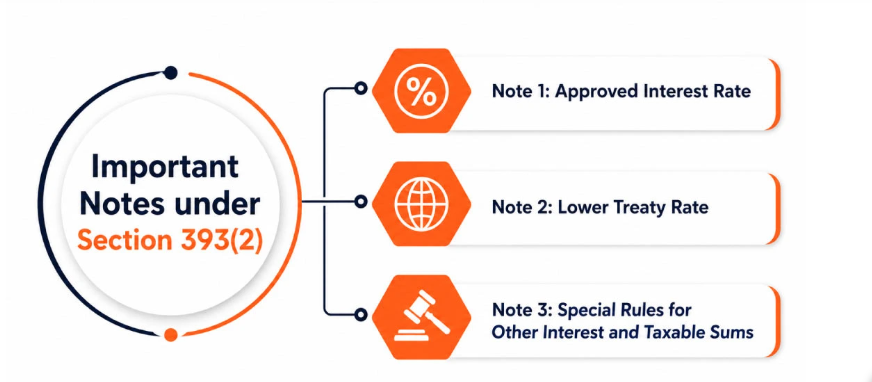
Important Notes: TDS is generally deducted at the earlier of credit or payment. Where a DTAA applies, the lower of the income tax Act rate or treaty rate may be claimed subject to a valid tax residency certificate and prescribed documentation. For payments covered under Sl. No. 17, TDS may be applicable even where the payer is a non-resident without any physical presence in India. Quarterly TDS reporting for non-resident payments is required in Form 144 (earlier Form 27Q).
What TDS rate U/s 393(2) ?
- The section prescribes different Tax Deducted at Source rates depending on the nature of income. For example, payments to non-resident sportspersons, entertainers, and sports associations attract tax deductions at source of 20%.
- Interest on specified foreign borrowings, infrastructure bonds, long-term bonds, and eligible rupee-denominated bonds may qualify for concessional tax-deducted-at-source rates ranging from 4% to 9%, subject to prescribed conditions.
- Income distributed by business trusts, investment funds, and securitisation trusts may be taxed at rates ranging from 5%, 10%, or the rates in force, depending on the nature of the income.
- Mutual fund income and securities income earned by FIIs are generally subject to tax deducted at source at 20%. However, eligible non-residents may claim a lower TDS rate under an applicable Double Taxation Avoidance Agreement by furnishing a valid Tax Residency Certificate and other prescribed documents, including Form 41 where applicable.
- Similarly, offshore fund income, Global Depository Receipts, bond income, and long-term capital gains on specified securities are taxed at separate prescribed rates.
- The law also allows eligible taxpayers to seek lower or nil Tax Deducted at Source deduction certificates u/s 395. To remain compliant, deductors must correctly identify the nature of the payment, determine the applicable Tax Deducted at Source rate, verify eligibility for treaty benefits, and timely file Form 144 for reporting non-salary payments made to non-residents.
- Proper classification, deduction, and reporting of tax help avoid disputes and ensure compliance with India’s non-resident taxation framework.
Non-residents can avail the benefit of a DTAA
- Non-residents can avail themselves of the benefit of a Double Taxation Avoidance Agreement, under which the lower of the Income Tax Act rate or treaty rate may be applied, subject to the furnishing of prescribed documents and tax residency proof. DTAA benefits help reduce tax liability and avoid double taxation. Key Highlights of Tax Deducted at Source u/s 393(2) (Earlier Section 195)
- Tax Deducted at Source on Eligible Bonds: Interest on eligible long-term or rupee-denominated bonds attracts Tax Deducted at Source at 4% for bonds issued between 1 April 2020 and 30 June 2023 and 9% for bonds issued on or after 1 July 2023, subject to specified conditions.
- The applicable TDS rate depends on the nature of income. Long-term capital gains generally attract 12.5% TDS, short-term capital gains under specified provisions attract 20% TDS, and interest, royalty, and technical service fees are generally taxed at 20%, while certain other incomes may be subject to 30% TDS, along with applicable surcharge and cess.
- Tax Deducted at Source on Interest Payments: The concessional 5% tax-deducted-at-source rate applies only to specified interest payments such as foreign currency borrowings, infrastructure bonds, long-term bonds, rupee-denominated bonds, and eligible infrastructure debt fund investments. Other interest payments are taxed at the applicable rates in force.
- Business Trust Distributions: Income distributed by a business trust may be subject to tax deducted at source at 5%, 10%, or the applicable rate, depending on the type of income and the provisions of Schedule V.
- Investment Fund Income: Tax Deducted at Source is deducted only on the taxable portion of income distributed by an investment fund to a non-resident. Any income exempt under Schedule V is excluded from tax deducted at source.
- Treaty Benefits for Mutual Fund Income: Although mutual fund income is generally subject to 20% tax deducted at source, non-residents may avail a lower rate under an applicable Double Taxation Avoidance Agreement by furnishing a valid tax residency certificate and prescribed documents.
- Offshore Fund Income: Income earned by an offshore fund from specified units is subject to 10% tax deducted at source, while long-term capital gains on the transfer of such units attract a 12.5% tax deducted at source.
- Tax Deducted at Source Liability of Non-Resident Payers: Under certain cases covered by Serial No. 17, the obligation to deduct Tax Deducted at Source may apply even to a non-resident payer who does not have a residence, business connection, or physical presence in India.
When DTAA is applicable
Where a Double Taxation Avoidance Agreement is applicable, a non-resident can benefit from the lower of the tax rate prescribed under the Income Tax Act or the DTAA rate. This helps ensure that the same income is not taxed twice and may reduce the overall TDS liability. The key advantages of claiming DTAA benefits include:
- Avoidance of double taxation on the same income.
- Lower TDS rates compared to domestic tax provisions.
- Exemptions or concessional treatment for specific categories of income, subject to prescribed conditions and documentation.
- As a result, non-residents can optimize their tax liability by availing treaty benefits after furnishing the required tax residency and supporting documents.
Conclusion
Section 393(2) establishes a comprehensive tax-deducted-at-source mechanism for payments made to non-residents and foreign entities. Since Tax Deducted at Source rates vary according to the type of income and recipient, payers must carefully assess the transaction before making payments. Proper application of TDS provisions, treaty benefits, and reporting requirements is essential for ensuring smooth tax compliance and avoiding penalties.
For compliance, deductors must report such transactions in Form 144 (earlier Form 27Q) and comply with prescribed remittance and documentation requirements, including Form 145 (earlier Form 15CA) and Form 146 (earlier Form 15CB), wherever applicable. Proper deduction and reporting of TDS are essential to avoid interest, penalties, and other compliance issues.
What IFCCL Offers:
- IFCCL assists with TDS compliance u/s 393(2). IFCCL can help with determining the correct TDS rate, reviewing the nature of payments, verifying challan details, preparing Form 144, and rectifying TDS filing errors.
- TDS return filing support for payments to non-residents: IFCCL offers end-to-end assistance, including document review, payment classification, TDS rate verification, return preparation and filing, and acknowledgement and compliance support.
**********************************************************
If this article has helped you in any way, i would appreciate if you could share/like it or leave a comment. Thank you for visiting my blog.
Legal Disclaimer:
The information / articles & any relies to the comments on this blog are provided purely for informational and educational purposes only & are purely based on my understanding / knowledge. They do noy constitute legal advice or legal opinions. The information / articles and any replies to the comments are intended but not promised or guaranteed to be current, complete, or up-to-date and should in no way be taken as a legal advice or an indication of future results. Therefore, i can not take any responsibility for the results or consequences of any attempt to use or adopt any of the information presented on this blog. You are advised not to act or rely on any information / articles contained without first seeking the advice of a practicing professional.