Guide to GST Registration : Circular No. 257/03/2026-GST
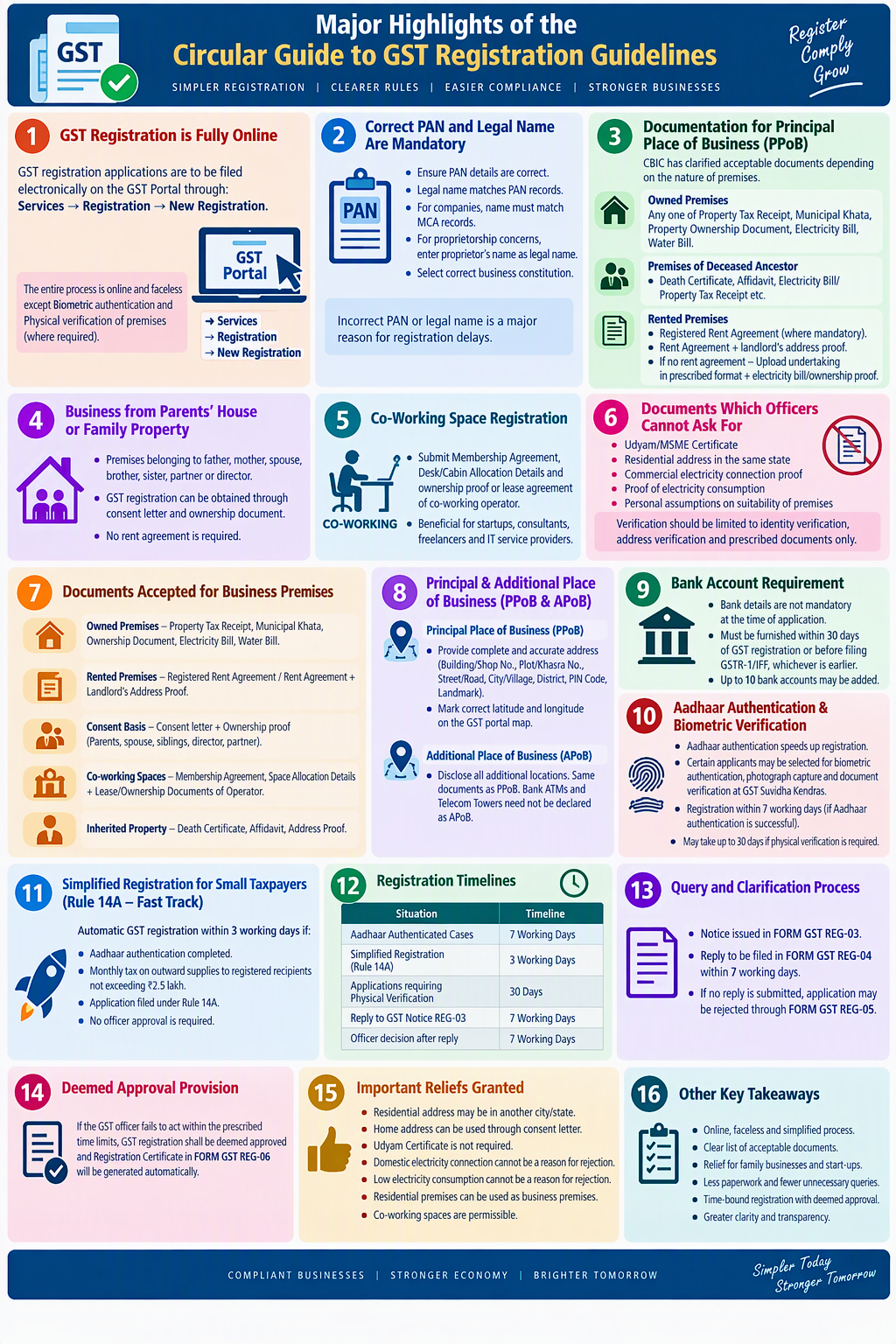
Table of Contents
Complete Guide to GST Registration Guidelines: Circular No. 257/03/2026-GST:
The CBIC has issued Circular-No-257-03-2026 dated 26 October 2026 to streamline the GST registration process, reduce unnecessary queries, and ensure faster registration for genuine taxpayers while preventing fake registrations.
Clear Eligibility for GST Registration
GST registration is required when the aggregate turnover exceeds the prescribed threshold:
- Goods Suppliers: INR 40 lakh
- Service Providers: INR 20 lakh
- Goods Suppliers in specified Special Category States: INR 20 lakh
- Service Providers in specified Special Category States: INR 10 lakh
Certain categories such as inter-state suppliers, casual taxable persons, non-resident taxable persons, TDS/TCS deductors, e-commerce operators, OIDAR service providers, etc., are required to obtain registration irrespective of turnover.
Why Was This Circular Issued?
- The government observed that many GST registration applications were being delayed or rejected because of Incomplete information, incorrect details in FORM GST REG-01, improper address proof, mismatches in PAN details, Unclear or illegible documents, and incorrect promoter or authorized signatory information.
- At the same time, CBIC noted the need to prevent fraudulent GST registrations used for fake ITC claims. Therefore, detailed guidelines have been prescribed for both taxpayers and officers.
- Prescribed GST Registration Forms
| Category | Form |
| Normal Taxpayer / ISD / Casual Taxable Person | GST REG-01 |
| TDS Deductor / TCS Collector | GST REG-07 |
| Non-Resident Taxable Person | GST REG-09 |
| OIDAR / Online Gaming Supplier | GST REG-10 |
| UN Bodies / Embassies | GST REG-13 |
- GST Registration applications are filed online through: GST Portal → Services → Registration → New Registration
Major Highlights of the Circular Guide to GST Registration Guidelines
-
GST Registration is Fully Online
GST registration applications are to be filed electronically on the GST Portal through: Services → Registration → New Registration. The entire registration process is online and faceless except Biometric authentication and Physical verification of premises (where required)
-
Correct PAN and Legal Name Are Mandatory
- Applicants must ensure PAN details are correct, Legal name matches PAN records, and In case of companies, the name must match MCA records and In proprietorship concerns, the proprietor’s name should be entered as legal name.
- So we can say that accurate PAN and Business Details are Critical : Applicants must ensure PAN and Legal Name exactly match PAN records, Companies must match MCA records, Proprietorship concerns should mention the proprietor’s name as the legal name, Correct business constitution must be selected, Incorrect PAN or legal name is one of the major reasons for registration delays.
-
Detailed Documentation for Principal Place of Business (PPOB)
One of the most important portions of the Circular relates to business address verification. CBIC has clarified acceptable documents depending upon the nature of premises.
-
Owned Premises
- Any one document is sufficient Latest Property Tax Receipt, Municipal Khata, Property Identification Document, Latest Electricity Bill and Latest Water Bill. The document must contain the same address as mentioned in GST registration application.
-
Premises Owned by Deceased Ancestor
- If business premises belong to a deceased parent or ancestor Upload: Death Certificate, Affidavit in prescribed format and Electricity Bill/Property Tax Receipt etc. of premises. This is a major relief for family businesses operating from inherited properties.
-
Rented Premises
- Where Registered Rent Agreement Exists Only registered rent agreement is required.
- Where Registration Not Mandatory Upload: Rent Agreement and Any utility bill/property document in landlord’s name
- No Rent Agreement Available : Now the Circular provides relief then Upload Undertaking in prescribed format and Electricity bill or ownership proof instead of formal lease agreement.
-
Business from Parents’ House or Family Property
- Many GST applications were earlier facing objections. CBIC has now clarified: Where premises belong to Father, Mother, Spouse, Brother, Sister, Partner and Director.
- GST registration can be obtained through Consent Letter, Ownership document of premises and No rent agreement is required.
-
Co-Working Space Registration
- Businesses operating from co-working spaces can obtain GST registration by submitting Membership Agreement, Desk/Cabin Allocation Details and Ownership proof of co-working operator or Lease agreement of co-working operator.
- This is beneficial for startups, consultants, freelancers, and IT service providers.
-
Documents Which GST Officers Cannot Ask For
- CBIC has specifically instructed officers not to seek unnecessary documents such as Udyam/MSME Certificate, Residential address in the same state, Commercial electricity connection proof, Proof regarding quantum of electricity consumption and Personal assumptions regarding suitability of premises
- The officer’s verification should be limited to Identity verification, Address verification, Required statutory documents. Nothing beyond the prescribed list should ordinarily be demanded.
Documents Accepted for Business Premises
The Circular categorizes documents based on possession of premises:
-
- Owned Premises: Any one of Property Tax Receipt, Municipal Khata, Property Ownership Document, Electricity Bill, Water Bill.
- Rented Premises: Registered Rent Agreement (where mandatory), Rent Agreement + Landlord’s Address Proof
- Consent Basis: Where property belongs to Parents, Spouse, Siblings, Director, Partner. A consent letter and ownership proof are sufficient.
- Co-working Spaces: Membership Agreement, Space Allocation Details and Lease/Ownership Documents of Operator
- Inherited Property: Death Certificate, Affidavit, Address Proof
- Principal Place of Business (PPoB) : The Circular emphasizes that complete and accurate business address details must be provided, including Building/Shop Number, Plot/Khasra Number, Street/Road, City/Village, District, PIN Code and Landmark. Incomplete addresses may result in clarification notices or physical verification. Applicants are also advised to correctly mark latitude and longitude on the GST portal map.
- Additional Place of Business (APoB) : All additional business locations should be disclosed. The same documentation requirements applicable for Principal Place of Business apply to Additional Places of Business. However Bank ATMs and Telecom Towers need not be declared as Additional Place of Business.
- Bank Account Requirement: Bank details are not mandatory at the time of application. However, details must be furnished Within 30 days of GST registration, or Before filing GSTR-1/IFF, whichever is earlier. Up to 10 bank accounts may be added.
-
Aadhaar Authentication Speeds Up Registration via Aadhaar Authentication & Biometric Verification
- Applicants are encouraged to complete Aadhaar Authentication. Certain applicants may be selected for Biometric Authentication, Photograph Capture, Original Document Verification at GST Suvidha Kendras. Failure to complete the process within the prescribed period may lead to processing delays.
- Aadhaar Authentication: If Aadhaar Authentication is successfully completed: Registration should be processed within 7 working days from the date of application. Where Aadhaar Authentication is not opted, Aadhaar Authentication fails, Application is selected for risk verification. Physical verification may be conducted, and registration can take up to 30 days.
- Biometric Verification: Certain applicants may be selected through risk parameters for Biometric Aadhaar Authentication, Photograph Capture and Original Document Verification. Such applicants must visit the designated GST Facilitation Centre.
-
Simplified GST Registration for Small Taxpayers
Rule 14A – Fast Track GST Registration
-
- Automatic GST Registration within 3 Working Days : Following Conditions like Aadhaar Authentication completed, Monthly ITC passed to registered recipients not exceeding INR 2.5 lakh, Application filed under Rule 14A. No officer approval is required in such cases.
- Small businesses can opt for a simplified registration mechanism under Rule 14A. An important feature highlighted in the Circular is Rule 14A. Small businesses can obtain. Fast Track GST Registration Conditions:
- Aadhaar Authentication completed.
- Monthly tax on outward supplies to registered recipients not exceeding INR 2.5 lakh.
- Registration requested under Rule 14A.
- Eligible applicants may receive GST registration within 3 working days without officer intervention
-
Registration Timelines
| Situation | Timeline |
| Aadhaar Authenticated Cases | 7 Working Days |
| Simplified Registration under Rule 14A | 3 Working Days |
| Applications requiring Physical Verification | 30 Days |
| Reply to GST Notice REG-03 | 7 Working Days |
| Officer decision after reply | 7 Working Days |
-
Query and Clarification Process
If the officer requires clarification, Notice issued in
-
- FORM GST REG-03 : Applicant must respond through:
- FORM GST REG-04 : within: 7 working days.
If no reply is submitted: Application may be rejected through: FORM GST REG-05.
Important Reliefs Granted :
CBIC has specifically clarified that GST officers should not object merely because Residential address is in another city/state, Electricity connection is domestic, Electricity consumption is low, Business is proposed from residential premises, and Applicant does not have Udyam/MSME registration. These grounds cannot be used as reasons for rejection.
-
Deemed Approval Provision
- A significant taxpayer-friendly provision reiterated by the Circular is If the GST officer fails to act within the prescribed statutory time limits, GST registration shall be deemed approved and Registration Certificate in FORM GST REG-06 will be generated automatically.
- The GST Circular reiterates that If the officer fails to take action within the prescribed statutory period, the GST registration shall be deemed approved and Registration Certificate in FORM GST REG-06 will be generated automatically.
Restriction on GST Officers :
The Circular specifically directs officers not to Ask for MSME/Udyam Certificate, Raise objections because the business runs from a residence, Raise objections due to domestic electricity connections, Question low electricity consumption, Ask for documents beyond prescribed requirements and finally Officers should restrict scrutiny to identity, address verification and prescribed documents only.
-
Important Relief for Taxpayers
Clarification Notices: Where clarification is required Notice issued in FORM GST REG-03, Reply to be filed in FORM GST REG-04 within 7 working days. If no response is submitted or deficiencies remain unresolved, the application may be rejected through FORM GST REG-05. The Circular specifically clarifies:
- Residential addresses may be in another city or state.
- Home address can be used through consent letter.
- Udyam Certificate is not required.
- Domestic electricity connection cannot be a reason for rejection.
- Low electricity consumption cannot be a reason for rejection.
- Residential premises can be used as business premises.
- Co-working spaces are permissible.
Key Takeaways for Chartered Accountants and Businesses
- GST registration process is now more standardized and transparent.
- Officers cannot ask for irrelevant or additional documents.
- Residential premises can be used for GST registration.
- Co-working spaces are recognized as valid business locations.
- Match PAN, Legal Name and Constitution correctly.
- Ensure complete address with PIN Code and landmark.
- Upload clear and legible documents.
- Use prescribed consent letter where property belongs to family members.
- Aadhaar authentication should be completed to obtain faster approval. Aadhaar Authentication significantly speeds up registration.
- Reply to REG-03 notices within 7 working days.
- Officers cannot demand documents beyond those prescribed in the Circular.
- Fast-track registration available under Rule 14A. Small businesses may opt for Rule 14A and get GST registration in 3 working days.
- Bank account details can be submitted after registration.
- Deemed approval protection continues for applicants.
Conclusion
- 257/03/2026-GST is a taxpayer-friendly reform aimed at reducing litigation and unnecessary objections during GST registration.
- Circular standardizes documentation requirements, restricts arbitrary queries by officers, recognizes modern business models such as co-working spaces and home offices, and introduces faster registration timelines through Aadhaar authentication and Rule 14A.
- The Circular balances ease of doing business with fraud prevention by prescribing uniform documentation standards, restricting arbitrary objections by officers, recognizing modern business structures, and ensuring time-bound registration approvals. For taxpayers, Chartered Accountants, and GST practitioners, compliance with these guidelines can significantly reduce registration delays and litigation.
- Genuine taxpayers should experience a much smoother and faster registration process if applications are filed in accordance with these guidelines
-
Registration Processing Timelines
| Situation | Time Limit |
| Rule 9A Automatic Registration | 3 Working Days |
| Rule 14A Simplified Registration | 3 Working Days |
| Aadhaar Authenticated Cases | 7 Working Days |
| Cases requiring Physical Verification | 30 Days |
| Reply to REG-03 Notice | 7 Working Days |
| Decision after REG-04 Reply | 7 Working Days |
**********************************************************
If this article has helped you in any way, i would appreciate if you could share/like it or leave a comment. Thank you for visiting my blog.
Legal Disclaimer:
The information / articles & any relies to the comments on this blog are provided purely for informational and educational purposes only & are purely based on my understanding / knowledge. They do noy constitute legal advice or legal opinions. The information / articles and any replies to the comments are intended but not promised or guaranteed to be current, complete, or up-to-date and should in no way be taken as a legal advice or an indication of future results. Therefore, i can not take any responsibility for the results or consequences of any attempt to use or adopt any of the information presented on this blog. You are advised not to act or rely on any information / articles contained without first seeking the advice of a practicing professional.