Buying Property from an NRI? No TAN Required from 1 Oct 2026
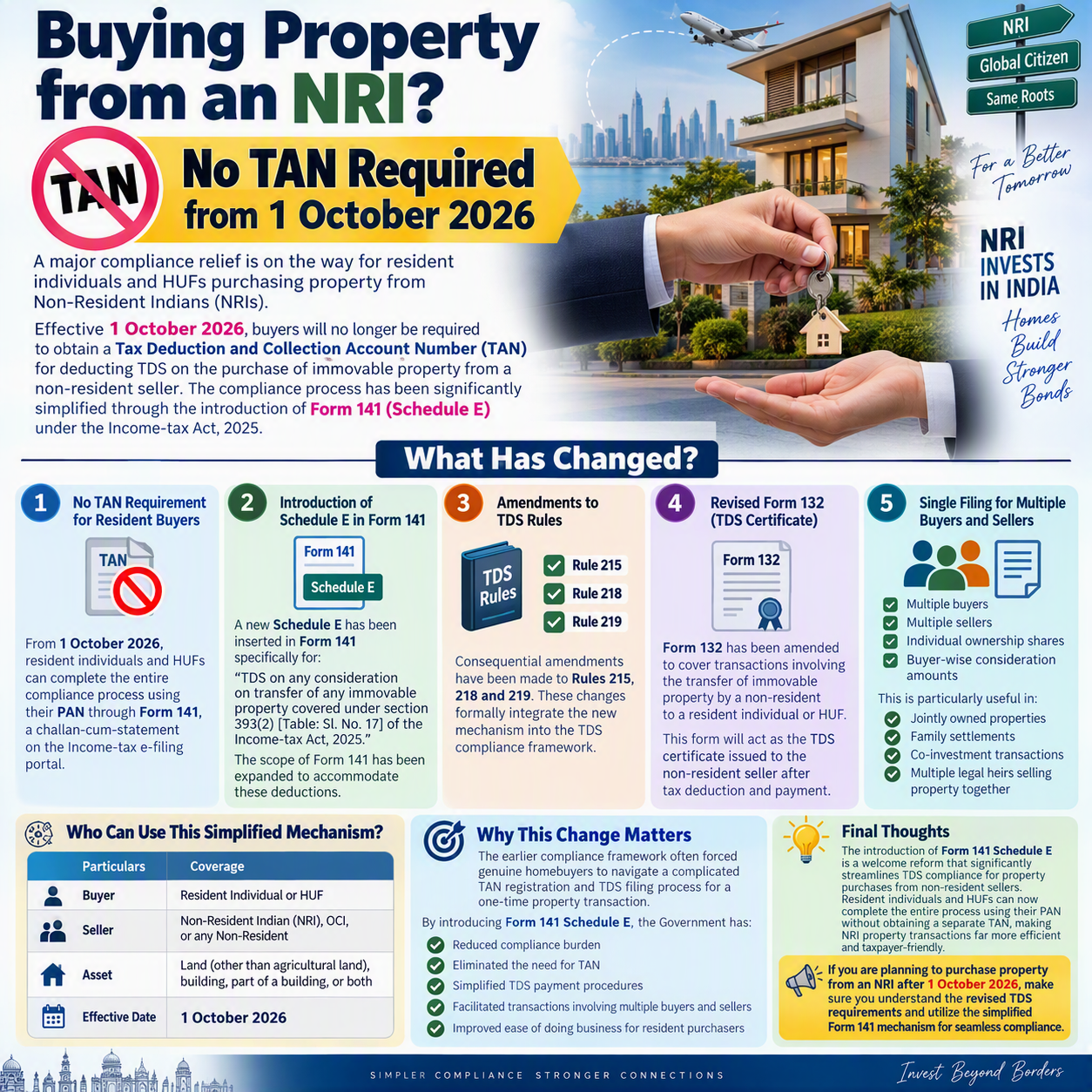
Table of Contents
Buying Property from an NRI? No TAN Required from 1 October 2026 – Complete Guide to Form 141 Schedule E
- Buying property from a Non-Resident Indian (NRI) or any other non-resident has always come with heavier TDS paperwork than buying from a resident seller. From 1 October 2026, that changes significantly.
- The Central Board of Direct Taxes has notified the Income-tax (Fifth Amendment) Rules, 2026 through Notification No. 121/2026 [G.S.R. 830(E)] dated 22 September 2026. It introduces a PAN-based, TAN-free compliance route for resident individuals and Hindu Undivided Families (HUFs) who buy immovable property from non-resident sellers.
The Problem Before This Amendment
- When a resident buyer purchased property from a non-resident seller, the buyer had to obtain a Tax Deduction and Collection Account Number (TAN), deduct and deposit TDS, file a quarterly TDS return, and issue a TDS certificate to the seller.
- For an individual making a one-time property purchase, getting a TAN just for a single transaction was time-consuming, costly and often confusing. Purchases from resident sellers already had a simpler PAN-based challan route. The new amendment brings non-resident transactions closer to that simplicity.
What Has Changed: Key Highlights
- TAN No Longer Required
Resident individual and HUF buyers no longer need to obtain a TAN to deduct TDS on property bought from a non-resident. The entire compliance can be completed using the buyer’s PAN through Form 141, which works as a challan-cum-statement on the income-tax e-filing portal.
- New Schedule E in Form 141
A dedicated Schedule E has been inserted in Form 141, titled “TDS on any consideration on transfer of any immovable property covered under section 393(2) [Table: Sl. No. 17]” of the Income-tax Act, 2025. The heading of Form 141 has also been expanded to cover these deductions.
- Amendments to Rules 215, 218 and 219
Rule 215 has been amended to include these deductions. Corresponding changes have been made in Rules 218 and 219.
- Revised Form 132 (TDS Certificate)
Form 132 has been amended to cover transfers of immovable property by a non-resident to a resident individual or HUF. It serves as the TDS certificate issued to the non-resident seller.
- Multiple Buyers and Sellers in One Filing
Schedule E captures details of all buyers and all sellers in the same transaction, along with each buyer’s share of the total consideration. This is especially useful for jointly-owned properties and family transactions.
Who Does This Apply To?
| Particulars | Covered |
| Buyer | Resident Individual or HUF |
| Seller | Any non-resident (NRI, OCI, or foreign national) |
| Asset | Immovable property: land (other than agricultural land), building or part of a building, or both |
| Effective date | 1 October 2026 |
Note: The new route is available to resident individuals and HUFs. Other buyers, such as companies, firms and LLPs, should continue to follow the regular TAN-based TDS process.
Step-by-Step Compliance Timeline
- Step 1 – Deduct TDS: Deduct tax at the applicable rate at the time of payment or credit, whichever is earlier, for each installment.
- Step 2 – Deposit and Report via Form 141 (Schedule E): Deposit the TDS and file Form 141 within 30 days from the end of the month in which the tax is deducted.
- Step-3 – Issue Form 132 to the Seller: Issue the TDS certificate in Form 132 within 15 days from the due date of filing Form 141, as prescribed under Rule 215.
Delays can attract interest, late fees and penalties under the Income-tax Act, 2025, so buyers should treat these timelines strictly.
Information Required in Schedule E
Keep the following ready before filing.
Property Details
- Complete address of the property
- Type of property: land (other than agricultural land), building or part thereof, or both
- Stamp duty value, including the proportionate value where there are multiple parties
Buyer Details
- Name and PAN of every buyer
- Each buyer’s share of the total sale consideration
Seller Details
- Name and PAN of the non-resident seller (where available)
- Residential status of the seller
Transaction and Payment Details
- Total sale consideration
- Date of agreement and date of registration
- Amounts paid in earlier instalments
- Amount paid or credited in the current installment and its date
Capital Gains and TDS Details
- Nature of capital gains (short-term or long-term)
- Amount on which tax is deductible
- Applicable TDS rate
- Amount of TDS and date of deduction
Lower or Nil Deduction Certificate (if any)
- Certificate number and validity period of any certificate obtained under Section 395
Additional Disclosures Where the Seller Has No PAN
If the non-resident seller does not have a PAN, Schedule E requires:
- Overseas residential address (in the country of residence)
- Contact number and email ID
- Tax Residency Certificate (TRC)
- Tax Identification Number (TIN) in the country of residence
These details help identify the non-resident and determine the correct TDS rate. Wherever possible, the seller should obtain a PAN before the transaction to avoid a higher rate of deduction.
Common Misconceptions
- “TDS itself has been removed.” : No. Only the TAN requirement has been removed. The obligation to deduct, deposit and report TDS continues in full.
- “TDS applies only if the property is worth more than ₹50 lakh.” : No. The ₹50 lakh threshold applies to purchases from resident When the seller is a non-resident, TDS applies regardless of the property value.
- “The rate is a flat 1%.” : No. The 1% rate applies to resident sellers. For non-resident sellers, TDS is generally computed on the capital gains component at the applicable rates, plus surcharge and cess, unless a lower or nil deduction certificate has been obtained.
Practical Tips for Buyers
- Verify residential status of the seller before the agreement. Getting this wrong can make the buyer an “assessee in default.”
- Encourage the seller to apply for a lower or nil deduction certificate under Section 395 early, since processing takes time.
- Track every instalment separately. TDS applies to each payment, including advances and token money.
- Keep documentation ready: sale agreement, stamp duty valuation, seller’s PAN or TRC and TIN, and purchase cost details for the capital gains computation.
- Issue Form 132 on time. The seller needs it to claim credit and to repatriate sale proceeds.
Impact on Taxpayers
The amendment removes one of the biggest practical hurdles for home buyers dealing with non-resident sellers. It also creates a more transparent, transaction-level reporting system for the Income Tax Department. Buyers will find the process simpler, but the information required in Schedule E is more detailed. Getting the TDS rate and capital gains figures right remains the buyer’s responsibility.
Conclusion
CBDT’s Notification No. 121/2026 is a welcome step towards ease of compliance. It replaces the TAN-based process with a PAN-based challan-cum-statement and introduces a dedicated Schedule E in Form 141. This brings property purchases from non-residents closer to the simplicity already available for purchases from resident sellers.
Buyers planning such transactions on or after 1 October 2026 should understand the new requirements in advance to avoid defaults, interest and penalties.
Need Expert Help with NRI Property Transactions?
Rajput Jain & Associates, Chartered Accountants, provides end-to-end support for:
- TDS computation and filing of Form 141 (Schedule E)
- Lower or nil deduction certificates under Section 395
- Capital gains computation for NRI sellers
- Issuance of Form 132 and repatriation compliance (Form 15CA/15CB)
- DTAA benefits and Tax Residency Certificate guidance
P-6/90 (2F), Connaught Circus, Connaught Place, New Delhi – 110001. +011-43-52-0194 | 📱 +91-98-11-322-785 info@carajput.com | www.carajput.com
**********************************************************
If this article has helped you in any way, i would appreciate if you could share/like it or leave a comment. Thank you for visiting my blog.
Legal Disclaimer:
The information / articles & any relies to the comments on this blog are provided purely for informational and educational purposes only & are purely based on my understanding / knowledge. They do noy constitute legal advice or legal opinions. The information / articles and any replies to the comments are intended but not promised or guaranteed to be current, complete, or up-to-date and should in no way be taken as a legal advice or an indication of future results. Therefore, i can not take any responsibility for the results or consequences of any attempt to use or adopt any of the information presented on this blog. You are advised not to act or rely on any information / articles contained without first seeking the advice of a practicing professional.