ICAI Advisory: Tax Audit Ceiling Enforced via UDIN System
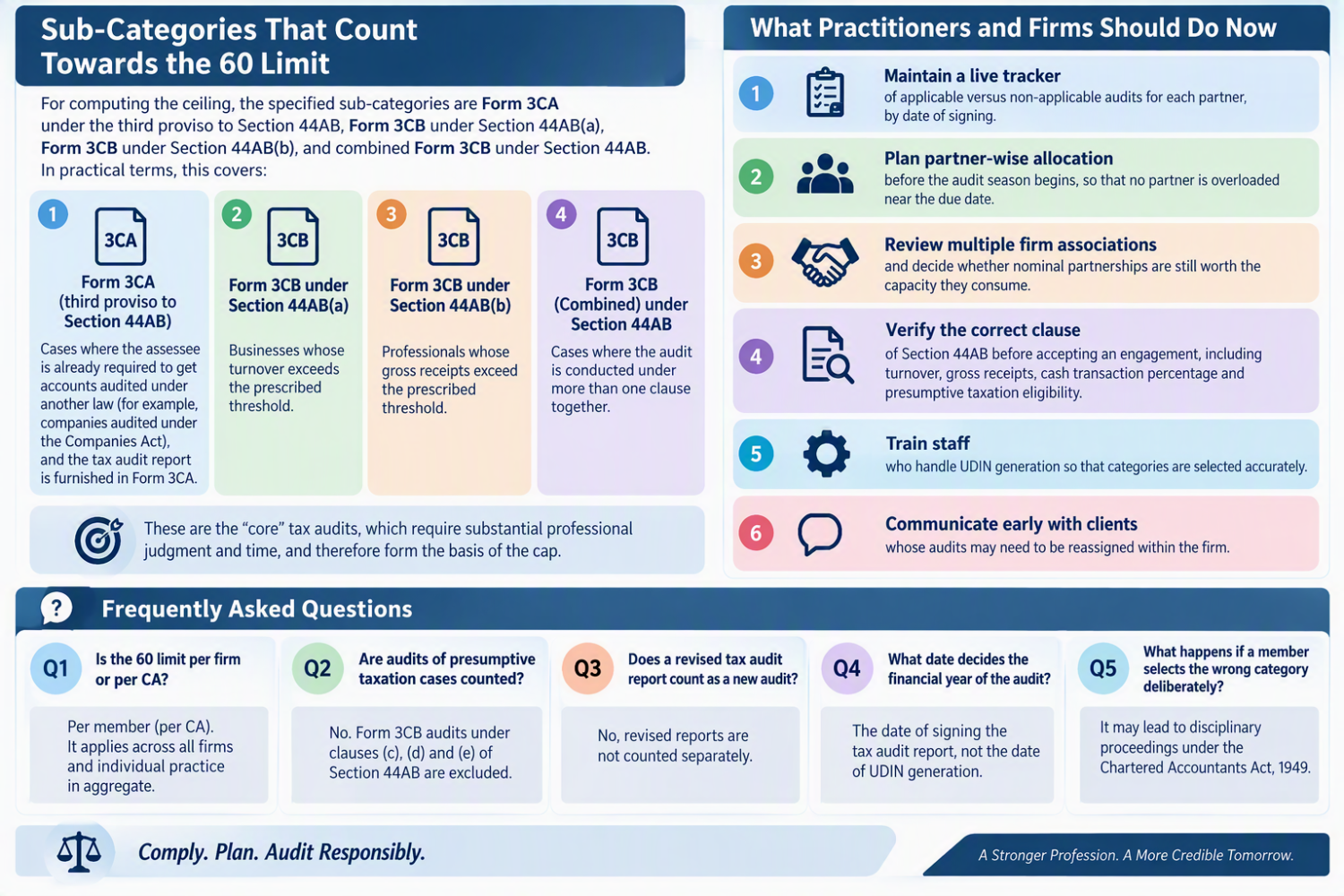
Table of Contents
ICAI Clarifies UDIN-Based Monitoring of the 60 Tax Audit Assignment Limit
The Institute of Chartered Accountants of India has released FAQs and clarifications on how the ceiling on tax audit assignments will be enforced through the UDIN (Unique Document Identification Number) system.
Background
The Institute of Chartered Accountants of India has reminded members of the Chartered Accountants (Limit on Number of Tax Audits) Guidelines, 2025, notified vide Gazette Notification No. F. No. 1-CA(7)/234/2025 dated 25 July 2025. Under these Guidelines, a member may accept a maximum of 60 tax audit assignments in a financial year, with effect from 1 April 2026. From that date, the limit will be closely monitored and enforced through the UDIN portal.
How the 60 Tax Audit Assignment Limit is Computed
Only certain specified tax audit categories will be counted towards the annual limit of 60 tax audits per member. The Institute of Chartered Accountants of India has classified the categories as follows.
-
Applicable Sub-Categories (counted towards the 60-audit limit)
- Form 3CA – Third proviso to Section 44AB
- I Tax Form 3CB – Section 44AB(a)
- Form 3CB – Section 44AB(b)
- I Tax Form 3CB (Combined) – Section 44AB
-
Non-Applicable Sub-Categories (excluded from the 60-audit limit)
- Form 3CB – Section 44AB(c)
- Income Tax Form 3CB – Section 44AB(d)
- Form 3CB – Section 44AB(e)
(i.e., cases u/s 44AE, 44ADA, and 44AD)
- Revised tax audit reports
Key Operational Points related to a maximum of 60 tax audit assignments in a FY, w.e.f. 1 April 2026
- Aggregation across firms and individual practice: The limit of 60 audits applies to each partner of a firm, counted together across all firms and any audits undertaken in an individual capacity.
- Head office and branches: Where a practitioner audits the head office and branches of the same entity, it is treated as a single tax audit assignment.
CA must be cautious against incorrect categorization
- ICAI has come across cases where certain members are generating UDINs under unsuitable or non-applicable categories to keep assignments outside the prescribed ceiling. Such conduct is contrary to the Guidelines.
- Members are therefore advised to ensure that UDINs are generated only under the correct category and strictly within the prescribed limit. Any member who deliberately generates a UDIN under a wrong category to circumvent the tax audit limit may face disciplinary proceedings under the Chartered Accountants Act, 1949, and the rules framed thereunder.
Conclusion
- ICAI has taken a firm stance to ensure adherence to the 60 tax audit assignment limit from 1 April 2026. CA should exercise due care while generating UDINs and make sure the right audit category is selected. Any attempt to avoid the prescribed ceiling through wrong classification may lead to disciplinary action and other professional consequences.
-
Need help with tax audit planning, compliance, or UDIN-related queries?
IFCCL assists businesses and professionals with tax audits, income tax compliance, and advisory services.
P-6/90 (2F), Connaught Circus, Connaught Place, New Delhi-110001 +011-43-52-0194 | 91-98-11-322-785 ✉️ info@caindelhiindia.com | 🌐 www.caindelhiindia.com
**********************************************************
If this article has helped you in any way, i would appreciate if you could share/like it or leave a comment. Thank you for visiting my blog.
Legal Disclaimer:
The information / articles & any relies to the comments on this blog are provided purely for informational and educational purposes only & are purely based on my understanding / knowledge. They do noy constitute legal advice or legal opinions. The information / articles and any replies to the comments are intended but not promised or guaranteed to be current, complete, or up-to-date and should in no way be taken as a legal advice or an indication of future results. Therefore, i can not take any responsibility for the results or consequences of any attempt to use or adopt any of the information presented on this blog. You are advised not to act or rely on any information / articles contained without first seeking the advice of a practicing professional.