Old TDS Challan Can Be Utilized in Another Tax Year
Table of Contents
Big TDS Update: Old TDS Challan Can Be Utilized in Another Tax Year
Unutilized TDS Challan Amount: Utilization in Future Quarters, Financial Years and Against Past Defaults
A significant relief has emerged for deductors facing issues due to incorrect selection of the Financial Year (FY), Assessment Year (AY), or Tax Year (TY) while depositing TDS. According to a public clarification by the Income Tax Department, a TDS challan deposited for one year may be utilized while filing a TDS statement of another year, subject to the condition that the utilization falls within ±1 Tax Year.
A common challenge faced by deductors is the existence of an unutilized balance in a TDS challan. This situation generally arises when the tax deposited through a challan exceeds the TDS liability reported in a particular quarter. Fortunately, the unconsumed portion of a valid TDS challan is not lost and can be utilized in subsequent TDS returns, subject to system validations and applicable guidelines.
Many taxpayers and deductors, particularly during the transition from the Income-tax Act, 1961 to the Income-tax Act, 2025, inadvertently deposited TDS under the wrong year. For example:
- TDS relating to TY 2026-27 was deposited under AY 2026-27/FY 2025-26.
- The challan was correctly paid, but the year selection was incorrect.
- Consequently, the challan did not appear while filing the relevant TDS return.
Utilization of Unused Challan Balance in Future Quarters
Where the amount deposited through a challan exceeds the TDS liability for a particular quarter, the unutilized balance may be carried forward and adjusted against TDS liabilities arising in subsequent quarters of the same financial year. For example:
- A deductor deposits INR 1,00,000 through a TDS challan in Quarter 1.
- While filing the TDS return for Quarter 1, only INR 70,000 is consumed.
- The remaining balance of INR 30,000 remains available for adjustment.
The deductor may utilize this balance while filing TDS returns for Quarter 2, Quarter 3, Quarter 4 of the same financial year.
Carry Forward of Challan Balance to Subsequent Financial Years
An important feature of the TDS system is that an unutilized challan balance can also be carried forward to future financial years. For instance A challan deposited during FY 2025-26 contains an unused balance of INR 50,000, If the balance remains unconsumed during FY 2025-26, the deductor may utilize the same balance while filing TDS returns for FY 2026-27, subject to availability in the challan ledger and system validations. Thus, a valid challan does not become unusable merely because the financial year has changed.
Utilization Against Previous Period TDS Defaults
The benefit of an unutilized challan extends beyond future liabilities. The available balance can also be used for adjustment against pending TDS defaults or short-payment demands relating to earlier periods. For example:
- A deductor discovers a short payment demand for FY 2023-24.
- Simultaneously, an excess challan balance remains available from FY 2025-26.
- Subject to applicable TDS return correction procedures, the available challan balance may be utilized for rectifying the previous default.
This facility helps deductors avoid making additional tax payments where sufficient tax has already been deposited and remains unconsumed.
One Challan Can Be Used Across Different TDS Sections
Another important aspect is that a single challan is not necessarily restricted to one section or one type of payment. Subject to TDS return filing rules, a challan can generally be allocated against deductions made under different sections, such as:
- Section 194C – Contractor Payments
- Under Section 194J – Professional Fees
- Section 194H – Commission or Brokerage
- Under Section 194A – Interest Payments
This flexibility ensures efficient utilization of challan balances and reduces the need for multiple challan payments.
What Has the Income Tax Department Clarified?
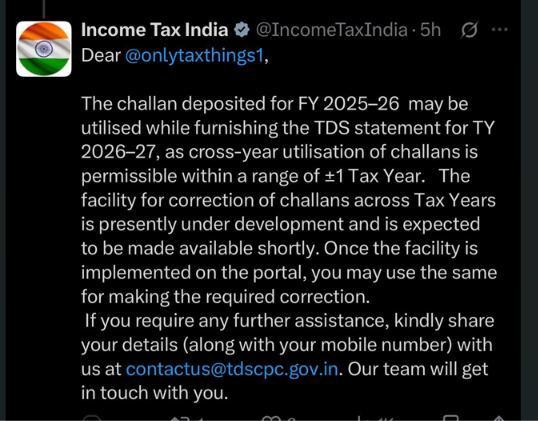
- The Income Tax Department has clarified that A challan deposited for FY 2025-26 may be utilized while filing the TDS statement for TY 2026-27 because cross-year utilization of challans is permissible within a range of ±1 Tax Year.
- This means that if TDS has been deposited under the wrong year, the deductor may not be required to pay TDS again, provided the challan can be matched and utilized under the permitted cross-year adjustment rules.
Practical Example 1
Situation ABC Pvt. Ltd. deducted TDS of INR 1,00,000 in April 2026. While depositing the amount, the accountant mistakenly selected: AY 2026-27 / FY 2025-26. instead of TY 2026-27. When ABC Pvt. Ltd. prepares its quarterly TDS return, the challan may still be utilized because cross-year utilization is permitted within the ±1 Tax Year range.
Practical Illustration 2
Suppose XYZ Pvt. Ltd. deposits a TDS challan of INR 2,00,000 in Quarter 1.
| Particulars | Amount (₹) |
|---|---|
| Challan Deposited | 2,00,000 |
| TDS Utilized in Q1 | 1,20,000 |
| Unutilized Balance | 80,000 |
The balance amount of INR 80,000 may be Utilized in Quarter 2, Quarter 3, or Quarter 4; Carried forward to subsequent financial years if not consumed; Used for regularization of earlier TDS defaults or short payments and Allocated against eligible TDS transactions reported under different sections.
What Does ±1 Tax Year Mean?
The rule generally allows utilization of a challan:
| Challan Year | Can be Used For |
| Tax Year 2025-26 | TY 2024-25 or TY 2026-27 |
| TY 2026-27 | Tax year 2025-26 or TY 2027-28 |
Subject to portal validations, available balance, TAN matching, and applicable system rules.
Is the Cross-Year Challan Correction Facility Available?
- The Department has indicated that a dedicated facility for correction of challans across tax years was under development and expected to be made available on the portal.
- Separately, TRACES has introduced online challan correction functionality for Tax Year 2026-27 and provides mechanisms for correction of certain challan details.
Difference Between Utilization and Correction
Important Difference: Utilization vs Correction. Many professionals are confusing two different concepts:
Cross-Year Utilization.
Cross-Year Utilization : Under this facility The original challan details remain unchanged, Challan is merely used for another year’s TDS statement, No separate challan correction is required if the system permits utilization. This is the most misunderstood aspect. Cross-Year Utilization. Under utilization:
- Challan remains unchanged.
- Original year remains unchanged.
- Only the balance is utilized while filing the TDS statement.
- No modification is made to challan particulars.
Challan Correction
Challan Correction : Under challan correction The year itself is corrected. Wrong AY, TY, TAN, PAN, Major Head, or Minor Head may be modified. The challan record is updated in the system. These are two distinct processes. Under correction
- Tax year can be corrected.
- TAN can be corrected.
- PAN can be corrected.
- Major head or minor head may be corrected.
- Challan details are actually changed in the system.
Therefore, utilization and correction are two entirely different concepts.
Is Online Challan Correction Available?
The Income Tax Department has stated that the facility for correction of challans across tax years is under development and is expected to be made available through the portal. Additionally, TRACES has introduced online challan correction facilities for several challan-related mistakes, including year-related corrections in certain cases.
Benefits for Deductors
- No Need for Duplicate Payment : If the challan is valid and falls within the permitted range, deductors may avoid making another TDS payment merely due to an incorrect year selection. Prevents duplication of tax payments.
- Reduced Demand Notices : Proper utilization can help avoid Short payment defaults, Interest demands, TDS mismatch notices and Challan non-matching issues
- Relief During Transition : The clarification is particularly beneficial during the transition from the old AY/FY system under the Income-tax Act, 1961 to the TY concept under the Income-tax Act, 2025.
- Points of Caution : Before utilizing an old challan Verify that the TAN is correct, Check challan balance availability, Confirm that the challan has not been fully consumed, Ensure the utilization falls within the permitted ±1 Tax Year range, Verify portal acceptance before final filing.
- Other Key Benefits of Carrying Forward Unused Challan Amount
- Improves cash flow management.
- Facilitates correction of historical TDS defaults.
- Allows efficient utilization of excess tax already deposited.
- Reduces unnecessary interest and demand notices arising from challan mismatches.
Points of Caution:
Before utilizing any old challan, verify the correct TAN, available balance, that the challan is not fully consumed, that the challan is valid, that the utilization falls within permitted limits, TRACES accepts challan mapping, and that TDS return validation is successful
Conclusion
- This is a major practical relief for deductors and chartered accountants. Where a TDS challan has been deposited under the wrong FY/AY/TY, the challan may still be utilized while filing the TDS return of the correct year, provided it falls within the ±1 Tax Year limit and satisfies TRACES validations.
- However, cross-year utilization does not automatically mean that the challan year has been corrected. Utilization and correction are separate concepts, and deductors should carefully review the challan status before filing the TDS return.
- The most important compliance point is that old TDS sections such as 194C, 194J, and 194H should no longer be quoted for transactions governed by the Income-tax Act, 2025. Instead, the corresponding entries u/s 393 & 394 must be used to ensure successful filing and compliance.
- An unutilized TDS challan balance is a valuable credit available to the deductor. Any excess amount deposited through a challan can generally be utilized in future quarters, carried forward to subsequent financial years, and even adjusted against eligible TDS defaults of earlier periods. Before making fresh TDS payments, deductors should always verify their available challan balance to ensure optimum utilization of taxes already deposited.
**********************************************************
If this article has helped you in any way, i would appreciate if you could share/like it or leave a comment. Thank you for visiting my blog.
Legal Disclaimer:
The information / articles & any relies to the comments on this blog are provided purely for informational and educational purposes only & are purely based on my understanding / knowledge. They do noy constitute legal advice or legal opinions. The information / articles and any replies to the comments are intended but not promised or guaranteed to be current, complete, or up-to-date and should in no way be taken as a legal advice or an indication of future results. Therefore, i can not take any responsibility for the results or consequences of any attempt to use or adopt any of the information presented on this blog. You are advised not to act or rely on any information / articles contained without first seeking the advice of a practicing professional.