Annual Disclosure by NPOs & Annual Impact Report under SSE
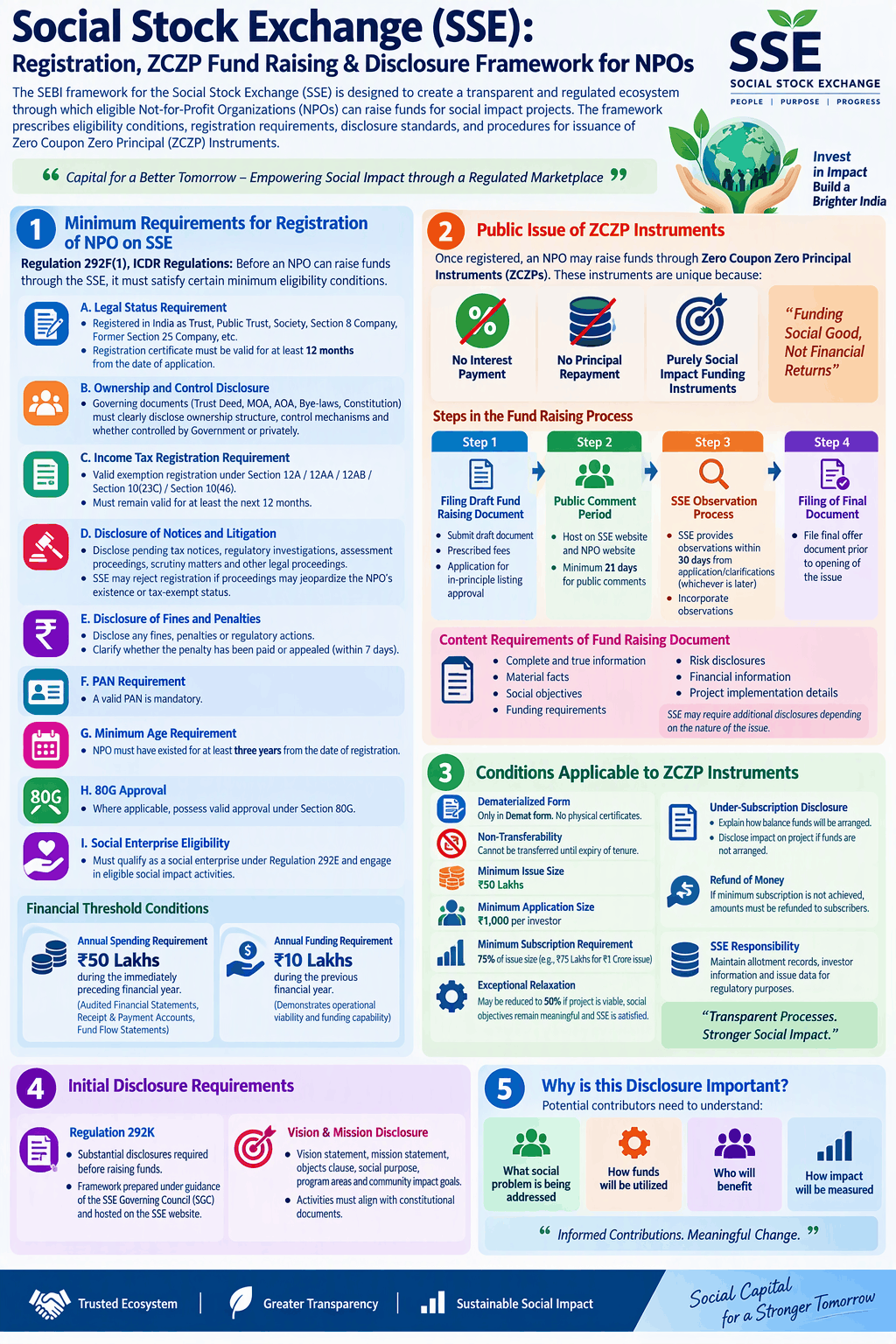
Table of Contents
Annual Disclosure by NPOs & Annual Impact Report under Social Stock Exchange
The Social Stock Exchange framework under SEBI does not merely permit fundraising by Not-for-Profit Organizations. it also imposes a robust disclosure and social impact reporting mechanism. The objective is to ensure transparency, accountability, and measurable social outcomes for all entities registered with or raising funds through SSE. The two major reporting requirements are:
- Annual Disclosure by NPOs under Regulation 91C of SEBI (LODR) Regulations.
- Annual Impact Report under Regulation 91E of SEBI (LODR) Regulations.
Annual Disclosure by NPOs – Regulation 91C :
These requirements apply to NPOs registered on SSE, NPOs that have raised funds through SSE. And NPOs having designated securities listed on SSE. The disclosures are divided into:
Time Limit: Must be submitted within 60 days from the end of the financial year.
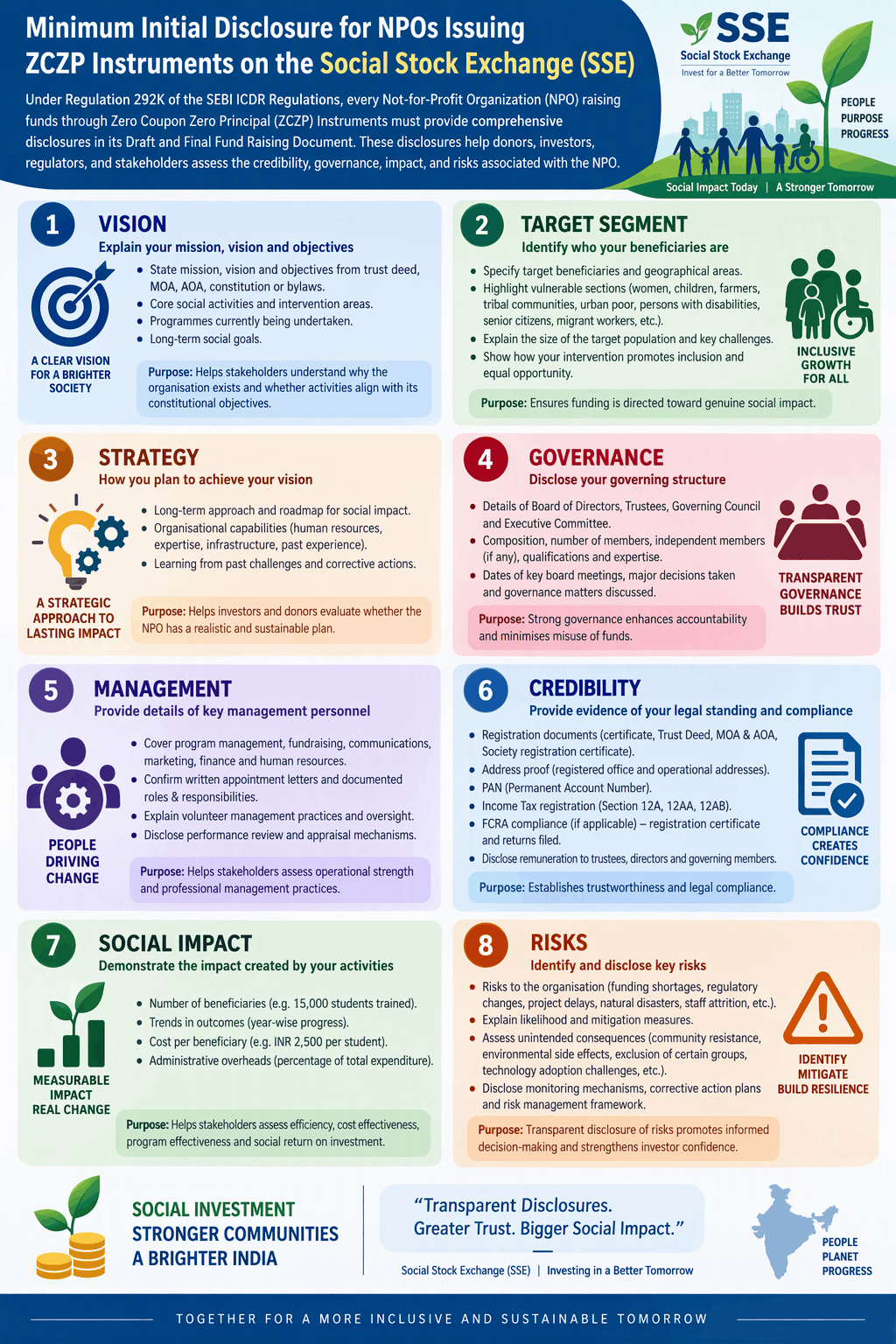
Non-Financial Annual Disclosure
- General Aspects: The NPO must provide detailed information regarding its identity and social activities.
- Organisation Details Disclosure includes the legal name of the organisation, the popularly known name (if different), and the head office location. And areas of operation.
- Vision and Mission: The NPO must explain why the organisation exists, the social issue being addressed and long-term objectives.
- Activities and Programs: Disclosure of projects undertaken, products and services offered and intervention models.
Outreach and Beneficiaries:
The NPO must report:
- Direct Beneficiaries: Persons directly receiving benefits. Example: students receiving scholarships and patients receiving healthcare.
- Indirect Beneficiaries: People benefiting indirectly. Example: Family members, communities.
- Institutional Beneficiaries: Organisations assisted example schools, hospitals and community groups.
- Scale of Operations: Information regarding the number of employees, number of volunteers, geographic coverage and operational reach.
-
Governance Aspects
Governance disclosures focus on accountability and management quality.
-
- Legal Structure: The NPO must disclose whether it is a Trust, Society, Section 8 Company and Other eligible structure.
- Governance Framework : Details relating to Board Structure, Governing Council, Committees, Internal controls, Governance policies and Decision-Making Processes.
- Governing Body Information : Disclosure includes Names of Trustees, Directors, Governing Members and Committee members.
- Executive Management : Details of CEO, Program Head, Finance Head, Fundraising Head and Other key personnel. Along with their responsibilities.
- Meetings and Attendance : NPO must disclose Number of Board Meetings, Committee Meetings and Attendance records.This helps assess governance effectiveness.
- Performance Review Mechanism : Disclosure of Board evaluation, Management appraisal systems, Review processes.
Risk Management : The NPO must disclose
Major Organisational Risks:
For example Funding risks, regulatory risks, operational risks and project implementation risks.
- Mitigation Measures : Steps taken to address these risks.
- Ethics and Conflict of Interest Framework: Details regarding whistleblower mechanisms, ethics policies, conflict-of-interest policies and reporting channels.
- Remuneration Policy : Information regarding Compensation philosophy, Payments to management and Payments to trustees where applicable.
- Stakeholder Grievance Redressal: The organization must disclose Complaint handling process, Number of complaints received and Number resolved.
- Regulatory Registrations : Complete details of Registration Certificate, PAN, 12A / 12AA / 12AB, 80G Registration, FCRA Registration, GST Registration and Other approvals.
Financial Annual Disclosure
Financial Disclosures
- Time Limit: To be filed On or before 31 October every year or before the due date of filing Income Tax Return, whichever is later.
General Information
- Outreach Statistics: Updated beneficiary details and impact coverage.
- Top 5 Donors / Investors: Disclosure of the five largest contributors based on funds received.
- Top 5 Programs: Programs consuming the largest budgets during the year.
Governance Disclosures
- Related Party Transactions: The NPO must disclose transactions with trustees, related entities and associated organisations. This reduces conflicts of interest.
- Compliance Statement: Senior management must confirm compliance with applicable regulations. Internal monitoring mechanisms.
Financial Statements :
The following must be disclosed:
- Balance Sheet: Financial position of the organisation.
- Income & Expenditure Statement: Revenue and expenses.
- Cash Flow Statement: Movement of funds.
- Programme-wise Utilisation: How funds were utilised across various programmes.
Auditor’s Report :
Disclosure of the auditor’s opinion and qualifications, if any. Auditor details.
Annual Impact Report (AIR) – Regulation 91E
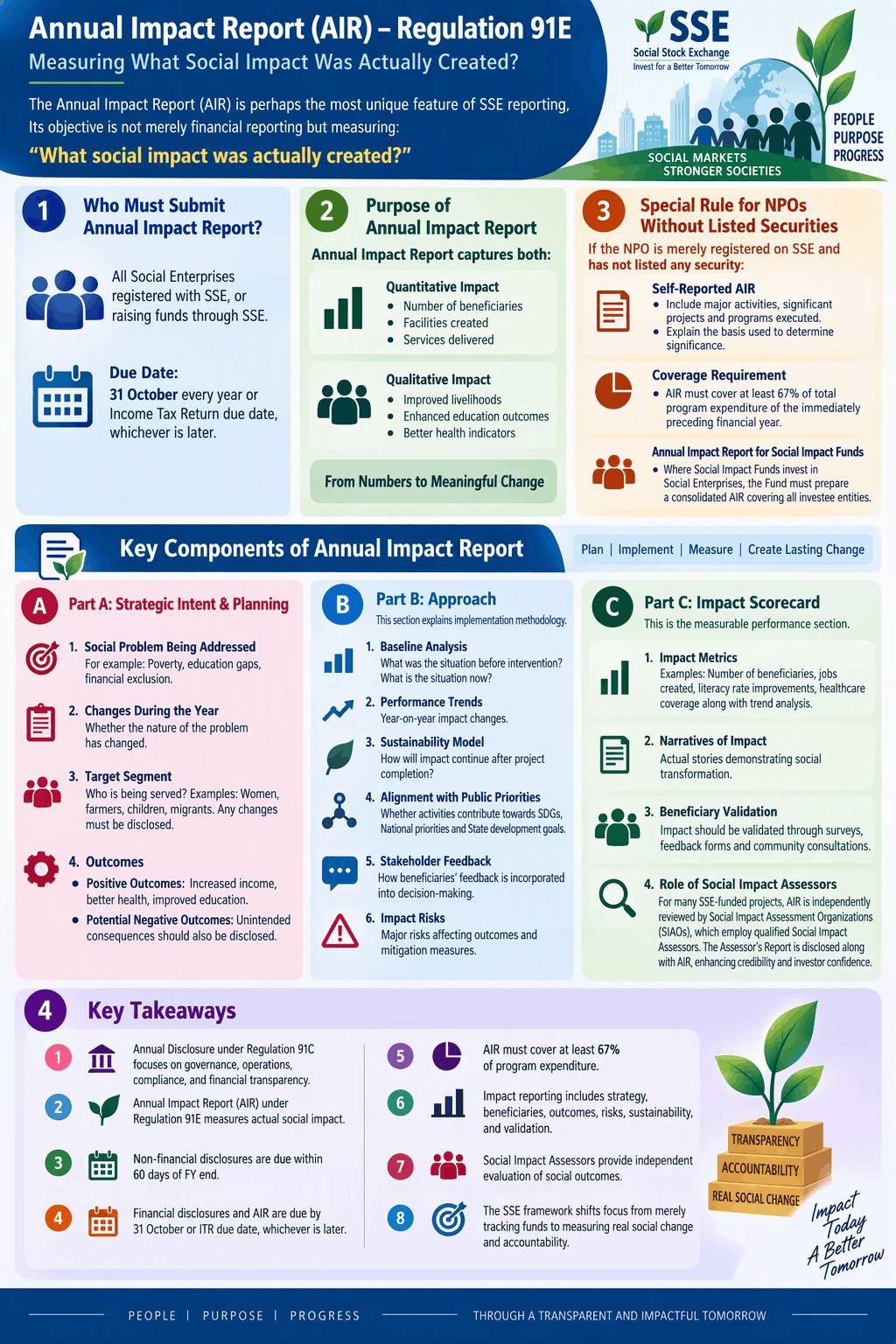
The Annual Impact Report is perhaps the most unique feature of SSE reporting. Its objective is not merely financial reporting but measuring: “What social impact was actually created?”
Who Must Submit an Annual Impact Report?
- All Social Enterprises registered with SSE, or raising funds through SSE. Due Date: 31 October every year or the Income Tax Return due date, whichever is later.
Purpose of Annual Impact Report
The Annual Impact Report captures both:
- Quantitative Impact: Such as number of beneficiaries and facilities created. And services delivered.
- Qualitative Impact : Such as improved livelihoods and enhanced education outcomes. And better health indicators.
Special Rule for NPOs Without Listed Securities
If the NPO is merely registered on SSE and has not listed any security:
- The Annual Impact Report may be self-reported. Such a report must include major activities, significant projects and programmes executed. The NPO must explain the basis used to determine significance.
- Coverage Requirement: AIR must cover at least 67% of the total programme expenditure of the immediately preceding financial year. This ensures meaningful coverage of organisational activities.
- Annual Impact Report for Social Impact Funds: Where Social Impact Funds invest in Social Enterprises: The Fund must prepare a Consolidated Annual Impact Report, covering all investee entities.
Key Components of Annual Impact Report
Part A: Strategic Intent & Planning
- The organisation must explain the social problem being addressed, for example, poverty, education gaps and financial exclusion.
- Changes During the Year: Whether the nature of the problem has changed.
- Target Segment: Who is being served? Examples: Women, Farmers, Children, Migrants. Any changes must be disclosed.
- Outcomes: The report must identify:
- Positive Outcomes: Such as Increased income, Better health, Improved education.
- Potential Negative Outcomes: Unintended consequences should also be disclosed.
Part B: Approach
This section explains implementation methodology.
Baseline Analysis : What was the situation before intervention? And What is the situation now?
Performance Trends : Year-on-year impact changes.
- Sustainability Model : How will impact continue after project completion?
- Alignment with Public Priorities : Whether activities contribute towards Sustainable Development Goals (SDGs), National priorities and State development goals
- Stakeholder Feedback : How beneficiaries’ feedback is incorporated into decision-making.
- Impact Risks : Major risks affecting outcomes and mitigation measures.
Part C: Impact Scorecard:
This is the measurable performance section.
- Impact Metrics: Examples include the number of beneficiaries, jobs created, and literacy rate improvements. And healthcare coverage. Along with trend analysis.
- Narratives of Impact: Actual stories demonstrating social transformation.
- Beneficiary Validation: Impact should be validated through surveys, feedback forms, and community consultations.
- Role of Social Impact Assessors: For many SSE-funded projects, AIR is independently reviewed. Assessment is conducted by Social Impact Assessment Organisations (SIAOs). which employ qualified social impact assessors. The Assessor’s Report is disclosed along with AIR, enhancing credibility and investor confidence.
Key Takeaways
- Annual Disclosure under Regulation 91C focuses on governance, operations, compliance, and financial transparency.
- Annual Impact Report (AIR) under Regulation 91E measures actual social impact.
- Non-financial disclosures are due within 60 days of FY end.
- Financial disclosures and AIR are due by 31 October or ITR due date, whichever is later.
- AIR must cover at least 67% of program expenditure.
- Impact reporting includes strategy, beneficiaries, outcomes, risks, sustainability, and validation.
- Social Impact Assessors provide independent evaluation of social outcomes.
- The SSE framework shifts focus from merely tracking funds to measuring real social change and accountability.
**********************************************************
If this article has helped you in any way, i would appreciate if you could share/like it or leave a comment. Thank you for visiting my blog.
Legal Disclaimer:
The information / articles & any relies to the comments on this blog are provided purely for informational and educational purposes only & are purely based on my understanding / knowledge. They do noy constitute legal advice or legal opinions. The information / articles and any replies to the comments are intended but not promised or guaranteed to be current, complete, or up-to-date and should in no way be taken as a legal advice or an indication of future results. Therefore, i can not take any responsibility for the results or consequences of any attempt to use or adopt any of the information presented on this blog. You are advised not to act or rely on any information / articles contained without first seeking the advice of a practicing professional.