Overview on Audit, Nomination & Remuneration Committee
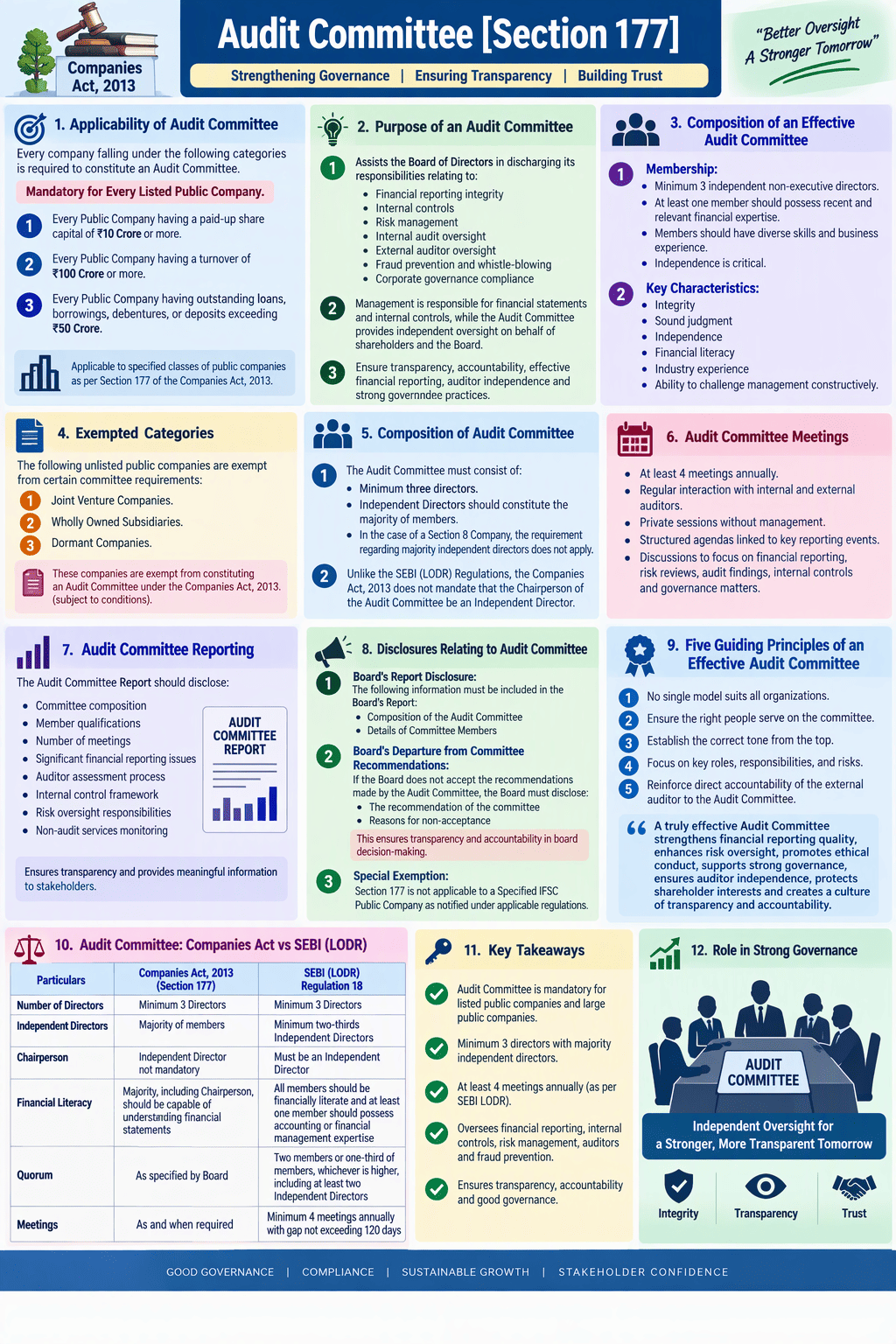
Table of Contents
Audit Committee and Nomination & Remuneration Committee under the Companies Act, 2013
The Companies Act, 2013 places strong emphasis on corporate governance by mandating the constitution of various Board Committees for specified classes of companies. These committees help the Board discharge its responsibilities more effectively and improve transparency, accountability, and stakeholder confidence. The key committees prescribed under the Companies Act, 2013 include Audit Committee, Nomination and Remuneration Committee (NRC), Stakeholders Relationship Committee (SRC), Corporate Social Responsibility Committee (CSR Committee)
In addition, the Securities and Exchange Board of India (SEBI) under the SEBI (LODR) Regulations requires listed entities to constitute a Risk Management Committee and comply with enhanced governance requirements.
Audit Committee [Section 177]
Applicability of Audit Committee: Every company falling under the following categories is required to constitute an Audit Committee: mandatory for every listed public company.
- Every Public Company having a paid-up share capital of INR 10 Crore or more.
- Public Company having a turnover of INR 100 Crore or more.
- Every Public Company having outstanding loans, borrowings, debentures, or deposits exceeding INR 50 Crore.
Purpose of an Audit Committee
- An Audit Committee assists the Board of Directors in discharging its responsibilities relating to Financial reporting integrity, Internal controls, Risk management, Internal audit oversight, External auditor oversight, fraud prevention and whistle-blowing and corporate governance compliance.
- Management is responsible for financial statements and internal controls, while the Audit Committee provides independent oversight on behalf of shareholders and the Board.
- Audit Committees must ensure Transparency, Accountability, Effective financial reporting, Auditor independence and Strong governance practices.
Composition of an Effective Audit Committee
- Membership : Minimum 3 independent non-executive directors, At least one member should possess recent and relevant financial expertise, Members should have diverse skills and business experience and Independence is critical.
- Key Characteristics : Members should possess Integrity, Sound judgment, Independence, Financial literacy, Industry experience and Ability to challenge management constructively.
Exempted Categories :
The following unlisted public companies are exempt from certain committee requirements:
- Joint Venture Companies.
- Wholly Owned Subsidiaries.
- Dormant Companies.
Composition of Audit Committee
- The Audit Committee must consist of Minimum Three Directors, Independent Directors should constitute the majority of members and In the case of a Section 8 Company, the requirement regarding majority independent directors does not apply.
- Unlike the SEBI (LODR) Regulations, the Companies Act, 2013 does not mandate that the Chairperson of the Audit Committee be an Independent Director.
Role of the Audit Committee Chair
- The role of the audit committee chair plays a vital role in driving committee effectiveness.
- Role of the Audit Committee Chair identifies key traits of an effective Chair: strong leadership, financial understanding, independence, effective communication, and the courage to challenge management. And the ability to manage discussions objectively.
- The Chair should maintain close interactions with Board Chairman, CEO, CFO, Internal Auditor and External Auditor.
Key Responsibilities of the Audit Committee
- Financial Reporting Oversight: Audit Committees review Annual financial statements, interim financial statements, accounting estimates, accounting policies, significant judgements, financial disclosures and Going concern assumptions.
- Areas Requiring Special Attention: Revenue recognition, goodwill impairment, fair value measurement, financial statement disclosures, and earnings management risks. And Provisioning.
- Risk Management and Internal Controls : The Audit Committee monitors internal controls, risk management systems, internal control deficiencies, and Risk monitoring mechanisms. And control effectiveness. Important responsibilities include reviewing strategic risks, operational risks, regulatory risks, financial risks, IT risks and emerging risks.
- Internal Audit Oversight: The Identifies Internal Audit as the third line of defence in governance. Audit Committee responsibilities include approving internal audit plans, monitoring internal audit effectiveness, reviewing audit findings. Ensuring management acts on recommendations and Meeting Internal Audit independently.
- Internal Audit Activities: Risk assessments, governance reviews, control evaluations, compliance reviews, Assurance mapping and investigation support.
- External Auditor Oversight: Audit Committees should Recommend appointment and removal of auditors Monitor audit quality, Review audit plans, Evaluate auditor independence Review audit findings, Discuss audit judgements and monitor non-audit services.
- Annual Auditor Evaluation: Assessment includes audit quality, technical expertise, industry knowledge, communication quality, audit team competency and independence and objectivity.
- Fraud, Misappropriation and Whistle-Blowing: The Audit Committee should oversee fraud risk assessments, anti-fraud controls, anti-bribery systems, whistleblower mechanisms and investigation procedures.
- Warning Indicators: red flags such as dominant executives, frequent management turnover, Excessive lifestyle inconsistency, aggressive accounting, overly complex structures and unrealistic performance.
- Whistle-Blowing Responsibilities: The Audit Committee should ensure confidential reporting channels, employee protection, independent investigations and appropriate follow-up action.
Powers and Functions of Audit Committee
The Audit Committee plays an important role in strengthening the financial reporting system and internal controls of the company. Major responsibilities include:
- Auditor-Related Functions: Recommending appointment, reappointment, remuneration, and terms of appointment of auditors. Reviewing and monitoring auditor independence. And evaluating the auditor performance and effectiveness of the audit process.
- Financial Reporting Functions: Examination and review of financial statements and review of Auditor’s report before submission to the Board.
- Related Party Transactions: Approval of related party transactions and review and approval of any subsequent modifications to such transactions.
- Investment and Funding Oversight: Scrutiny of inter-corporate loans and investments and monitoring utilisation of funds raised through public issues and other capital-raising activities.
- Risk and Internal Control Functions: Evaluation of internal financial controls, review of risk management systems and assessment of compliance mechanisms.
- Valuation Functions: Valuation of assets, undertakings, and business divisions whenever necessary.
- Rights of Auditors and KMPs: The following individuals are entitled to participate in meetings of the Audit Committee: statutory auditors, internal auditors, and Key Managerial Personnel. However, although they have the right to be heard and express their views, they do not possess voting rights at Audit Committee Meetings.
Audit Committee Meetings:
The Audit Committee Meetings recommends At least 4 meetings annually, regular interaction with internal and external auditors, private sessions without management and structured agendas linked to key reporting events.
Meeting discussions should focus on financial reporting, risk reviews, audit findings, internal controls, and governance matters.
Audit Committee Reporting:
The Audit Committee Report should disclose Committee composition, Member qualifications, Number of meetings, Significant financial reporting issues, Auditor assessment process, Internal control framework, Risk oversight responsibilities and Non-audit services monitoring. Disclosures Relating to Audit Committee
- Board’s Report Disclosure: The following information must be included in the Board’s Report Composition of the Audit Committee and Details of Committee Members.
- The Board’s Departure from Committee Recommendations: If the Board of Directors does not accept the recommendations made by the Audit Committee, the Board must disclose: The recommendation of the committee. Reasons for non-acceptance. And this ensures transparency and accountability in board decision-making.
- Special Exemption: Section 177 relating to the Audit Committee is not applicable to a Specified IFSC Public Company as notified under applicable regulations.
Five Guiding Principles of an Effective Audit Committee
Highlights five fundamental principles:
- No single model suits all organizations.
- Ensure the right people serve on the committee.
- Establish the correct tone from the top.
- Focus on key roles, responsibilities, and risks.
- Reinforce direct accountability of the external auditor to the Audit Committee.
Audit Committee should not merely act as a compliance mechanism. A truly effective Audit Committee Strengthens financial reporting quality, enhances risk oversight, Promotes ethical conduct, Supports strong governance, Ensures auditor independence and protects shareholder interests and creates a culture of transparency and accountability.
The Audit Committee serves as the independent guardian of financial integrity, risk management, internal controls, governance, and stakeholder confidence within an organization
Audit Committee: Companies Act vs SEBI (LODR)
| Particulars | Companies Act, 2013 (Section 177) | SEBI (LODR) Regulation 18 |
| Number of Directors | Minimum 3 Directors | Minimum 3 Directors |
| Independent Directors | Majority of members | Minimum two-thirds Independent Directors |
| Chairperson | Independent Director not mandatory | Must be an Independent Director |
| Financial Literacy | Majority, including Chairperson, should be capable of understanding financial statements | All members should be financially literate and at least one member should possess accounting or financial management expertise |
| Quorum | As specified by Board | Two members or one-third of members, whichever is higher, including at least two Independent Directors |
| Meetings | As and when required | Minimum 4 meetings annually with gap not exceeding 120 days |
Nomination and Remuneration Committee (NRC) [Section 178]
Applicability of Nomination and Remuneration Committee : The Nomination and Remuneration Committee is required to be constituted by:
- Every Listed Public Company.
- Public Company having paid-up capital of INR 10 Crore or more.
- Every Public Company having turnover of INR 100 Crore or more.
- Public Company having aggregate outstanding loans, borrowings, debentures, and deposits exceeding INR 50 Crore.
Composition of Nomination and Remuneration Committee
- The Committee shall consist of Three or more Non-Executive Directors and At least one-half of the members must be Independent Directors.
- Chairperson of the Committee may be present at the Annual General Meeting to answer shareholders’ queries regarding remuneration matters.
Functions of Nomination and Remuneration Committee
Identification of Leadership Talent : The Committee identifies individuals suitable for Appointment as Directors, Senior Management positions, Key strategic roles.
- Recommendation of Appointments and Removals : The Committee recommends Appointment of Directors, Reappointment of Directors, Removal of Directors and Appointment and removal of Senior Management Personnel.
- Performance Evaluation Framework : The Committee formulates the methodology for evaluating Board Performance, Performance of Committees, Individual Director Performance.
- Director Independence : The Committee prescribes criteria relating to Qualifications of Directors, Positive attributes expected from Directors and Standards of Independence for Independent Directors.
- Remuneration Policy : The Committee formulates a remuneration policy covering Directors, Key Managerial Personnel (KMPs). And Senior Management Employees.
Key Principles of Remuneration Policy
The remuneration framework should ensure:
- Fair Compensation : Compensation should be sufficient to attract, retain, and motivate competent professionals.
- Performance Linkage : Remuneration should be linked with Individual performance, Company performance, Long-term value creation.
- Balance Between Fixed and Incentive Pay : The policy should maintain a balanced mix of Fixed salary, Performance incentives and Long-term benefits.
- Corporate Governance Alignment : Compensation structures should promote accountability and support sustainable business growth.
- Together, the Audit Committee and Nomination & Remuneration Committee form the backbone of corporate governance under the Companies Act, 2013.
- Audit Committee safeguards financial integrity, compliance, and internal controls.
- The Nomination & Remuneration Committee ensures that the company has competent leadership and a transparent compensation structure.
- For listed companies and large public companies, these committees are critical in meeting statutory obligations, improving investor confidence, and ensuring effective governance practices.
**********************************************************
If this article has helped you in any way, i would appreciate if you could share/like it or leave a comment. Thank you for visiting my blog.
Legal Disclaimer:
The information / articles & any relies to the comments on this blog are provided purely for informational and educational purposes only & are purely based on my understanding / knowledge. They do noy constitute legal advice or legal opinions. The information / articles and any replies to the comments are intended but not promised or guaranteed to be current, complete, or up-to-date and should in no way be taken as a legal advice or an indication of future results. Therefore, i can not take any responsibility for the results or consequences of any attempt to use or adopt any of the information presented on this blog. You are advised not to act or rely on any information / articles contained without first seeking the advice of a practicing professional.