CG will Be Pre-filled in ITR for Market Investors & Trader
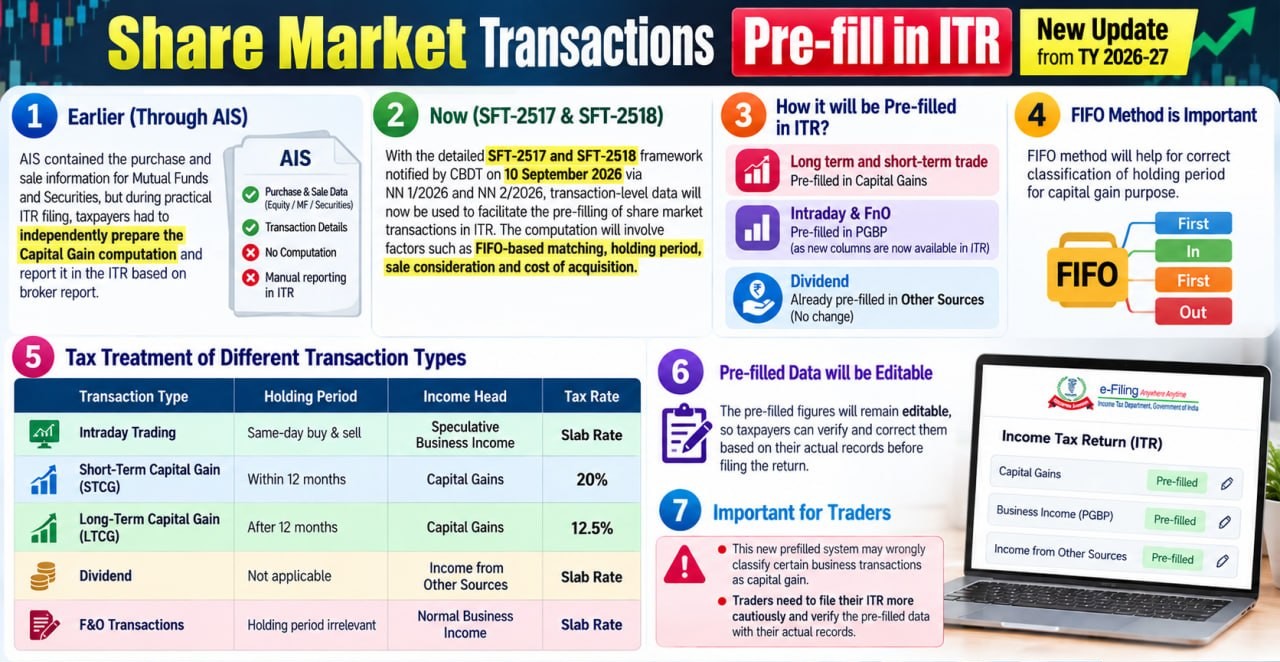
Table of Contents
Big Change for Share Market Investors and Traders: Capital Gains Will Be Pre-filled in ITR
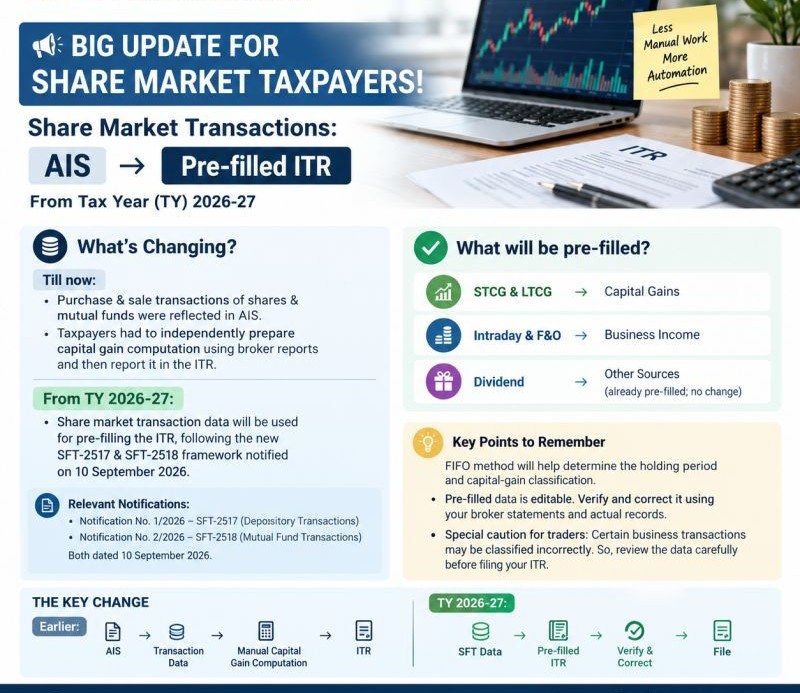
- The Income Tax Department is moving towards a more automated tax reporting system. From Tax Year 2026-27, capital gains from shares and mutual funds are expected to be directly reflected in your pre-filled Income Tax Return (ITR) instead of merely appearing as transaction data in the Annual Information Statement (AIS).
- Pre-filled ITR is a convenience, not a substitute for verification. Always reconcile the pre-filled capital gains with broker statements, mutual fund records, and tax reports before filing your return
What Happened Earlier?
Until now:
- Share and mutual fund transactions were reported in AIS as raw purchase and sale data. Investors and their Chartered Accountants had to:
- Collect broker statements and Mutual Fund CAS.
- Calculate Short-Term Capital Gains (STCG) and Long-Term Capital Gains (LTCG).
- Determine the correct cost of acquisition.
- Report the gains manually in the ITR.
Process Earlier: AIS → Purchase/Sale Data → Capital Gain Calculation → ITR Filing
What Changes from Tax Year 2026-27?
Under the new SFT-2517 and SFT-2518 reporting framework:
- Depositories (NSDL/CDSL) and Mutual Fund RTAs will report detailed transaction data directly to the Income Tax Department.
- The system will calculate capital gains and populate them in the taxpayer’s ITR.
New Process: SFT Data → Pre-filled Capital Gains in ITR → Verification → Filing
This is intended to reduce manual errors and simplify return filing.
What Will Be Pre-filled?
- Capital Gains
-
- Short-Term Capital Gains (STCG)
- Long-Term Capital Gains (LTCG)
These figures will appear in the Capital Gains Schedule of the ITR.
- Trading Income
-
- Intraday trading transactions
- Futures & Options (F&O) transactions
These may be reflected under Profits and Gains from Business or Profession (PGBP), subject to the final ITR utility.
- Dividend Income : Dividend income is already being pre-filled and will continue to be reported under Income from Other Sources.
Why Is FIFO Important?
The system will generally use the FIFO (First In First Out) method. Example:
| Purchase Date | Quantity | Cost |
| Jan 2025 | 100 | ₹100 |
| Jun 2025 | 100 | ₹150 |
If you sell 100 shares in December 2026, the system will assume that the January 2025 shares were sold first.
FIFO determines: Cost of acquisition, Holding period and Whether the gain is STCG or LTCG
Pre-filled Does Not Mean Correct
- Starting in Tax Year 2026-27, capital gains data from depositories and mutual fund RTAs will flow directly into the ITR under the SFT-2517 and SFT-2518 framework. This is a real convenience, but it also creates a false sense of security. The pre-filled figures are generated mechanically from transaction records. They cannot see the tax facts that sit outside the depository system. Below is why that matters and where the most common errors are likely to appear.
Why pre-filled figures remain editable
- The Income Tax Department is pre-filling data reported by third parties, not certifying your tax liability. The return is still the taxpayer’s own declaration, verified by the taxpayer’s signature or e-verification. That is why every pre-filled field stays editable.
- If you accept an incorrect figure, the law treats it as your own statement. You cannot later argue that “the department filled it in.” Editing wrong data is part of your responsibility, not an optional extra.
What to reconcile against, and why each source matters
- Broker tax P&L report. Your broker’s capital gains or tax statement gives scrip-wise buy and sell values, holding periods and short-term or long-term classification. It is the first document to compare against the pre-filled schedule. Differences often come from the broker and the depository applying different cost bases or lot-matching.
- Contract notes. Contract notes are the primary evidence of the actual price, brokerage, STT and other charges for each trade. When the P&L report and pre-filled data disagree, the contract note settles it.
- Demat statement (NSDL/CDSL). The demat statement shows the actual movement of securities: credits from bonus issues, splits, mergers, off-market transfers and transmissions. Many classification errors trace back to entries here that the system treats as fresh purchases.
- Mutual Fund Consolidated Account Statement (CAS). The CAS gives unit-wise purchase dates and NAVs, including SIP instalments. With SIPs, every instalment is a separate lot with its own holding period, so FIFO matching must be checked unit by unit.
- AIS and TIS. The pre-filled ITR should match what appears in the AIS. If it doesn’t, one of them is wrong. You can submit feedback on AIS entries that are incorrect, duplicated or relate to someone else.
- Previous years’ loss records. Brought-forward losses come from your earlier returns, not from SFT data. Unless your past returns are properly reflected, the pre-filled return may miss set-offs you are entitled to. Brought-forward capital losses can generally be carried forward for eight years, but only if the loss return was filed on time.
Transactions that need particular care
- The FIFO-based system works well for simple buy-and-sell trades. It struggles with events that change the cost or holding period without a normal purchase.
- Bonus shares. Bonus shares are treated as acquired at nil cost, with the holding period running from the allotment date, not the date of the original shares. If the system assigns them a market-value cost, or merges them into the original lot’s holding period, both the gain and its short-term/long-term classification will be wrong.
- Stock splits. A split doesn’t create new cost. The original cost is spread across the larger number of shares, and the holding period continues from the original purchase date. Because a split often generates a new ISIN in the demat account, the system may read it as a fresh acquisition. That would wrongly turn a long-term holding into a short-term one.
- Rights issues. Rights shares carry their own cost (the amount paid) and their own holding period (from allotment). If you renounced your rights entitlement instead of subscribing, the sale proceeds are taxable, usually as short-term gains, with nil cost if the entitlement was received free. These are frequently missed or misreported.
- Mergers and demergers. In a qualifying amalgamation, receiving the new company’s shares is generally not a taxable transfer. The cost and holding period of the old shares carry over to the new ones. In a demerger, the original cost has to be split between the parent and the resulting company’s shares in the prescribed ratio, usually based on net book value. The depository has no way to know that ratio. Pre-filled data for demerged shares is therefore likely to show nil or incorrect cost.
- Off-market transfers. When shares move between demat accounts outside the exchange, whether between family members, between your own accounts or as a gift, the depository may record no consideration. The system may then show these shares with zero cost, or treat the transfer itself as a sale. Each off-market entry needs to be explained and corrected.
- Gifts and inheritance. Shares received as a gift from a relative or through inheritance take on the previous owner’s cost and holding period. The recipient’s demat account only shows the date of credit, so the pre-filled data will usually understate both. Supporting documents such as a gift deed, will or transmission records should be kept.
- Grandfathering (listed equity bought before 1 February 2018). For listed equity shares and equity-oriented funds acquired before 1 February 2018, the cost of acquisition is the higher of two figures. The first is the actual cost. The second is the lower of the fair market value on 31 January 2018 and the actual sale value. This protects gains that accrued before LTCG on equity was reintroduced. The depository may not always apply this correctly, especially for corporate-action shares or holdings transferred between accounts.
Special caution for traders
- For active traders, the bigger risk is not the amount but the head of income. The correct head decides the ITR form, how losses can be set off, how long they can be carried forward and whether a tax audit is needed.
- Intraday trading: speculative business income. Intraday equity trades are settled without delivery, so they are generally treated as speculative business. Speculative losses can only be set off against speculative profits, and can be carried forward for only four years.
- F&O trading: non-speculative business income. Trades in futures and options on a recognised exchange are expressly excluded from “speculative transactions.” They are taxed as normal business income. Losses can be set off against other income (except salary) in the same year and carried forward for eight years against business income.
- If the pre-filled return places F&O or intraday results under capital gains, or mixes the two categories, the result can be a wrong tax figure, disallowed losses and a return filed on the wrong form. Traders with business income must file ITR-3, not ITR-2.
What traders must verify before filing:
- Turnover computation. Trading turnover is not the contract value. Under the ICAI Guidance Note on Tax Audit, F&O turnover is the aggregate of the absolute values of profits and losses on each trade. Intraday turnover is computed the same way on price differences. The pre-filled figure needs to be checked against this method.
- Profit and loss figures. These must be reconciled trade-wise with broker ledgers, including expired options and carried-forward positions.
- Brokerage and expenses. For business income, brokerage, exchange charges, STT, internet, advisory subscriptions and similar costs are deductible. Pre-filled data will usually not capture these.
- Head of income classification. Check the capital gains vs. speculative business vs. non-speculative business split described above.
- Tax audit applicability. An audit is generally required where business turnover exceeds ₹1 crore, or ₹10 crore where cash transactions are within 5%. It may also be required where a trader who has opted for presumptive taxation in the past declares lower profits. A wrong turnover figure can mean missing a mandatory audit, which carries its own penalty.
Impact on Chartered Accountants
A common assumption is that pre-filled data makes tax professionals unnecessary. The opposite is closer to the truth. Pre-filling removes data entry, but the problem areas above are all matters of judgement and legal interpretation. A CA’s role shifts from compiling data to verifying and advising, in particular:
- Capital gain verification. Checking FIFO matching, holding periods and cost against source documents.
- Loss set-off and carry-forward. Applying the intra-head and inter-head rules correctly, and ensuring losses are preserved through timely filing.
- Tax planning. Timing sales to use the LTCG exemption threshold, harvesting losses and choosing the tax regime.
- Grandfathering calculations. Especially for older portfolios, inherited shares and corporate-action holdings.
- F&O turnover computation. Applying the ICAI method correctly.
- Tax audit compliance. Deciding applicability and conducting the audit.
- Resolving discrepancies. Filing AIS feedback, correcting the return and responding to mismatch notices
Key takeaway- Capital Gains Will Be Pre-filled in ITR
The main change is that capital gains move from being reported in the AIS to being pre-filled in the ITR itself. This saves time and reduces manual entry, especially for salaried investors with simple portfolios.
The biggest change is that capital gains will move from being merely reported in AIS to being directly pre-filled in the ITR. This will save time and reduce manual data entry. However, the responsibility for accuracy remains with the taxpayer. If incorrect pre-filled figures are accepted without verification, the taxpayer may still receive scrutiny notices or tax demands later.
Pre-filled Does Not Mean Correct :
The pre-filled figures will remain editable. Taxpayers should reconcile the information with Broker tax P&L reports, Contract notes, Demat statements, Mutual Fund CAS, AIS and Previous years’ loss records. Particular care is needed where transactions involve Bonus shares, Stock splits, Rights issues, Mergers and demergers, Off-market transfers, Gifts and inheritance and Grandfathering provisions for older equity investments. Special Caution for Traders, Who For active traders, classification errors may occur.
- Intraday Trading : Generally treated as Speculative Business Income
- F&O Trading : Generally treated as Non-Speculative Business Income
- Before filing the ITR, traders should verify Turnover computation, Profit/loss figures, Brokerage and expenses, Correct income head classification and Tax audit applicability
Many people assume that pre-filled data eliminates the need for tax professionals. That is not the case. A CA will still be required for Capital gain verification, Loss set-off and carry-forward, Tax planning, Grandfathering calculations, F&O turnover computation, Tax audit compliance, and Resolution of discrepancies in pre-filled data
However, responsibility for accuracy stays with the taxpayer. Pre-filled data reflects what reporting entities uploaded, not a tax conclusion. If an incorrect figure is accepted without checking, the taxpayer can still face mismatch notices, scrutiny, tax demands, interest and penalties later. The safest approach is to treat the pre-filled return as a starting draft: reconcile it, correct it and then file.
**********************************************************
If this article has helped you in any way, i would appreciate if you could share/like it or leave a comment. Thank you for visiting my blog.
Legal Disclaimer:
The information / articles & any relies to the comments on this blog are provided purely for informational and educational purposes only & are purely based on my understanding / knowledge. They do noy constitute legal advice or legal opinions. The information / articles and any replies to the comments are intended but not promised or guaranteed to be current, complete, or up-to-date and should in no way be taken as a legal advice or an indication of future results. Therefore, i can not take any responsibility for the results or consequences of any attempt to use or adopt any of the information presented on this blog. You are advised not to act or rely on any information / articles contained without first seeking the advice of a practicing professional.