Form 15CA & 15CB- Revised rules related to Filling Form
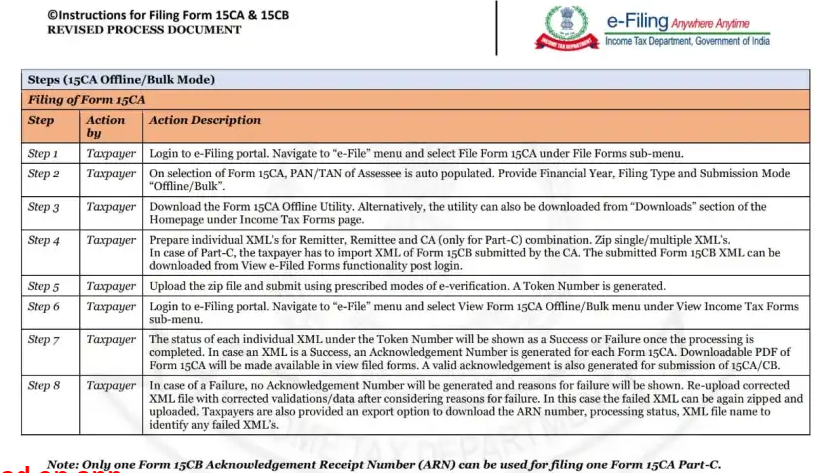
Table of Contents
Form 15CA & 15CB- Revised rules related to Filling Form
While making payments outside India it is needs few compliances. These compliance to be done form 15CB & 15CA, when it is need. The several transaction where you required to field this form as per explained in this article. `
Before sending the payment to a foreign country, a person responsible for making such a remittance (payment) must submit the form 15CA. Both online and offline submissions of this form are available at the income tax portal. Before uploading the form 15CA online, a certificate from a chartered accountant in the form 15CB may be needed in some situations.
A CBDT Notification issued on 14th June 2021, Govt Tax dept. has simplified filing the form 15CB/15CA in online on the new website on www.incometax.gov.in. The assesse can also file this form in manual mode to the AD till 30th June 2021.
The tax department has changed the rules & regulations for the making and filed of form 15CB and Form 15CA (check old rules of form 15CB)
The changed rules are applicable from 1st April 2016. The main aspect revision are given below—
- Form 15CB & 15CA will not be need remittance for the individual. As per RBI guidelines.
- A list of payments for a specific purpose in explained in Rule 37BB. We do not need to file Form 15CB & 15CA. which is explained from 28 to 33 as well as payment for imports.
- The 15CB Form will always need to payment done by non-residents when the amount is chargeable to tax and where the payment increases by Rs. 5 lakhs.
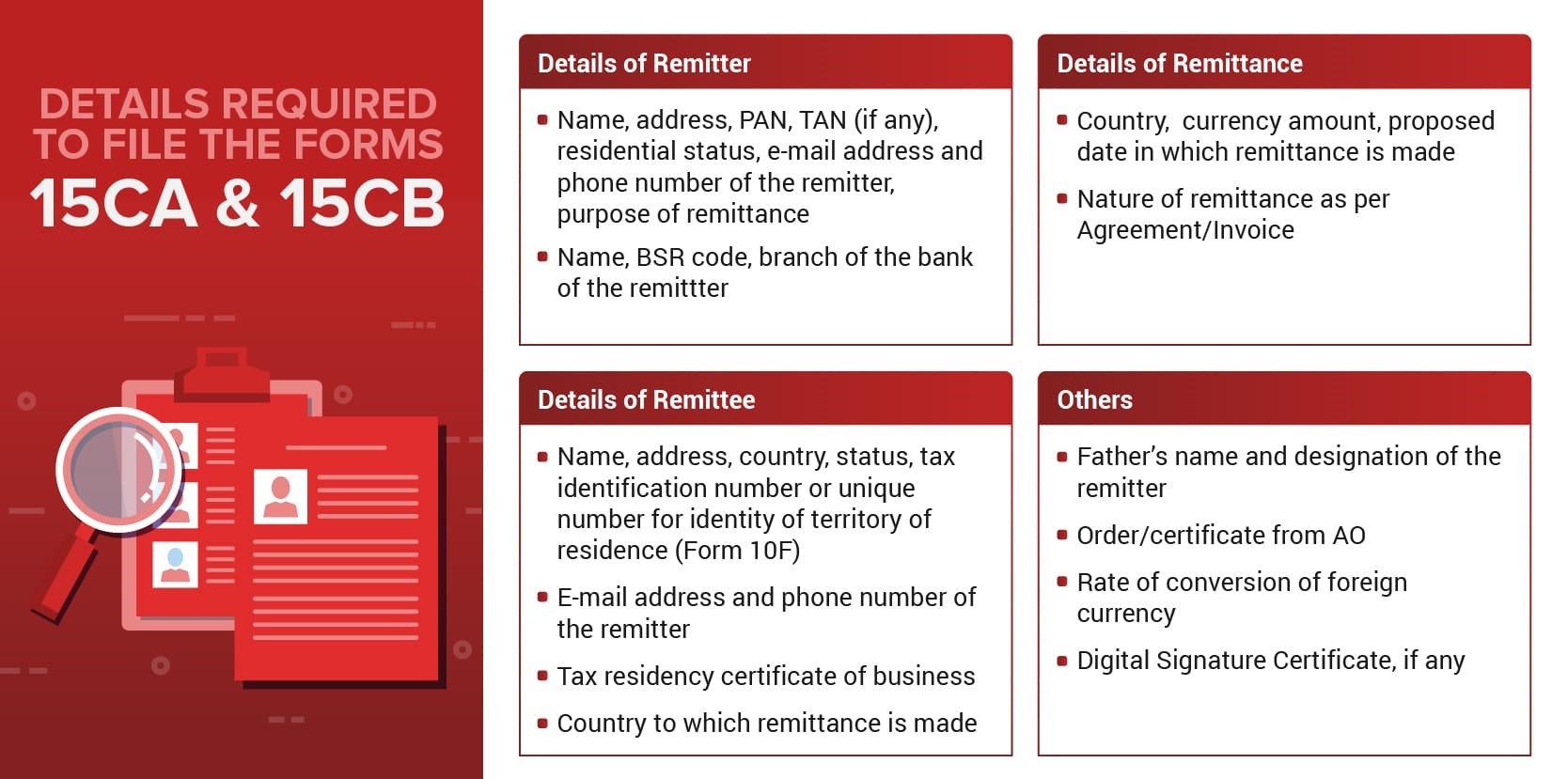
A person responsible for making a payment to a foreign company or to a non-resident has to be available for the following information & details.
When a foreign payment is made that is less than the amount of Rs. 500,000/-.
- For such payments information needs to be filed in Part A of Form 15CA
When foreign payment made above Rs. 500,000/-
The following documents need to be filed.
Part B: Form 15CA of part B has to be submitted
Form 15CB Certificate issued from CA
Part C : 15CA of Part of C
When the foreign payment made is not chargeable to tax under the Income Tax Act.
Part D of Form 15CA of Part D needs to be filed.
Under the below-mentioned cases, no filling of details or information is required.
The amount paid to a non-resident by an individual, and it is not need initial approval of RBI {the FEMA 1999 (42 of 1999) of section 5 and read with Schedule III to the Foreign Exchange (Current Account)
- Transaction Rules 2000 As per the Rule 37BB, the following remittance is nature-prescribed as specified below:
Rule 37BB
- Remittance towards donations to religious and charitable institutions abroad
- Loans extended to Non-Residents
- Travel for medical treatment
- Freight insurance – relating to import and export of goods
- Indian investment abroad—in branches and wholly owned subsidiaries
- Travel for education (including fees, hostel expenses, etc.)
- Payment—for operating expenses of Indian shipping companies operating abroad
- Remittance by non-residents towards family maintenance and savings
- Indian investment abroad -in subsidiaries and associates
- Payments by residents for international bidding.
- Refunds or rebates or reduction in invoice value on account of exports
- Indian investment abroad -in real estate
- Remittance towards payment or refund of taxes.
- Imports by diplomatic missions
- Payments for maintenance of offices abroad
- Remittance towards personal gifts and donations
- Maintenance of Indian embassies abroad
- Contributions or donations by the Government to international institutions
- Indian investment abroad -in debt securities
- Remittance towards grants and donations to other Governments and charitable institutions established by the Governments.
- Indian investment abroad -in equity capital (shares)
- Remittances by foreign embassies in India
- Postal Services
- Construction of projects abroad by Indian companies including import of goods at project site
- Payment towards imports-settlement of invoice
- Advance payment against imports
- Imports below Rs.5,00,000-(For use by ECD offices)
- Intermediary trade
- Travel for pilgrimage
- Travel under basic travel quota (BTQ)
- Operating expenses of Indian Airlines companies operating abroad
- Remittance towards business travel.
- Booking of passages abroad -Airlines companies
FAQ’s on 15CB & Form 15CA
What are the consequences of non-submission of Form 15CB & Form 15CA?
- When an individual needs to submit Form 15CB/15CA and defaults to filing the Form 15CB/15CA before making payment to a company outside India or a foreign company, then he will be responsible to the penalty as per section 271I of the Income Tax Act, 1961.
- As well, the penal section shall be attracted even if the individual filed wrong data. The amount can paid by the assessee as per the demand of the assessing officer for non-compliance is Rs. 1 lakh.
Is any time prescribed for the revision or cancellation of filing Form 15CA\15CB?
Form 15CB/15CA can be cancelled/ Revised up to 7 days from the filing. This Form 15CB\15CA service will withdraw the filed form, which will be shown on the e-filing portal of the assessee area.
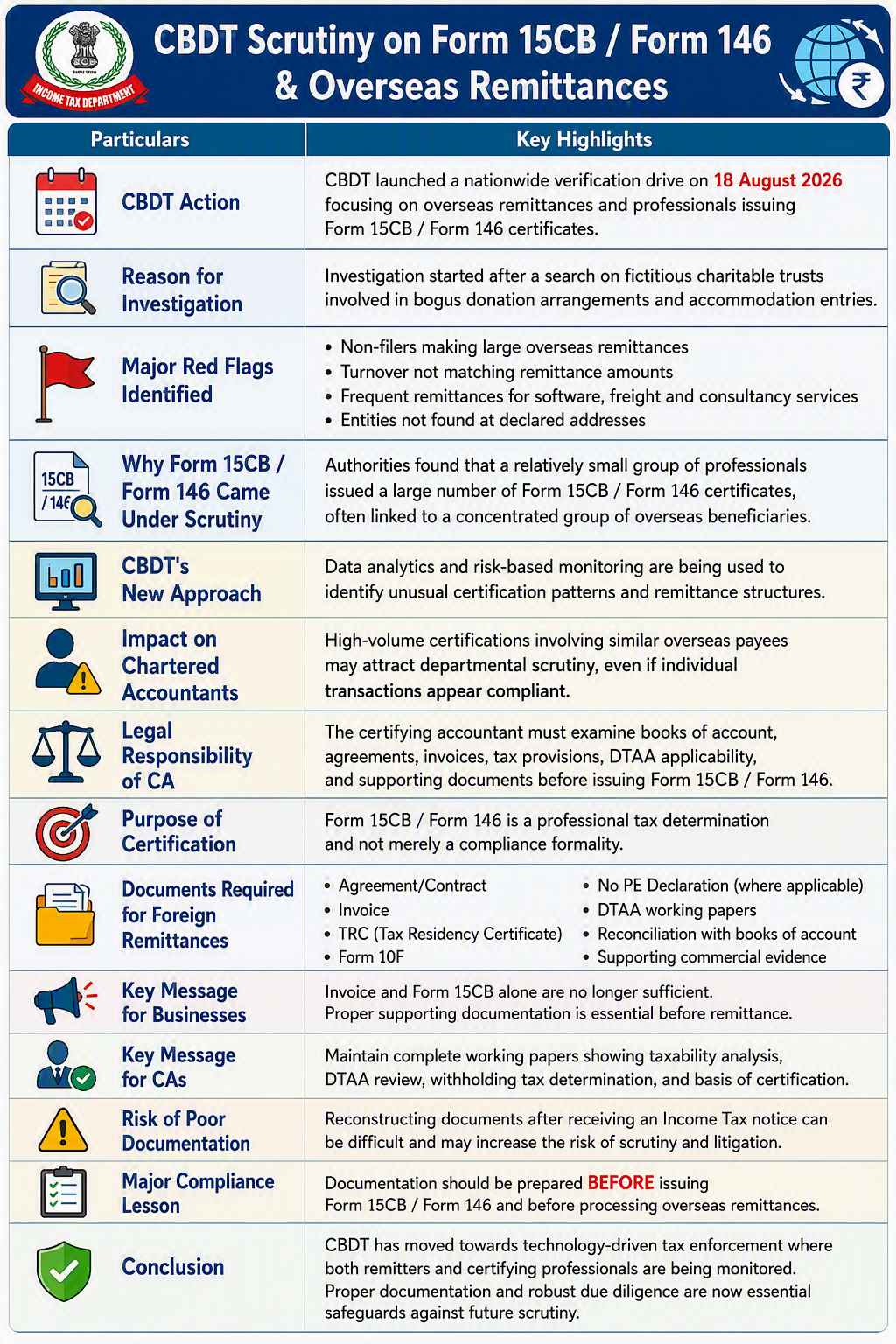
Form 15CB: Due Diligence Over Document Authentication
- A chartered accountant issuing Form 15CB is expected to exercise professional due diligence based on the documents and information furnished by the client but is not ordinarily required to independently investigate or establish the absolute genuineness of every underlying document.
- The role of the CA is to examine the available records, determine the taxability of the foreign remittance, evaluate withholding tax implications, and issue the certificate based on reasonable verification and professional judgment.
- However, the recent CBDT verification drive indicates that regulatory expectations have evolved significantly. While past judicial precedents have provided protection to chartered accountants acting in good faith on documents submitted by clients, professionals can no longer treat Form 15CB as a routine certification.
- With increased use of data analytics, scrutiny of certification patterns, and monitoring of overseas remittances, chartered accountants should maintain robust documentation; detailed working papers; taxability analysis; DTAA evaluations; TRC, Form 10F, agreements, invoices, and supporting evidence before issuing Form 15CB / Form 146. Proper documentation remains the strongest defense against future tax scrutiny and professional liability.
Practical Lesson for CAs
- Rely on client documents, but document your verification process.
- Maintain detailed working papers supporting taxability conclusions.
- Verify treaty benefits, TRC, Form 10F, and PE declarations wherever applicable.
- Avoid issuing Form 15CB solely on the basis of an invoice or client representation.
- A well-documented file is the best protection against departmental inquiries.
In today’s compliance environment, the issue is no longer whether a CA must prove the genuineness of every document but whether the CA can demonstrate adequate professional diligence before issuing Form 15CB / Form 146.
**********************************************************
If this article has helped you in any way, i would appreciate if you could share/like it or leave a comment. Thank you for visiting my blog.
Legal Disclaimer:
The information / articles & any relies to the comments on this blog are provided purely for informational and educational purposes only & are purely based on my understanding / knowledge. They do noy constitute legal advice or legal opinions. The information / articles and any replies to the comments are intended but not promised or guaranteed to be current, complete, or up-to-date and should in no way be taken as a legal advice or an indication of future results. Therefore, i can not take any responsibility for the results or consequences of any attempt to use or adopt any of the information presented on this blog. You are advised not to act or rely on any information / articles contained without first seeking the advice of a practicing professional.