RBI Raises Repo Rate to 5.50%: Detailed Explanation
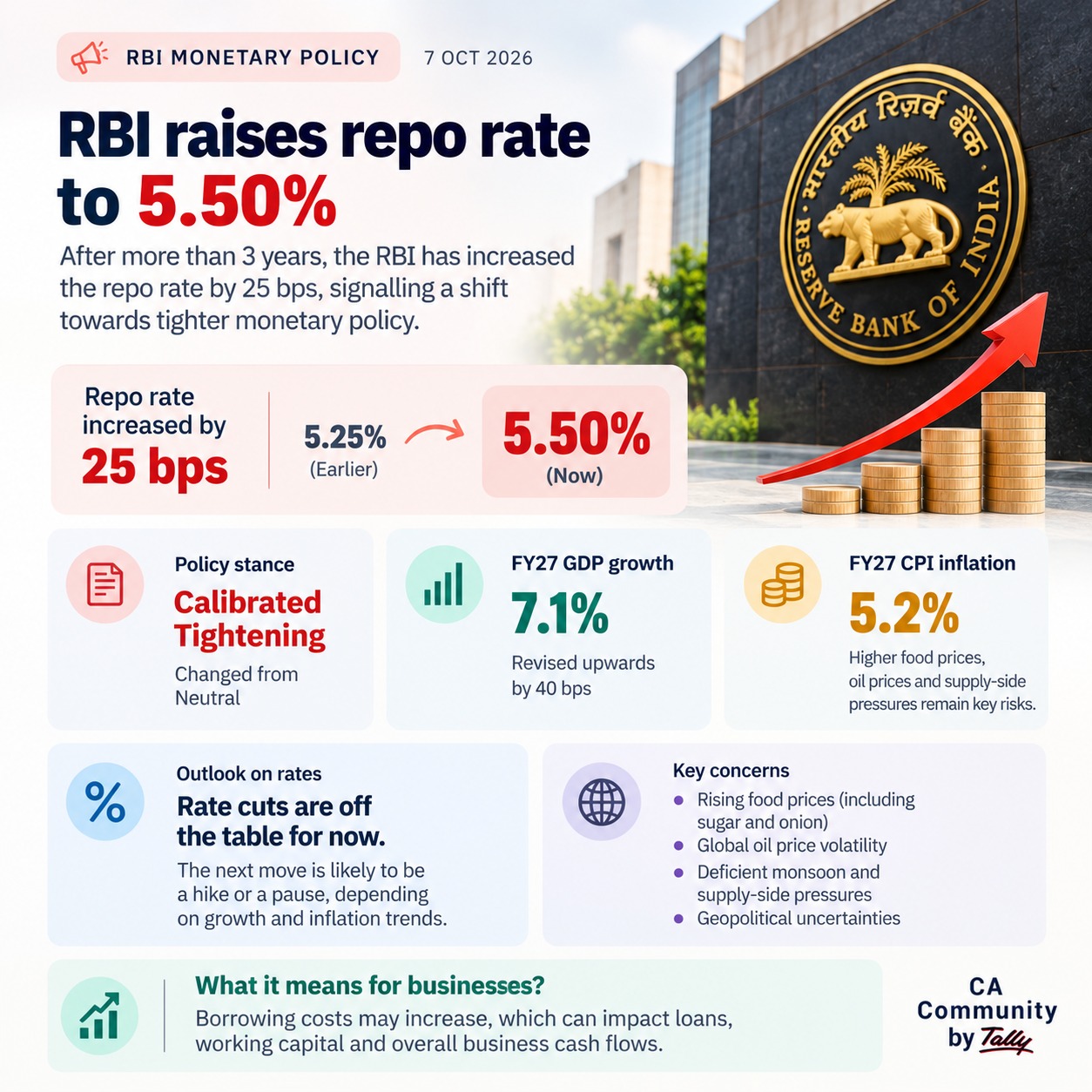
Table of Contents
RBI Raises Repo Rate to 5.50%: Detailed Explanation
The Reserve Bank of India (RBI) has increased the repo rate by 25 basis points (0.25%), raising it from 5.25% to 5.50%. This is significant because it marks a shift towards controlling inflation and signals that interest rates are likely to remain elevated for some time.
What is the Repo Rate?
The repo rate is the rate at which commercial banks borrow short-term funds from the RBI.
- Higher Repo Rate = Costlier borrowing for banks.
- Costlier borrowing for banks = Higher interest rates on loans for customers.
- Lower Repo Rate = Cheaper loans and increased liquidity in the economy.
When RBI wants to control inflation, it generally increases the repo rate.
Why Has RBI Increased the Repo Rate?
1. Rising Inflation Concerns
Inflation is projected at 5.2% for FY 2026-27, which remains above the RBI’s long-term comfort level of 4%. The primary reasons include Increase in food prices, Higher crude oil prices, Supply-side pressures, Global geopolitical uncertainties. When prices rise rapidly, RBI uses higher interest rates to reduce excess demand in the economy.
2. Strong Economic Growth
RBI has projected GDP growth of 7.1% for FY 2026-27. Since economic growth remains healthy, RBI believes the economy can absorb a moderate increase in interest rates without significantly affecting growth.
Change in Policy Stance
Earlier: Neutral : A neutral stance meant RBI was open to either increasing or decreasing rates depending on economic conditions. Now: Calibrated Tightening : A “Calibrated Tightening” stance indicates:
- RBI’s focus is now on containing inflation.
- Further rate cuts are unlikely in the near future.
- The central bank may maintain higher rates for an extended period.
- If inflation worsens, further rate hikes remain possible.
This is often viewed as a cautionary signal to markets and borrowers.
Impact on Businesses
Higher Borrowing Costs:
Businesses relying on Working capital loans, Term loans, Project financing, Overdraft facilities may face higher interest expenses. Example If a company has a ₹10 crore floating-rate loan:
- Interest rate may increase by approximately 0.25%.
- Annual interest burden could rise by around ₹2.5 lakh.
Large borrowers may witness a significant increase in finance costs.
Impact on Expansion Plans :
When borrowing becomes expensive New investments may be postponed, Expansion projects may be delayed. Capital expenditure decisions may become more cautious. This is especially relevant for Real estate, Infrastructure, Manufacturing and MSMEs. which are heavily dependent on debt financing.
Impact on Home Loan Borrowers
Most home loans are linked to external benchmark rates. As a result, EMI may increase, or Loan tenure may increase. Illustration: For an INR 50 lakh home loan:A 0.25% increase could result in a higher monthly EMI or an additional repayment period depending on bank policy.
Impact on Personal Loans and Auto Loans
Banks may gradually revise rates on Personal loans, Vehicle loans, Education loans and Business loans. New borrowers are likely to feel the impact more quickly than existing fixed-rate borrowers.
Impact on Depositors
Higher interest rates are generally positive for savers. Banks may offer Better fixed deposit rates, Higher recurring deposit returns and Improved savings products. Therefore: Borrowers may face higher costs and Depositors may enjoy better returns.
Impact on Stock Markets
Rate hikes generally have mixed effects:
- Negative for Real estate companies, NBFCs, Capital-intensive sectors, Highly leveraged businesses
- Positive for Banks, Financial institutions, and Companies with strong cash reserves, Investors often reassess valuations when interest rates rise.
What Does “No Rate Cuts Expected” Mean?
The RBI’s shift to calibrated tightening suggests Interest rates may remain elevated through much of FY27, Businesses should not expect cheaper credit soon, Borrowers may consider locking in fixed-rate loans where appropriate and Financial planning should factor in a “higher-for-longer” interest rate environment.
Key Takeaway
The RBI’s decision to increase the repo rate from 5.25% to 5.50% reflects its priority of controlling inflation amid rising food and oil prices. While India’s growth outlook remains strong at 7.1%, businesses and borrowers should prepare for higher financing costs, stricter liquidity conditions, and a prolonged period of relatively elevated interest rates. On the positive side, savers and depositors may benefit from improved returns on bank deposits and fixed-income investments.
**********************************************************
If this article has helped you in any way, i would appreciate if you could share/like it or leave a comment. Thank you for visiting my blog.
Legal Disclaimer:
The information / articles & any relies to the comments on this blog are provided purely for informational and educational purposes only & are purely based on my understanding / knowledge. They do noy constitute legal advice or legal opinions. The information / articles and any replies to the comments are intended but not promised or guaranteed to be current, complete, or up-to-date and should in no way be taken as a legal advice or an indication of future results. Therefore, i can not take any responsibility for the results or consequences of any attempt to use or adopt any of the information presented on this blog. You are advised not to act or rely on any information / articles contained without first seeking the advice of a practicing professional.