Highlights & Analysis of 57th Meeting of GST Council Meeting
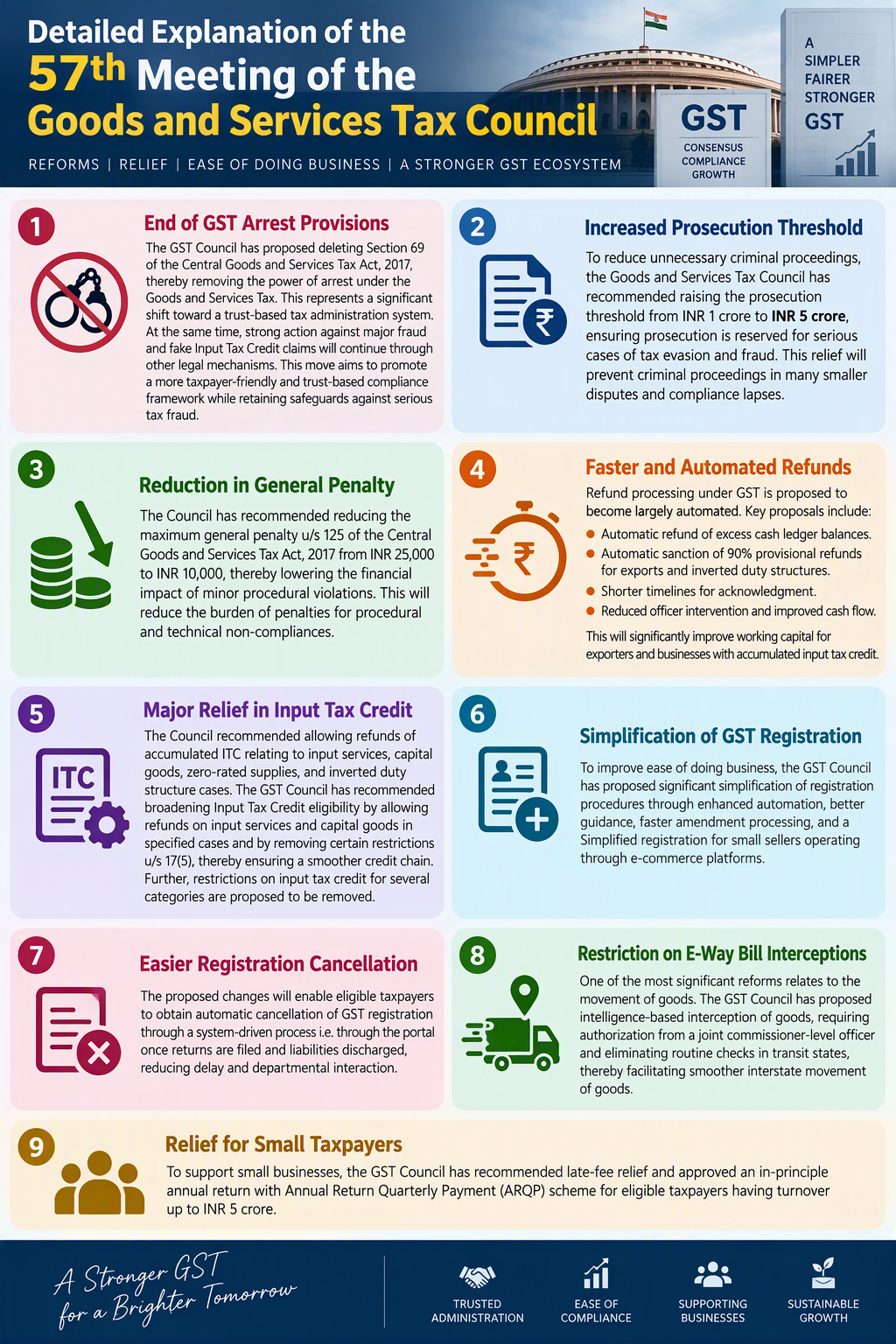
Table of Contents
Key Highlights & Analysis 57th GST Council Meeting (8 October 2026)
The 57th Meeting of the Goods and Services Tax Council introduced some of the most taxpayer-friendly reforms since the Goods and Services Tax was implemented. The focus has shifted from rate changes to simplifying compliance, reducing litigation, speeding up refunds, and improving the flow of input tax credit.
Detailed Explanation of the 57th Meeting of the Goods and Services Tax Council
End of GST Arrest Provisions
The GST Council has proposed deleting Section 69 of the Central Goods and Services Tax Act, 2017, thereby removing the power of arrest under the Goods and Services Tax. This represents a significant shift toward a trust-based tax administration system. At the same time, strong action against major fraud and fake Input Tax Credit claims will continue through other legal mechanisms. This move aims to promote a more taxpayer-friendly and trust-based compliance framework while retaining safeguards against serious tax fraud.
Increased Prosecution Threshold
To reduce unnecessary criminal proceedings, the Goods and Services Tax Council has recommended raising the prosecution threshold from INR 1 crore to INR 5 crore, ensuring prosecution is reserved for serious cases of tax evasion and fraud. This relief will prevent criminal proceedings in many smaller disputes and compliance lapses.
Reduction in General Penalty
The Council has recommended reducing the maximum general penalty u/s 125 of the Central Goods and Services Tax Act, 2017 from INR 25,000 to INR 10,000, thereby lowering the financial impact of minor procedural violations. This will reduce the burden of penalties for procedural and technical non-compliances.
Faster and Automated Refunds
Refund processing under GST is proposed to become largely automated. Key proposals include automatic refund of excess cash ledger balances. Automatic sanction of 90% provisional refunds for exports and inverted duty structures. Shorter timelines for acknowledgment. Reduced officer intervention and improved cash flow. This will significantly improve working capital for exporters and businesses with accumulated input tax credit.
Major Relief in Input Tax Credit
The Council recommended allowing refunds of accumulated ITC relating to input services, capital goods, zero-rated supplies, and inverted duty structure cases. The GST Council has recommended broadening Input Tax Credit eligibility by allowing refunds on input services and capital goods in specified cases and by removing certain restrictions u/s 17(5), thereby ensuring a smoother credit chain. Further, restrictions on input tax credit for several categories are proposed to be removed.
Simplification of GST Registration
To improve ease of doing business, the GST Council has proposed significant simplification of registration procedures through enhanced automation, better guidance, faster amendment processing, and a Simplified registration for small sellers operating through e-commerce platforms.
Easier Registration Cancellation
The proposed changes will enable eligible taxpayers to obtain automatic cancellation of GST registration through a system-driven process i.e. through the portal once returns are filed and liabilities discharged, reducing delay and departmental interaction.
Restriction on E-Way Bill Interceptions
One of the most significant reforms relates to the movement of goods. The GST Council has proposed intelligence-based interception of goods, requiring authorization from a joint commissioner-level officer and eliminating routine checks in transit states, thereby facilitating smoother interstate movement of goods.
Relief for Small Taxpayers
To support small businesses, the GST Council has recommended late-fee relief and approved an in-principle annual return with Annual Return Quarterly Payment (ARQP) scheme for eligible taxpayers having turnover up to INR 5 crore.
Final Takeaway of 57th GST Council Meeting
The 57th GST Council Meeting marks a major shift toward a facilitative and trust-based GST regime. The proposed reforms reduce litigation, remove arrest powers, improve refund timelines, expand Input Tax Credit benefits, simplify registrations, and streamline compliance procedures. If implemented through statutory amendments and notifications, these measures could significantly improve ease of doing business and cash flow for taxpayers across sectors. Major Changes in 57th Meeting of the GST Council at Glance
- GST arrest provisions proposed to be removed.
- The prosecution threshold increased from INR 1 crore to INR 5 crore.
- General penalty reduced from INR 25,000 to INR 10,000.
- Refunds to become largely automated.
- Wider availability of input tax credit and refund benefits.
- Simplified GST registration and cancellation process.
- Restrictions on interception of goods during transit.
- New relief measures for small taxpayers and exporters.
**********************************************************
If this article has helped you in any way, i would appreciate if you could share/like it or leave a comment. Thank you for visiting my blog.
Legal Disclaimer:
The information / articles & any relies to the comments on this blog are provided purely for informational and educational purposes only & are purely based on my understanding / knowledge. They do noy constitute legal advice or legal opinions. The information / articles and any replies to the comments are intended but not promised or guaranteed to be current, complete, or up-to-date and should in no way be taken as a legal advice or an indication of future results. Therefore, i can not take any responsibility for the results or consequences of any attempt to use or adopt any of the information presented on this blog. You are advised not to act or rely on any information / articles contained without first seeking the advice of a practicing professional.