Why Are More Taxpayers Choosing the New Income Tax Regime?
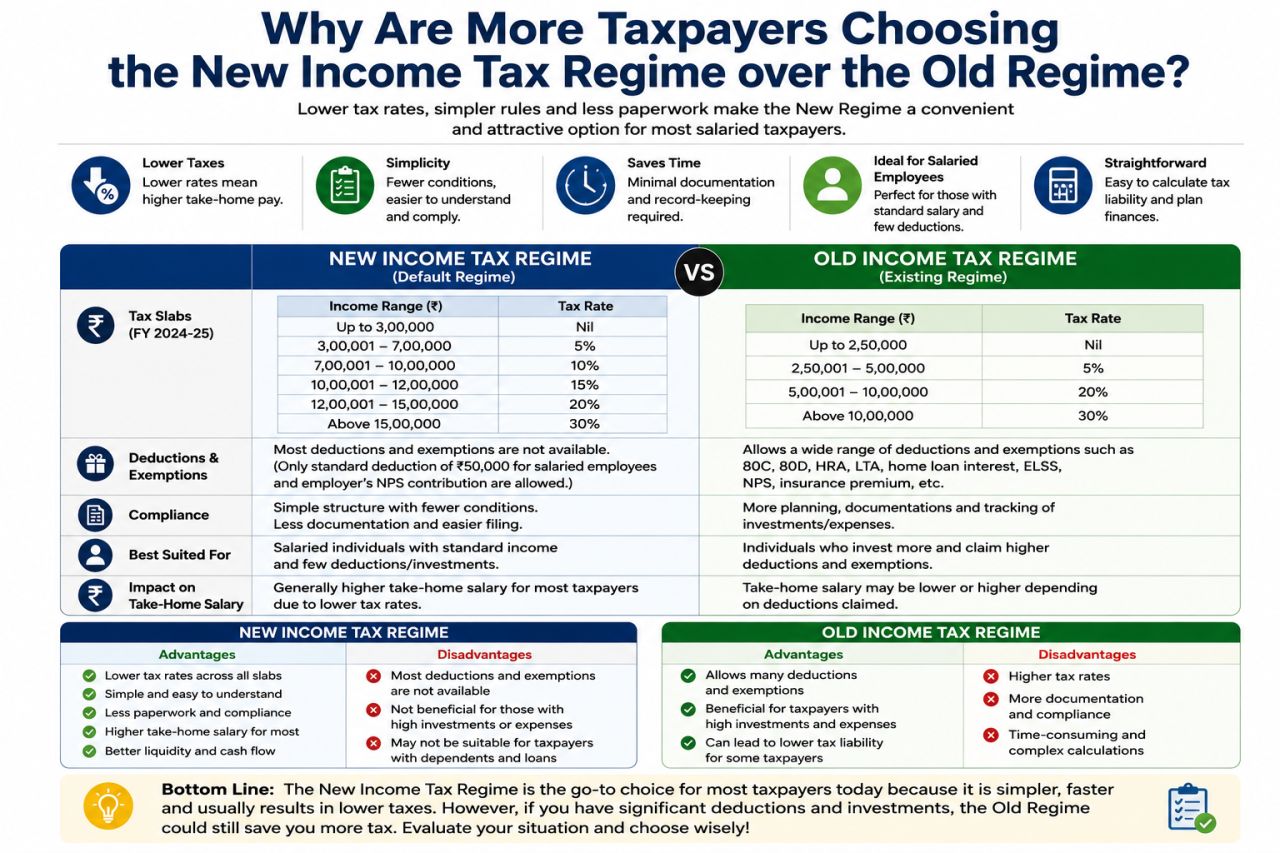
Table of Contents
Why Are More Taxpayers Choosing the New Income Tax Regime?
For many years, Indian taxpayers depended heavily on deductions and exemptions under the Old Tax Regime to reduce their tax liability. However, with the introduction of the New Tax Regime, the focus has shifted toward Lower tax rates, simpler compliance, and Greater financial flexibility
As a result, a growing number of taxpayers, especially salaried individuals, freelancers, and professionals, are reconsidering their choice.
(A) Is the New Tax Regime Better?
In many cases, yes, but it depends on Income structure, available deductions, and Investment habits
(i) Old Tax Regime : Key Features Allows multiple deductions & exemptions like Section 80C (LIC, PPF, ELSS, etc.), HRA, LTA, home loan interest, medical insurance (80D) and standard deduction. Limitation of Old Tax Regime is Higher tax rates, heavy documentation, and Investment may be tax-driven, not goal-driven
(ii) New Tax Regime : Key Features like Lower tax slab rates, Minimal deductions/exemptions and Simplified filing process, basic Purpose of New Tax Regime is to designed for taxpayers who prefer Simplicity, Liquidity and Freedom in financial decisions
(B) Major Benefits of the New Tax Regime
- Lower Tax Rates: reduced slab rates across income levels, Beneficial for Young professionals, Freelancers, startup employees, and Individuals without large deductions
- Simpler Tax Filing: The old regime requires LIC receipts, rent receipts, investment proofs, and medical bills, and new regime eliminates most of this. Which result is easier filing, less stress, and minimal paperwork?
- Greater Flexibility in Investments: Under the old regime, taxpayers often invest just to save tax. Basic Common Issues in it like Buying unnecessary insurance policies, locking money in low-return products and Forced tax-saving investments
- New Regime Advantage: Invest based on financial goals—not tax pressure
- Standard Deduction Benefit: Salaried taxpayers can now claim standard deduction even under the new regime and taxpayers make it more attractive and competitive with the old regime
New vs Old Tax Regime – Quick Decision Guide (FY 2025–26)
The New Tax Regime is positioned as a simpler, more transparent, and efficient alternative to the traditional system. While it reduces deductions, it compensates with lower tax rates, higher rebate limits, and minimal compliance burden. However, the right choice still depends on your income structure and deductions.
Quick Decision Rule: Key Insight
- Old Regime → Deduction-driven tax planning—Choose the old tax regime if the taxpayer claims high deductions, such as Section 80C (INR 1.5 lakh), home loan interest (INR 2 lakh), HRA exemption, and medical insurance (80D). You actively invest to reduce taxes
- New Regime → Rate-driven simplified taxation: Choose New Tax Regime if You have limited deductions, taxpayers want simplified filing, You prefer flexibility and liquidity and Your income falls in mid-level slabs without heavy tax planning
Quick Comparison Table
| Particulars | Old Tax Regime | New Tax Regime |
| Applicability | Optional regime | Default regime |
| Basic Exemption Limit | INR 2.5 lakh | INR 4 lakh |
| Maximum Tax Rate | 30% (above INR 10 lakh) | 30% (above INR 24 lakh) |
| Rebate (Sec 87A) | INR 12,500 | INR 60,000 |
| Standard Deduction | INR 50,000 | INR 75,000 |
| Tax-Free Income | Up to INR 5 lakh | Up to INR 12 lakh |
New Tax Regime is not just a change in rates—it represents a shift toward ease of compliance and financial flexibility. Taxpayers should evaluate salary structure, eligible deductions, investment strategy, and long-term financial goals. before making a choice.
Old vs. New Tax Regime—Which is Better? (FY 2025–26)
| Feature | Old Tax Regime | New Tax Regime |
| Default Regime | No | Yes |
| Basic Exemption Limit | INR 2.5 lakh | INR 4 lakh |
| Rebate u/s 87A | INR 12,500 (income up to INR 5 lakh) | INR 60,000 (income up to INR 12 lakh) |
| Standard Deduction | INR 50,000 | INR 75,000 |
| Section 80C Deductions | Allowed | Not Allowed |
| HRA Exemption | Allowed | Not Allowed |
| Home Loan Interest (Self-occupied) | Allowed | Not Allowed |
| NPS Deduction | Fully Allowed | Only Employer Contribution Allowed |
| Set-off of House Property Losses | Allowed | Not Allowed |
| Section 80D (Medical Insurance) | Allowed | Not Allowed |
When Should a Taxpayer Choose the Old Tax Regime?
Taxpayer: Opt for the Old Regime if:
- You have high HRA exemption (common in metro cities)
- Taxpayer are servicing a home loan (interest + principal benefits)
- You fully utilize deductions under the following:
- Section 80C (₹1.5 lakh)
- Section 80D (medical insurance)
- NPS contributions
- taxpayer total deductions exceed ₹6–8 lakh
- Old Old Regime is Best suited for Salaried individuals with structured investments, taxpayers actively using tax-saving instruments
When Should You Choose the New Tax Regime?
Taxpayer: Opt for the new regime if:
- You have minimal or no deductions
- Taxpayer do not have a home loan
- You prefer simple tax filing with minimal documentation
- Taxpayer want flexibility and liquidity in investments
New Regime is best suited for young professionals, Freelancers / consultants, and individuals without tax-saving investments
Why the Government Promotes the New Tax Regime
The Government of India actively promotes the New Tax Regime as part of a broader strategy to modernize the taxation system, enhance compliance, and simplify the overall tax experience for individuals and businesses.
- Simplification of Tax Structure: The old tax regime is complex, with numerous exemptions, deductions, conditions, and documentation requirements. The new regime removes most of these elements, creating a clean and straightforward tax system. Which Impact that Easier understanding for taxpayers, Reduced dependency on tax professionals for basic filing and Less confusion and fewer errors
- Reduction in Administrative Burden: Under the old regime, tax authorities had to verify multiple deductions (80C, 80D, HRA, etc.) and taxpayers had to maintain extensive documentation. The new regime significantly cuts down this burden by limiting deductions. Which result in faster processing of returns, Reduced scrutiny and verification workload and More efficient tax administration
- Increased Voluntary Compliance: A simpler system encourages taxpayers to file returns on time and declare income accurately. When compliance becomes easier, taxpayers are more willing to comply voluntarily. Which gives outcomes like Improved tax compliance rates, lower litigation and disputes, and better tax culture.
- Lower Tax Rates as an Incentive: The government offers reduced slab rates across income brackets. This acts as a direct incentive for taxpayers to shift to the new regime. Which creates benefits like Immediate tax savings (especially for those with fewer deductions) and Increased adoption among salaried individuals and professionals
- Transparency and Reduced Litigation: The old regime often leads to Disputes over deduction eligibility, incorrect claims, and scrutiny notices. The new regime reduces these issues by removing most exemptions and standardizing taxable income computation. Which result in lesser chances of disputes and greater transparency in tax calculation
- Encouraging a Broader Tax Base: By simplifying compliance and lowering rates More individuals are encouraged to enter the tax system. This leads to widening of the tax base, which is a key policy objective. Which impact, like Increased overall tax collection and Reduced dependence on a small group of taxpayers
- Alignment with Digital Tax Ecosystem: India is moving toward pre-filled ITRs, AIS / TIS integration, and data-driven compliance monitoring.
Final Thoughts: Why new regime
The government promotes the New Tax Regime to create a system that is simpler, transparent, efficient, digitally aligned, and compliance-friendly. “The new tax regime is not just a change in tax rates—it is a structural reform aimed at making taxation simpler, fairer, and more efficient for the future.” The new regime fits perfectly with this digital tax framework. Advantages Easier income tracking, Automated compliance checks and Improved accuracy in reporting The promotion of the new regime reflects a policy shift from incentive-based taxation to rate-based taxation:
- Old Regime → Tax-saving driven decisions
- New Regime → Income-based transparent taxation
This aligns with global best practices where lower rates & fewer exemptions = higher compliance & efficiency.
The new tax regime is not just about lower taxes reflecting a modern shift in taxation philosophy:
- From forced savings → to financial independence
- From complex compliance → to simplified filing
It is especially beneficial for younger taxpayers. Professionals with limited deductions and Individuals prioritizing liquidity The best regime depends on income level, deduction eligibility, investment behavior, and long-term financial goals. Taxpayer: “Choosing wisely can improve both your tax savings and your long-term financial planning.”
ITR Filing Changes Checklist – AY 2026-27
**********************************************************
If this article has helped you in any way, i would appreciate if you could share/like it or leave a comment. Thank you for visiting my blog.
Legal Disclaimer:
The information / articles & any relies to the comments on this blog are provided purely for informational and educational purposes only & are purely based on my understanding / knowledge. They do noy constitute legal advice or legal opinions. The information / articles and any replies to the comments are intended but not promised or guaranteed to be current, complete, or up-to-date and should in no way be taken as a legal advice or an indication of future results. Therefore, i can not take any responsibility for the results or consequences of any attempt to use or adopt any of the information presented on this blog. You are advised not to act or rely on any information / articles contained without first seeking the advice of a practicing professional.