How to Check Your UPPCL Electricity Bill Before You Pay
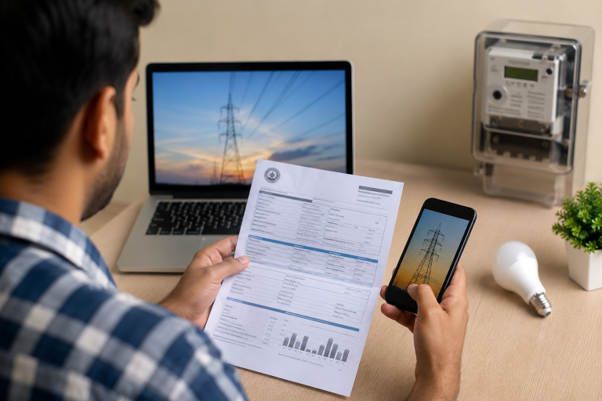
Table of Contents
How to Check Your UPPCL Electricity Bill Before You Pay
Your UPPCL bill carries energy charges, a fuel surcharge, fixed charges, and duty. Here is how to check it online, what each item means, and how to pay before the due date.
Most UP consumers pay their electricity bill the moment they see the total. They do not read it. A UPPCL electricity bill payment in 2026 is not just one number. It is five or six separate charges added together. One of them is a fuel surcharge that changed in June 2026. Another can show a reading that was estimated rather than measured. If you pay without looking, you cannot catch either. Checking takes two minutes. Here is how.
For UPPCL consumers managing their monthly bill, Bajaj Pay, the Bharat Connect payments platform on Bajaj Finance, shows your exact outstanding bill amount before you confirm payment, pulled live from the DISCOM’s system.
Step One: Find Your Consumer Number
Everything starts here. Your consumer number is a 10 or 12-digit number printed in bold at the top of any previous bill. You can also find it on your meter box or through the UPPCL consumer app once registered.
Without this number, no portal or app can pull your bill. Write it down somewhere accessible.
Step Two: Check Your Bill
There are three ways to view UPPCL electricity bill details before paying.
On the official UPPCL portal:
- Go to consumer.uppcl.org
- Select View Bill
- Enter your consumer number and submit
- Your current bill appears with a full breakdown
- Download the PDF to keep a copy
On the UPPCL consumer app:
- Download the app and register with your mobile number
- Log in and select View Bill from the dashboard
- Current and past bills are listed with full details
On a BBPS payment platform:
- Select your UPPCL DISCOM and enter your consumer number
- The platform fetches your live bill directly from the DISCOM
- You see the exact amount before paying anything
Step Three: Read What You Are Looking At
Most people see the total and stop. The total is built from these components, per UPERC’s Tariff Order for FY 2026-27.
| What It Is Called | What It Actually Means | Does It Change Each Month |
| Energy charges | Units you used × rate per unit. Rate increases in slabs as usage goes up. | Yes. Depends on how much electricity you used. |
| Fixed charge | A flat monthly fee based on the size of your connection in kW. Not linked to usage. | No. Same every month regardless of consumption. |
| FPPAS | Fuel surcharge. Added when the cost of buying power rises. Revised quarterly. | Yes. Can go up or down each quarter. |
| Electricity duty | 5% charged by the state government on your energy and fixed charges. | Partially. Fixed rate, but the amount changes with energy usage. |
| Meter rent | Small flat charge for the meter itself. | No. Same every month. |
| Arrears | Any amount unpaid from a previous billing period. | Only if you have an outstanding balance. |
The One Line Most People Never Check
On your bill, there is a meter reading section. It shows last month’s reading and this month’s reading. The difference is the units you are billed for.
Look for one word next to the reading.
- If it says ACTUAL: Your meter was read this month. The units on the bill are real. You used what it says.
- If it says ESTIMATED: The DISCOM used an average of your past bills to calculate this month’s charge. It is a guess. If you used significantly more or less than your average, the estimate will be wrong.
Estimated readings are common. They are often accurate. But if your bill looks higher than it should and the reading is estimated, do not pay until you have raised it.
Call the UPPCL helpline on 1912. It is available 24 hours a day, seven days a week. Or lodge a complaint through consumer.uppcl.org before paying. Getting a correction after payment takes considerably longer.
The June 2026 Update Worth Knowing
UPPCL added a 10% FPPAS fuel surcharge to all June 2026 bills, per an official order by UPPCL’s Chief Engineer. This applies to domestic, commercial, and industrial connections. A bill that was Rs. 1,000 last month is approximately Rs. 1,100 this month on energy charges alone, before other line items.
FPPAS is revised quarterly by UPERC. It is one of the items that causes a bill to jump even when your consumption has not changed. Checking the bill tells you how much of this month’s increase is usage and how much is the surcharge.
Step Four: Pay Before the Due Date
Bills arrive by the 10th of each month. The payment window is 15 days from the bill date.
Two things change depending on when you pay.
- Pay digitally before the due date: 1% rebate on the energy charge, per UPERC’s tariff order.
- Pay after the due date:25% to 1.5% late payment surcharge per month on the outstanding amount.
On a Rs. 1,500 bill, the swing between paying on time and paying late is roughly Rs. 34 to Rs. 37. It is not a large amount. But it happens every month and it goes in the wrong direction if you miss the date.
Paying two days before the due date removes the risk of any processing delay pushing the transaction a day over.
For UPPCL electricity bill payment through Bajaj Finance, the steps are straightforward.
Steps to pay your UPPCL electricity bill:
- Open the Bajaj Finance app or visit bajajfinserv.in and log in
- Go to Bills and Recharges and select Electricity
- Select your UPPCL distribution company from the list
- Enter your consumer number and click Fetch Bill
- Review the exact bill amount shown before confirming
- Choose a payment method and complete the transaction for instant confirmation
Find your consumer number. Check the bill before paying. Look at whether the reading is actual or estimated. Note the FPPAS line if it has changed. Pay before the due date. That is the full routine. It takes two minutes and it is the difference between paying the right amount and paying the wrong one without knowing it.
**********************************************************
If this article has helped you in any way, i would appreciate if you could share/like it or leave a comment. Thank you for visiting my blog.
Legal Disclaimer:
The information / articles & any relies to the comments on this blog are provided purely for informational and educational purposes only & are purely based on my understanding / knowledge. They do noy constitute legal advice or legal opinions. The information / articles and any replies to the comments are intended but not promised or guaranteed to be current, complete, or up-to-date and should in no way be taken as a legal advice or an indication of future results. Therefore, i can not take any responsibility for the results or consequences of any attempt to use or adopt any of the information presented on this blog. You are advised not to act or rely on any information / articles contained without first seeking the advice of a practicing professional.