E-Invoicing Extended to RCM & Imported Services
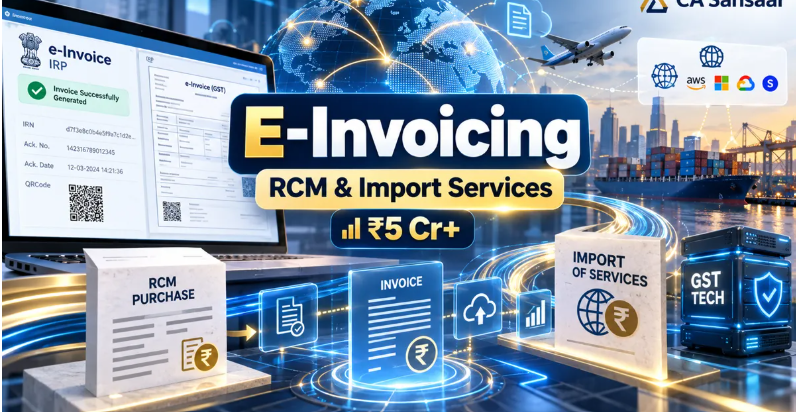
Table of Contents
E-Invoicing Extended to RCM & Imported Services: What Does It Mean?
One of the most significant compliance proposals of the 57th GST Council Meeting is the expansion of e-invoicing requirements to certain Reverse Charge Mechanism transactions and imported services for taxpayers having annual turnover of INR 5 crore or more.
- Current Position : At present, e-invoicing is generally applicable to outward taxable supplies made by eligible registered taxpayers. Businesses are not required to generate e-invoices for Purchases from unregistered suppliers liable under RCM, Import of services from foreign entities and Self-invoices raised under Section 31(3)(f) of the CGST Act.
- Proposed Change : Businesses with aggregate turnover exceeding INR 5 crore may be required to generate e-invoices even for Purchases from unregistered suppliers covered under RCM, Import of services from overseas suppliers and self-invoices issued under Reverse Charge Mechanism. This means such transactions will have to be reported through the Invoice Registration Portal (IRP) and obtain an Invoice Reference Number (IRN), just like regular e-invoices.
- This is currently a GST Council recommendation and will become effective only after the necessary notifications, rules, and system changes are notified by the government.
Practical Example 1: RCM Purchase :
Suppose a company with a turnover of INR 10 crore receives legal services from an unregistered advocate and pays GST under RCM.
- Current System: The company issues a self-invoice and pays GST under RCM. And Claims ITC subject to conditions.
- Proposed System: The company issues a self-invoice. The self-invoice may need e-invoice generation through IRP., IRN and QR code may be mandatory. And GST paid under RCM and subsequently claimed as ITC.
Practical Example 2: Imported Services :
An Indian company receives software subscription services from a foreign vendor.
- Current System: The company raises a self-invoice. Pays IGST under RCM. And Claims ITC.
- Proposed System: Self-invoice may need to be reported on the e-invoicing portal, IRN generation may become mandatory. And additional reporting and compliance requirements will arise.
Why Is the Government Introducing This?
The objective appears to be Better tracking of RCM transactions, Improved reconciliation between GST returns and e-invoice data, Reduction of under-reporting of imported services, automated verification of ITC claims and Stronger data analytics and compliance monitoring.
Compliance Impact on Businesses
- Additional Compliance Burden: Businesses will have to generate self-invoices for RCM transactions, Upload eligible transactions to the IRP, ensure IRN generation, reconcile RCM e-invoices with GSTR-3B and books of accounts, and modify ERP and accounting systems.
- Increased Record-Keeping: Finance teams will need to maintain separate controls for Domestic RCM purchases, imported services, and self-invoicing requirements. And E-invoice reporting.
- ERP & Software Changes: Businesses may need to Upgrade ERP systems, Create automated self-invoice workflows, Integrate RCM transactions with e-invoicing APIs and Build reconciliation reports between IRN data and GST returns.
Who Will Be Most Affected?
The proposal is likely to impact IT and software companies, multinational corporations, Global Capability Centres (GCCs), consulting firms, financial services businesses, manufacturing companies using foreign software or technical services, and large enterprises making frequent RCM payments.
Better Invoice Reconciliation and Return Corrections
To reduce mismatches between reported turnover, GST liability, and Input Tax Credit (ITC), the GST Council has proposed a comprehensive return-matching framework. These measures are aimed at improving data accuracy, minimizing notices, and ensuring smoother GST compliance.
- Improved Matching of Sales and Tax Liability: The GST system will strengthen reconciliation between outward supplies reported in GSTR-1, GSTR-1A, and the Invoice Furnishing Facility (IFF) and the tax liability discharged through GSTR-3B. This will help identify discrepancies at an early stage and reduce compliance disputes.
- Formalization of the Invoice Management System (IMS) : The proposed framework gives legal backing to the Invoice Management System (IMS), allowing recipients to accept supplier invoices, Reject incorrect invoices, and keep invoices pending for verification
- before such documents are reflected in GSTR-2B for ITC purposes. This is expected to improve ITC accuracy and reduce reconciliation issues.
- Dedicated Statement for Reverse Charge Mechanism (RCM) : A separate electronic statement is proposed for tracking Reverse Charge Mechanism (RCM) transactions. Under RCM, the responsibility to pay GST shifts from the supplier to the recipient. The new statement will facilitate better reporting of tax paid under RCM, ITC claimed against RCM payments, and reconciliation of RCM transactions with GST returns.
- Enhanced Transparency in Return Filing : The proposed changes seek to create a more integrated GST ecosystem where tax liability, ITC claims, and RCM payments are automatically matched across returns, reducing the likelihood of errors, notices, and litigation.
- Public Consultation Before Implementation: Before these reforms are introduced, the government plans to release the detailed framework for stakeholder consultation and public feedback. The revised return-matching system is proposed to be implemented from the April 2027 return period, subject to approval and notification.
Key Takeaway on E-Invoicing Extended to RCM & Imported Services
While the proposal improves transparency and GST data matching, it also introduces a new layer of compliance for businesses with turnover above INR 5 crore. Companies will need to revisit their RCM processes, imported service transactions, accounting software, and ERP configurations to ensure seamless e-invoice generation for self-invoiced transactions once the proposal is implemented.
**********************************************************
If this article has helped you in any way, i would appreciate if you could share/like it or leave a comment. Thank you for visiting my blog.
Legal Disclaimer:
The information / articles & any relies to the comments on this blog are provided purely for informational and educational purposes only & are purely based on my understanding / knowledge. They do noy constitute legal advice or legal opinions. The information / articles and any replies to the comments are intended but not promised or guaranteed to be current, complete, or up-to-date and should in no way be taken as a legal advice or an indication of future results. Therefore, i can not take any responsibility for the results or consequences of any attempt to use or adopt any of the information presented on this blog. You are advised not to act or rely on any information / articles contained without first seeking the advice of a practicing professional.