Labour Codes 2026: Key Buzzwords Every Employer
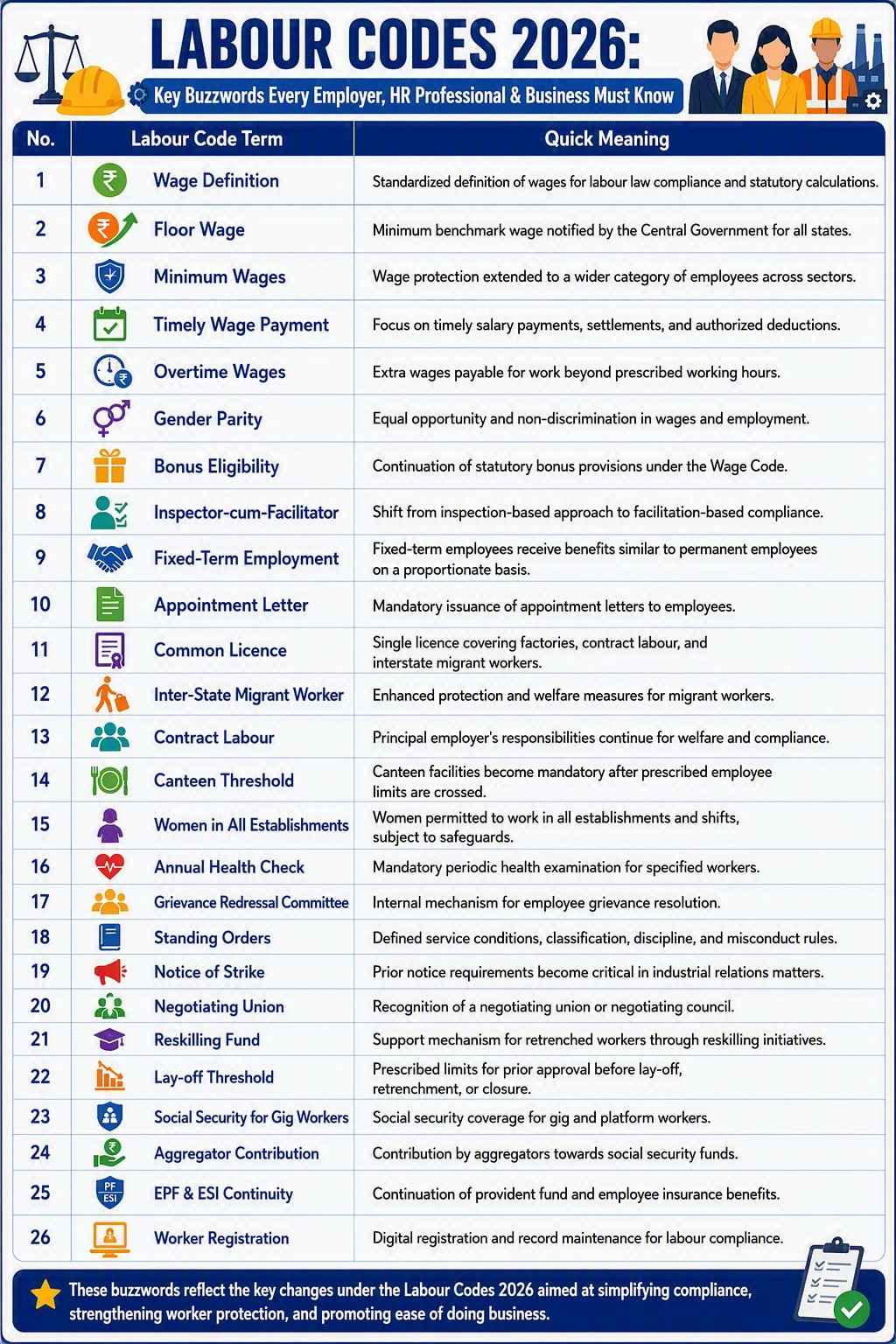
Labour Codes 2026: Key Buzzwords Every Employer, HR Professional & Business Must Know
| No. | Labour Code Term | Quick Meaning |
|---|---|---|
| 1 | Wage Definition | Standardized definition of wages for labour law compliance and statutory calculations. |
| 2 | Floor Wage | Minimum benchmark wage notified by the Central Government for all states. |
| 3 | Minimum Wages | Wage protection extended to a wider category of employees across sectors. |
| 4 | Timely Wage Payment | Focus on timely salary payments, settlements, and authorized deductions. |
| 5 | Overtime Wages | Extra wages payable for work beyond prescribed working hours. |
| 6 | Gender Parity | Equal opportunity and non-discrimination in wages and employment. |
| 7 | Bonus Eligibility | Continuation of statutory bonus provisions under the Wage Code. |
| 8 | Inspector-cum-Facilitator | Shift from inspection-based approach to facilitation-based compliance. |
| 9 | Fixed-Term Employment | Fixed-term employees receive benefits similar to permanent employees on a proportionate basis. |
| 10 | Appointment Letter | Mandatory issuance of appointment letters to employees. |
| 11 | Common Licence | Single licence covering factories, contract labour, and interstate migrant workers. |
| 12 | Inter-State Migrant Worker | Enhanced protection and welfare measures for migrant workers. |
| 13 | Contract Labour | Principal employer’s responsibilities continue for welfare and compliance. |
| 14 | Canteen Threshold | Canteen facilities become mandatory after prescribed employee limits are crossed. |
| 15 | Women in All Establishments | Women permitted to work in all establishments and shifts, subject to safeguards. |
| 16 | Annual Health Check | Mandatory periodic health examination for specified workers. |
| 17 | Grievance Redressal Committee | Internal mechanism for employee grievance resolution. |
| 18 | Standing Orders | Defined service conditions, classification, discipline, and misconduct rules. |
| 19 | Notice of Strike | Prior notice requirements become critical in industrial relations matters. |
| 20 | Negotiating Union | Recognition of a negotiating union or negotiating council. |
| 21 | Reskilling Fund | Support mechanism for retrenched workers through reskilling initiatives. |
| 22 | Lay-off Threshold | Prescribed limits for prior approval before lay-off, retrenchment, or closure. |
| 23 | Social Security for Gig Workers | Social security coverage for gig and platform workers. |
| 24 | Aggregator Contribution | Contribution by aggregators towards social security funds. |
| 25 | EPF & ESI Continuity | Continuation of provident fund and employee insurance benefits. |
| 26 | Worker Registration | Digital registration and record maintenance for labour compliance. |
Key Takeaway
- Labour Codes aim to simplify labour law compliance.
- Greater focus on employee welfare, social security, and digital compliance.
- Mandatory appointment letters, worker registration, grievance systems, and health checks gain importance.
- Gig workers, fixed-term employees, women workers, and migrant workers receive enhanced protection.
- Employers, HR professionals, compliance officers, and business owners should review policies and documentation to align with Labour Codes 2026 requirements.
**********************************************************
If this article has helped you in any way, i would appreciate if you could share/like it or leave a comment. Thank you for visiting my blog.
Legal Disclaimer:
The information / articles & any relies to the comments on this blog are provided purely for informational and educational purposes only & are purely based on my understanding / knowledge. They do noy constitute legal advice or legal opinions. The information / articles and any replies to the comments are intended but not promised or guaranteed to be current, complete, or up-to-date and should in no way be taken as a legal advice or an indication of future results. Therefore, i can not take any responsibility for the results or consequences of any attempt to use or adopt any of the information presented on this blog. You are advised not to act or rely on any information / articles contained without first seeking the advice of a practicing professional.