Complete Guide on Reverse Charge Mechanism under GST
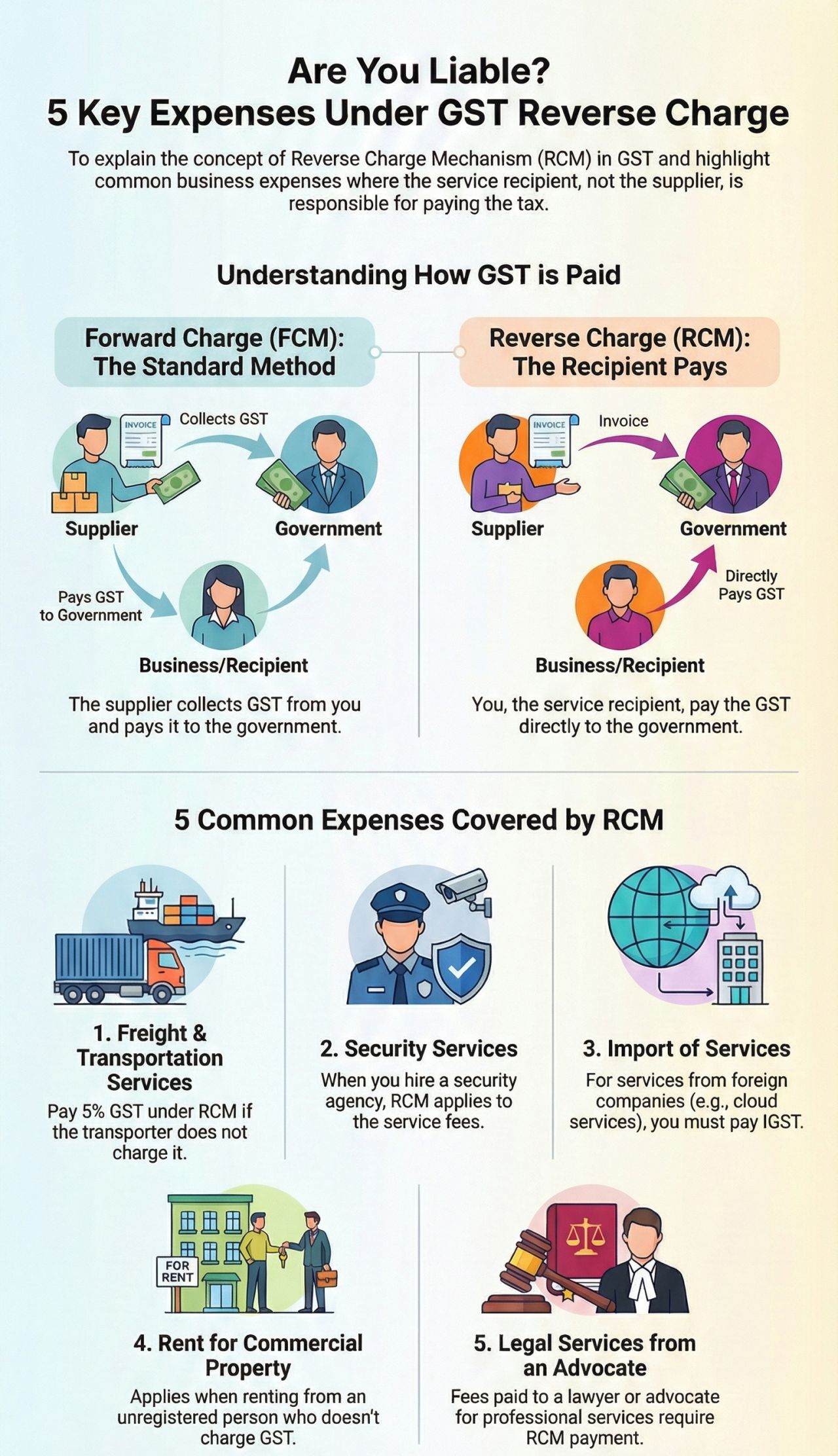
Table of Contents
Complete 2026 Guide on Reverse Charge Mechanism under GST
As per 2026 updated RCM list & RCM rules, the Reverse Charge Mechanism (RCM) is a GST provision where the recipient of goods or services is liable to pay GST instead of the supplier. The legal basis for RCM is provided under Section 9(3) and 9(4) of the of the Central Goods and Services Tax Act 2017 and Section 5(3) and 5(4) of the IGST Act, 2017.
Major Services Covered Under Reverse Charge Mechanism
Goods Transport Agency (GTA) Services:
If GTA services are provided to specified recipients such as companies, registered persons, partnership firms, factories, societies, etc., GST is payable by the recipient under RCM subject to prescribed conditions.
Legal Services:
Services provided by individual advocates, senior advocates, and firms of advocates to a business entity located in India are covered under RCM. The business entity is liable to pay GST.
Arbitral Tribunal Services
Where an arbitral tribunal provides services to a business entity, the recipient business entity pays GST under RCM.
Sponsorship Services
When sponsorship services are supplied to a body corporate or partnership firm, GST liability shifts to the recipient under the Reverse Charge Mechanism.
Government Services
Specified services provided by the central government, state government, union territory, or local authority to a business entity attract GST under reverse charge, subject to exclusions.
Renting of Immovable Property by Government
When the government rents immovable property to a registered person, GST is payable by the registered recipient under the reverse charge mechanism.
Director’s Services
Services provided by directors to a company or body corporate are generally covered under the reverse charge mechanism. The company is liable to pay GST.
Insurance Agent Services
Commission paid to insurance agents attracts Reverse Charge Mechanism and the insurance company pays GST.
Recovery Agent Services
Recovery agents providing services to banks, financial institutions, and NBFCs are covered under the reverse charge mechanism.
Security Services
Security services supplied by a non-body corporate to a registered person generally attract GST under the reverse charge mechanism.
Renting of Motor Vehicles
Where motor vehicle renting services are provided by a non-body corporate to a body corporate under specified conditions, GST is payable under Reverse Charge Mechanism by the recipient company.
Direct Selling Agent (DSA) Services
Services provided by an individual DSA to a bank or NBFC attract the Reverse Charge Mechanism.
Business Correspondent / Business Facilitator Services
Banks receiving services from business correspondents and business facilitators are liable to pay GST under the reverse charge mechanism.
Development Rights, FSI and Long-Term Lease of Land
Promoters may be liable to pay GST under the Reverse Charge Mechanism in specified real estate transactions involving development rights, FSI, or long-term lease of land.
Renting of Residential Dwelling to Registered Persons
If a registered person takes a residential property on rent for business or commercial purposes from an unregistered landlord, GST is payable under the Reverse Charge Mechanism by the registered tenant.
Import of Services Under GST – Important RCM Provision
The following conditions constitute an import of service Supplier located outside India, Recipient located in India, Place of supply situated in India.,Where these conditions are satisfied, IGST is generally payable by the Indian recipient under Reverse Charge Mechanism.
Common Examples of Reverse Charge Mechanism under Import of Services
- Foreign legal consultancy.
- Software subscriptions (ChatGPT, Claude, SaaS platforms)
- Foreign management consultancy
- Overseas engineering or technical services
- International advertising services
- Royalty and intellectual property payments
- Services from foreign parent companies to Indian subsidiaries
In such cases, the Indian recipient generally pays IGST under the Reverse Charge Mechanism.
Reverse Charge Mechanism on Goods
RCM is applicable not only on services but also to certain notified goods, including cashew nuts (unprocessed), Tendu leaves, tobacco leaves, silk yarn, and lottery transactions under notified structures subject to specified conditions.
Section 9(4) – Purchases from Unregistered Suppliers
- A common myth is that every purchase from an unregistered supplier attracts GST under RCM. This is incorrect. Section 9(4) of the Central Goods and Services Tax Act currently applies only to Notified categories of registered persons and Specified supplies
- The most significant application is in the real estate sector involving promoters. Normal business purchases from unregistered vendors generally do not attract RCM merely because the supplier is unregistered.
Practical GST Compliance Under the Reverse Charge Mechanism.
Payment Must Be Made in Cash: Reverse Charge Mechanism liability cannot generally be discharged using Input Tax Credit (ITC). GST must first be paid in cash, and thereafter eligible ITC can be claimed.
Type of Tax
- Intra-State Supply → CGST + SGST
- Inter-State Supply / Import of Services → IGST
Self-Invoice and Payment Voucher
Recipients liable under Reverse Charge Mechanism may be required to issue Self-invoice and payment voucher and report the same appropriately in GST returns.
- ITC Eligibility: Even after paying GST under the Reverse Charge Mechanism, ITC is available only if Used for business purposes, proper documentation is available, tax has been paid, and conditions of Section 16 of the Central Goods and Services Tax Act are satisfied. and credit is not blocked u/s 17(5) of the Central Goods and Services Tax Act
- Time Limit for Claiming RCM ITC: As clarified through Circular No. 211/5/2024-GST, the time limit for claiming ITC depends upon the financial year in which the self-invoice is issued, not the year in which services were received.
- 180-Day Payment Rule Not Applicable: The normal supplier payment condition does not apply to supplies covered under reverse charge. Therefore, the 180-day payment reversal provisions are generally not applicable to reverse charge mechanism supplies.
Key Takeaway from Reverse Charge Mechanism update in 2026
Businesses should carefully examine transactions involving legal fees, director remuneration, security services, GTA, import of services, residential property rented for business purposes, and foreign software subscriptions such as ChatGPT or other overseas SaaS tools, since these are among the most frequently missed RCM liabilities. Proper payment of GST under the Reverse Charge Mechanism, timely self-invoicing, and correct ITC claims are essential to avoid future GST notices, interest, and penalties.
**********************************************************
If this article has helped you in any way, i would appreciate if you could share/like it or leave a comment. Thank you for visiting my blog.
Legal Disclaimer:
The information / articles & any relies to the comments on this blog are provided purely for informational and educational purposes only & are purely based on my understanding / knowledge. They do noy constitute legal advice or legal opinions. The information / articles and any replies to the comments are intended but not promised or guaranteed to be current, complete, or up-to-date and should in no way be taken as a legal advice or an indication of future results. Therefore, i can not take any responsibility for the results or consequences of any attempt to use or adopt any of the information presented on this blog. You are advised not to act or rely on any information / articles contained without first seeking the advice of a practicing professional.