IBC Advisory on Heightened Diligence to Prevent IBC Misuse
 IBC Advisory on Heightened Diligence to Prevent Misuse of IBC Proceedings for Fraudulent Purposes: A Wake-Up Call for IP’s
Introduction
- The Insolvency and Bankruptcy Code, 2016 was enacted to provide a transparent, time-bound, and efficient framework for resolving corporate distress, maximizing value for stakeholders, and promoting responsible business conduct.
- Over the years, the IBC has emerged as one of India’s most significant economic reforms, strengthening creditor confidence and improving the country’s insolvency resolution ecosystem.
- However, the IPA of the IIIPI ICAI, via its Advisory dated 03 September 2026, has highlighted growing concerns regarding the alleged misuse of IBC proceedings by certain entities for purposes unrelated to genuine insolvency resolution.
- Based on inputs from law enforcement agencies, the advisory serves as a critical reminder to IPs to exercise enhanced diligence and vigilance while undertaking assignments under the Code.
Growing Concerns Over Misuse of the IBC Framework
According to the advisory, certain entities are allegedly leveraging the insolvency process as a strategic tool to achieve objectives beyond the legislative intent of the Code.
Instead of facilitating bona fide resolution of stressed businesses, IBC proceedings are reportedly being used for:
- Settlement of debts through improper mechanisms.
- Reduction or avoidance of tax liabilities.
- Closure, merger, or restructuring of companies without adequate regulatory scrutiny.
- Escaping investigations, prosecutions, or statutory penalties.
- Monetization and protection of assets for the benefit of related parties.
Such practices undermine the credibility of the insolvency framework and create significant risks for creditors, regulators, and other stakeholders.
Indicative Patterns of Misuse under the CIRP
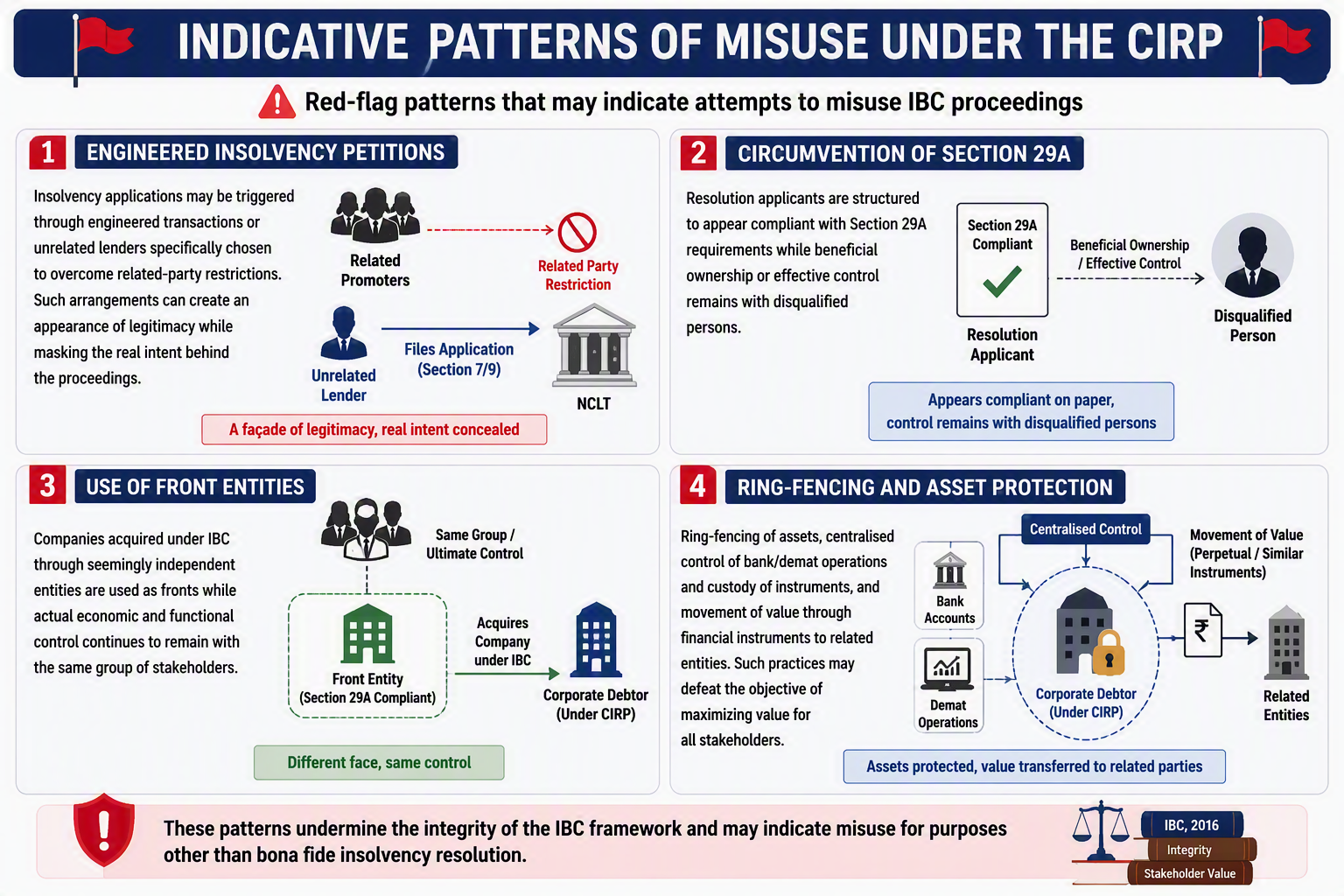
The advisory identifies several red-flag patterns that may indicate attempts to misuse IBC proceedings.
-
Engineered Insolvency Petitions
-
- In some cases, insolvency applications may be triggered through engineered transactions or unrelated lenders specifically chosen to overcome related-party restrictions.
- Such arrangements can create an appearance of legitimacy while masking the real intent behind the proceedings.
-
Circumvention of Section 29A
-
- Section 29A was introduced to prevent undesirable persons from regaining control of distressed companies.
- However, authorities have observed instances where resolution applicants are structured to appear compliant with Section 29A requirements while beneficial ownership or effective control remains with disqualified persons.
-
Use of Front Entities
-
- Another concern involves the acquisition of companies under the IBC through seemingly independent entities, which are then used as fronts while actual economic and functional control continues to remain with the same group of stakeholders.
-
Ring-Fencing and Asset Protection
-
- The advisory also highlights instances involving the ring-fencing of assets, centralized control of banking and demat operations, and movement of value through financial instruments to related entities.
- Such practices may defeat the objective of maximizing value for all stakeholders.
Signs of Orchestrated Insolvency Proceedings
- Law enforcement agencies have alerted regulators that certain entities are allegedly misusing the Insolvency and Bankruptcy Code (IBC), 2016 for purposes other than genuine insolvency resolution.
- Such misuse may involve avoiding taxes, evading investigations and penalties, restructuring or closing companies without proper scrutiny, and protecting or monetizing assets through fraudulent arrangements.
- The reported practices include filing insolvency applications through unrelated lenders, circumventing Section 29A restrictions while retaining actual control, using IBC-acquired entities as front companies, and ring-fencing assets for related parties.
- Law enforcement agencies have further indicated that some insolvency processes may be carefully orchestrated even before the commencement of proceedings. Warning signs may include:
-
- Identification of a pre-selected Section 29A-compliant resolution applicant.
- Advance arrangement of funding sources for acquisition under the IBC.
- Selection of unrelated lenders for filing applications under Sections 7 or 9 of the Code.
- Identification and engagement of professionals to facilitate such planned transactions.
- When multiple such factors are present simultaneously, insolvency professionals should exercise heightened caution and thoroughly evaluate the underlying commercial rationale of the transaction.
- In some cases, insolvency proceedings are allegedly pre-planned by identifying compliant resolution applicants, arranging acquisition funding, engaging unrelated lenders, and selecting professionals to facilitate the process.
- These actions undermine the integrity and objectives of the IBC, defeat its legislative intent, and risk damaging the credibility of the insolvency ecosystem and its stakeholders.
The Critical Role of Insolvency Professionals under the CIRP
- Insolvency Professionals occupy a position of trust within the insolvency ecosystem.
- They are expected to maintain independence, integrity, objectivity, and professional competence throughout the Corporate Insolvency Resolution Process .
- The advisory reinforces the responsibility of IPs to act as gatekeepers of the insolvency framework by identifying and addressing potential red flags at an early stage.
- Failure to detect or adequately address suspicious arrangements may expose professionals to regulatory scrutiny and damage the credibility of the insolvency profession.
Key Expectations from Insolvency Professionals under CIRP
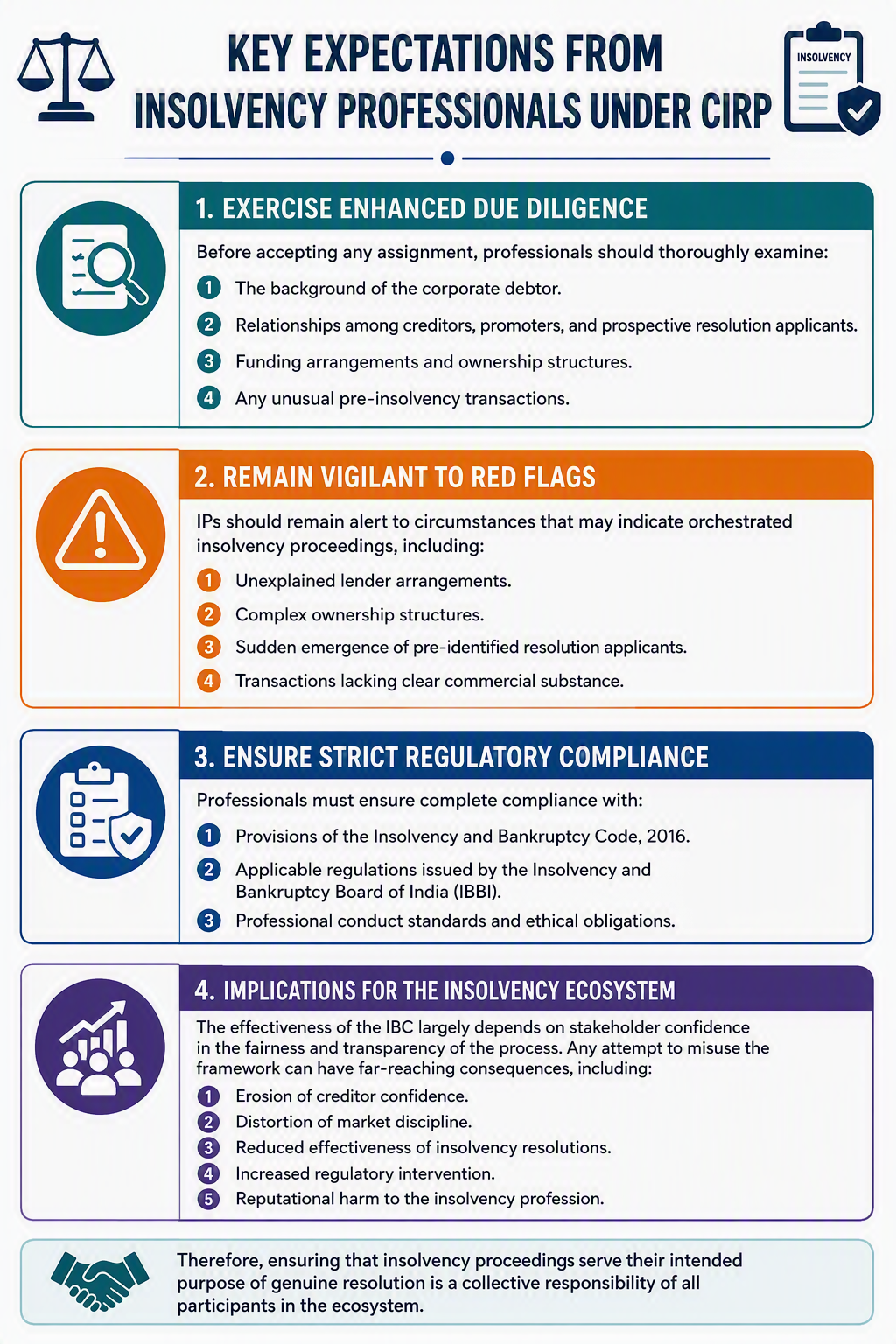
Exercise Enhanced Due Diligence
Before accepting any assignment, professionals should thoroughly examine:
- The background of the corporate debtor.
- Relationships among creditors, promoters, and prospective resolution applicants.
- Funding arrangements and ownership structures.
- Any unusual pre-insolvency transactions.
Remain Vigilant to Red Flags
IPs should remain alert to circumstances that may indicate orchestrated insolvency proceedings, including:
- Unexplained lender arrangements.
- Complex ownership structures.
- Sudden emergence of pre-identified resolution applicants.
- Transactions lacking clear commercial substance.
Ensure Strict Regulatory Compliance
Professionals must ensure complete compliance with:
- Provisions of the Insolvency and Bankruptcy Code, 2016.
- Applicable regulations issued by the Insolvency and Bankruptcy Board of India (IBBI).
- Professional conduct standards and ethical obligations.
Implications for the Insolvency Ecosystem
The effectiveness of the IBC largely depends on stakeholder confidence in the fairness and transparency of the process. Any attempt to misuse the framework can have far-reaching consequences, including:
- Erosion of creditor confidence.
- Distortion of market discipline.
- Reduced effectiveness of insolvency resolutions.
- Increased regulatory intervention.
- Reputational harm to the insolvency profession.
Therefore, ensuring that insolvency proceedings serve their intended purpose of genuine resolution is a collective responsibility of all participants in the ecosystem.
Conclusion
- The IIIPI Advisory dated 03 September 2026 is a timely reminder that the Insolvency and Bankruptcy Code must not become a vehicle for achieving objectives unrelated to insolvency resolution.
- Alleged attempts to use the framework for tax mitigation, avoidance of regulatory action, asset protection, or promoter-driven restructuring threaten the integrity of the Code and undermine public trust in the insolvency process.
- For insolvency professionals, the message is clear: exercise heightened diligence, identify potential red flags, maintain professional independence, and ensure strict compliance with the letter and spirit of the IBC.
- By doing so, they can play a crucial role in safeguarding the credibility, transparency, and effectiveness of India’s insolvency resolution framework.
**********************************************************
If this article has helped you in any way, i would appreciate if you could share/like it or leave a comment. Thank you for visiting my blog.
Legal Disclaimer:
The information / articles & any relies to the comments on this blog are provided purely for informational and educational purposes only & are purely based on my understanding / knowledge. They do noy constitute legal advice or legal opinions. The information / articles and any replies to the comments are intended but not promised or guaranteed to be current, complete, or up-to-date and should in no way be taken as a legal advice or an indication of future results. Therefore, i can not take any responsibility for the results or consequences of any attempt to use or adopt any of the information presented on this blog. You are advised not to act or rely on any information / articles contained without first seeking the advice of a practicing professional.