E-Invoicing for RCM Self-Invoices to be Introduced Soon
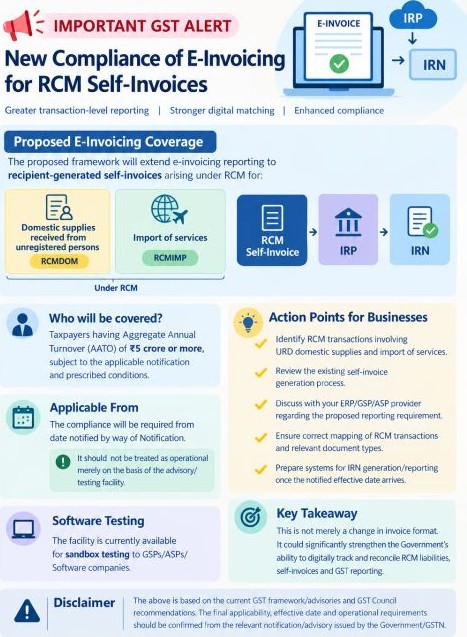
Table of Contents
E-Invoicing for RCM Self-Invoices to be Introduced Soon : GST Alert
The Goods and Services Tax Network has issued an advisory introducing a new e-invoicing framework for recipient-generated self-invoices under the Reverse Charge Mechanism. The proposal follows recommendations of the GST Council and is currently available for sandbox testing.
What is Changing?
GSTN proposes to extend the e-Invoicing system to self-invoices generated by recipients in the following cases:
- RCMDOM (Reverse Charge Mechanism – Domestic) : For specified domestic supplies received from unregistered suppliers, where GST is payable by the recipient under RCM.
- RCMIMP (Reverse Charge Mechanism – Import) : For import of services received from suppliers located outside India, where GST is payable under RCM by the recipient.
- Applicability : The proposed facility is intended for registered taxpayers having an Aggregate Annual Turnover of INR 5 crore or more, which aligns with the current e-Invoicing eligibility threshold. The actual applicability will be subject to notifications issued by the Government.
- Effective Date : The reporting requirement has not yet been notified for live implementation. The Goods and Services Tax Network has clarified that the effective date, scope and compliance requirements will be governed through future notifications.
- Current Status : At present, the functionality is available only in the sandbox environment of authorized Invoice Registration Portals (IRPs) for testing by ERP Providers, GSPs (GST Suvidha Providers), ASPs (Application Service Providers) and Software Developers. This enables businesses and technology partners to prepare their systems before the production rollout.
Key Impact on Businesses:
Once implemented:
- Self-invoices under eligible RCM transactions may require generation of an Invoice Reference Number (IRN).
- Businesses will need to integrate their ERP/accounting systems with the e-Invoice framework.
- Additional compliance checks and documentation processes may be required.
- Import of services and specified purchases from unregistered persons will come within the e-Invoicing ecosystem.
Action Points for Taxpayers
Businesses should proactively review all transactions that may attract the Reverse Charge Mechanism and identify purchases from unregistered suppliers as well as import of service transactions. Organizations should engage with their ERP, accounting software, and GSP providers to evaluate system readiness for the proposed e-invoicing requirements.
Further, taxpayers should closely monitor updates and notifications issued by the Goods and Services Tax Network, CBIC, and the e-Invoice Portal regarding the official implementation date and compliance requirements. Internal accounting, tax compliance, documentation, and reporting processes should also be reviewed and strengthened well in advance.
What Should Businesses Do Now?
- At this stage, the focus should be on preparedness rather than immediate implementation. Businesses with an annual turnover of INR 5 crore or more should undertake a comprehensive impact assessment to understand how the proposed changes may affect their operations.
- This includes mapping transactions covered under RCM, evaluating the current self-invoicing process, identifying data sources within ERP systems, and assessing the changes required across Tax, Finance, Procurement, and IT functions.
- Organizations should also review whether their existing systems can accurately identify RCM transactions, generate compliant self-invoices, and support future reporting through the Invoice Registration Portal (IRP).
- Once RCM self-invoices are brought within the e-invoicing framework, compliance will extend beyond merely discharging tax liability. Businesses will be required to maintain accurate transaction-level data, robust documentation processes, and seamless integration between accounting systems and the e-invoicing ecosystem.
Conclusion—Key Takeaway
- Proposed framework represents a significant evolution in GST compliance. E-invoicing is gradually expanding beyond outward supplies and is expected to play an important role in the documentation and control of specific inward RCM transactions as well. Businesses that strengthen their data quality, system controls, and process integration today will be better positioned for smooth compliance when the new requirements are formally notified
- The proposed introduction of RCMDOM and RCMIMP marks a significant expansion of the GST e-Invoicing framework. Although the compliance requirement is not yet mandatory, businesses with turnover exceeding INR 5 crore should begin assessing the impact and preparing their systems to ensure a smooth transition once the government notifies the effective date
**********************************************************
If this article has helped you in any way, i would appreciate if you could share/like it or leave a comment. Thank you for visiting my blog.
Legal Disclaimer:
The information / articles & any relies to the comments on this blog are provided purely for informational and educational purposes only & are purely based on my understanding / knowledge. They do noy constitute legal advice or legal opinions. The information / articles and any replies to the comments are intended but not promised or guaranteed to be current, complete, or up-to-date and should in no way be taken as a legal advice or an indication of future results. Therefore, i can not take any responsibility for the results or consequences of any attempt to use or adopt any of the information presented on this blog. You are advised not to act or rely on any information / articles contained without first seeking the advice of a practicing professional.