Release of Excel Utilities for ITR-1 & ITR-4
Table of Contents
BREAKING NEW : Excel Utilities for ITR-1 & ITR-4 Now Available for AY 2026-27!
Tax Filing Season Officially Begins :
The early release of Excel Utilities for ITR-1 and ITR-4 for AY 2025-26 is a welcome step, allowing taxpayers to prepare and file their returns well ahead of time. Don’t wait for the deadline rush—start now and enjoy a stress-free filing experience. The Income Tax Department has released the Excel-based Offline Utilities for:
- ITR-1 (Sahaj)
- ITR-4 (Sugam)
for Assessment Year 2025-26 (pertaining to Financial Year 2024-25). These utilities enable offline preparation and XML upload via the Income Tax e-Filing Portal.
Who Should Use These Forms?
Overview of ITR-4 & ITR-1.
| ITR Form | Who Can File | Type of Utility Available |
| ITR-1 (Sahaj) | Resident individuals having total income up to INR 50 lakh from: – Salary/pension – One house property – Other sources (interest, etc.) – Agricultural income up to ₹5,000 |
Online and Offline |
| ITR-4 (Sugam) | Resident Individuals, HUFs, and Firms (other than LLP) with income up to ₹50 lakh and income from: – Business & profession computed under presumptive taxation under Sections 44AD, 44ADA, or 44AE |
Online and Offline |
ITR-4 & ITR-1 Utility Mode:
- Online filing: Directly through the e-Filing portal
- Offline utility (JavaScript-based): Can be downloaded from the portal under “Downloads” → “ITR Utilities”
-
These utilities allow taxpayers to fill, validate, and generate their return forms offline without relying on continuous internet connectivity. Once the form is filled and validated, the tool creates a .json file that can be uploaded on the Income Tax e-filing portal. Built-in checks and validations help users minimize errors before submission.
Steps to File ITR-4 & ITR-1 Using Excel Utility
- Download Excel Utility from the Income Tax Portal.
- Fill in details: Income, deductions, TDS, bank details.
- Validate entries and calculate tax using utility.
- Generate XML file after successful validation.
- Upload XML on the portal under “File Income Tax Return”.
- E-Verify the return (Aadhaar OTP, Net Banking, DSC, or ITR-V post).
You can start preparing and filing your return for AY 2025–26 using these forms if you are eligible. Let me know if you want
- A checklist of documents needed
- Tax planning tips before filing
- Help with selecting the correct ITR form
- A comparison of new vs old tax regime based on your income
- Documents to Keep Ready
-
- Form 16/16A
- Form 26AS, AIS & TIS
- PAN, Aadhaar
- Bank statements
- Investment proofs
- Home loan/employment rent receipts
Old vs. New Tax Regime: What to Know
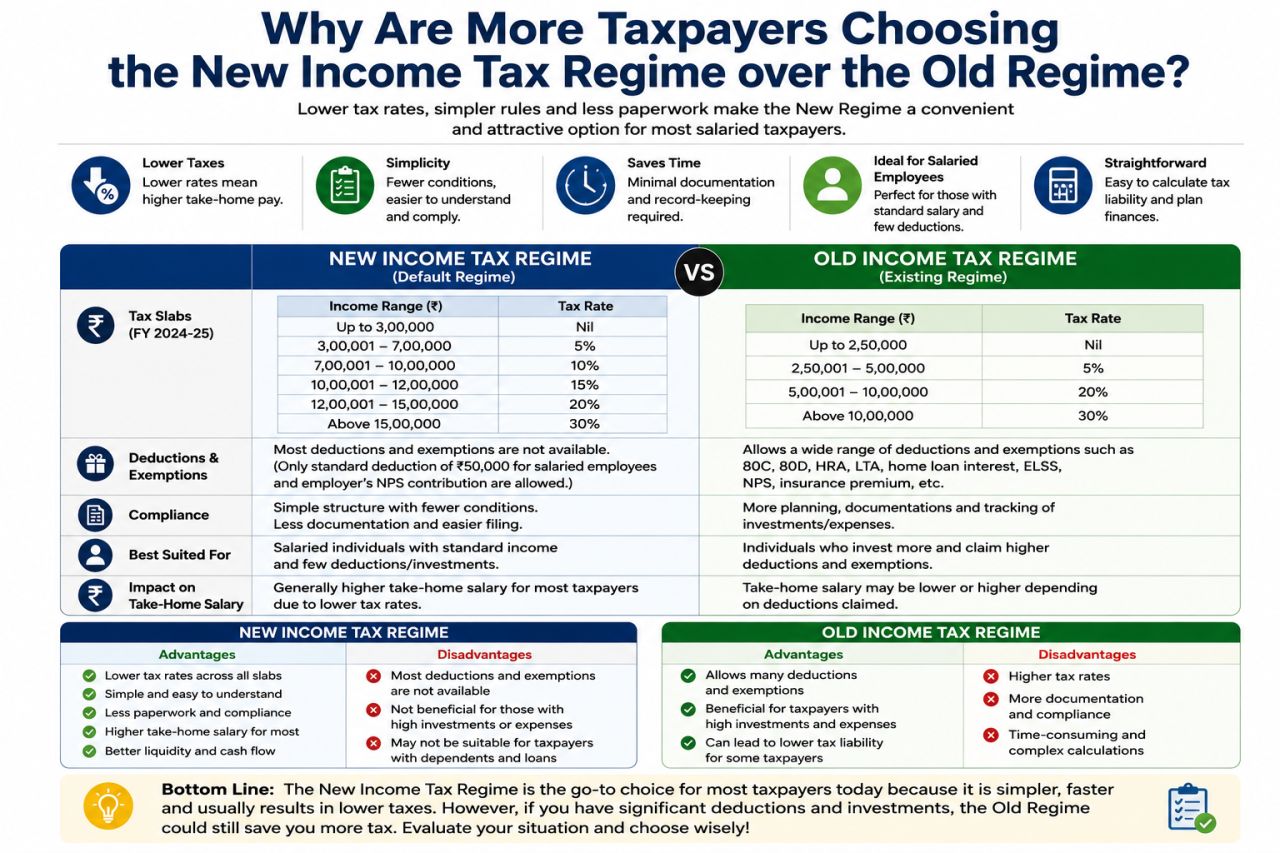
- Default Regime for FY 2025-26 is New Tax Regime
- You can opt for Old Tax Regime if it gives more benefit (e.g., 80C, 80D, HRA, interest on home loan)
- Form 10-IEA must be filed if opting for Old Regime
- Common Filing Mistakes to Avoid like Selecting wrong ITR form, Entering incorrect PAN/Aadhaar/IFSC, Mismatch between reported income and Form 26AS/AIS and Not declaring interest income from savings/FDs.
Benefits of Early ITR Filing
- Avoids last-minute portal congestion
- Quicker processing and faster tax refunds
- More time for error correction and rectification
- Peace of mind and more time for financial planning
- Improved visibility into income and tax liabilities
Who is NOT Required to File ITR
1. Income Below Basic Exemption Limit
For Financial Year 2025-26 (AY 2026-27), your table is not correct under the new tax regime. The basic exemption limit has been increased to INR 4,00,000 for all individuals irrespective of age. Basic Exemption Limit – FY 2025-26
| Category | New Regime | Old Regime |
|---|---|---|
| Individuals below 60 years | INR 4,00,000 | INR 2,50,000 |
| Senior Citizens (60–80 years) | INR 4,00,000 | INR 3,00,000 |
| Super Senior Citizens (80+ years) | INR 4,00,000 | INR 5,00,000 |
Under the new tax regime, the Section 87A rebate has been enhanced, making income up to INR 1,200,000 effectively tax-free (and up to approximately INR 12.75 lakh salary income after the standard deduction of ₹75,000). However, ITR filing may still be required in specific situations such as:
- Holding foreign assets,
- Foreign income,
- Claiming a refund of tax deducted at source.
- Certain high-value transactions,
- Carrying forward losses.
Therefore, for FY 2025-26, replace INR 300,000 with INR 400,000 in all New Regime rows.
2. Income Only from Interest or Pension (No TDS Deducted)
-
If total income (e.g., FD, savings interest, pension) is within exemption limit and no TDS is deducted ➝ ITR not required
3. Agricultural Income (Below Threshold)
-
If only agricultural income and it is ≤ ₹5,000 ➝ ITR not required
-
If agricultural income > ₹5,000 AND non-agricultural income > exemption limit ➝ ITR mandatory (due to partial integration)
4. Housewives & Students with No Taxable Income
-
No ITR needed if income is from gifts, pocket money, or family allowances
5. NRIs with No or Minimal Indian Income
-
NRIs with Indian income < ₹2.5 lakh ➝ No ITR required
6. Income Only from Dividends/Savings Interest (Below Limit)
-
If total of such income is below exemption limit, no ITR needed
7. Senior Citizens Exempt under Section 194P
Conditions for ITR Exemption (Age 75+):
-
Resident Senior Citizen (75+ years)
-
Only pension + interest from same bank
-
Form 12BBA submitted to that bank
-
Bank is notified by CBDT
-
Bank computes and deducts tax after considering deductions (80C, 80D, etc.)
When ITR Filing is Mandatory (Even if Income is Below Limit)
You must file ITR if any of the following apply:
| Condition |
|---|
| You are a director in a company |
| You are a partner in an LLP |
| Deposited INR 1 crore or more in a bank account in a year |
| Spent INR 2 lakh or more on foreign travel |
| Paid INR 1 lakh or more electricity bill in a year |
| TDS of INR 25,000 or more deducted (INR 50,000 for senior citizens) |
| Turnover of business ≥ INR 60 lakh or receipts from profession ≥ INR 10 lakh |
| You are claiming a refund |
Why File ITR Even If Not Mandatory?
While many individuals are legally exempt from filing ITR based on income type and amount, filing is often beneficial. Always evaluate based on your financial goals and compliance needs.
| Benefits of Voluntary ITR Filing |
|---|
| Helps in securing loans and credit cards |
| Useful for visa applications |
| Serves as income proof for various purposes |
| Helps in claiming TDS refunds |
| Builds a consistent financial track record |
ITR Filing Changes Checklist – AY 2026-27 (FY 2025-26)
Forms ITR-1 to ITR-7, ITR-V and ITR-U notified 30 March 2026 (Income-Tax Sixth Amendment Rules, 2026), effective 31 March 2026. Corrigendum 10 April 2026. The utility/schema was further updated in July 2026. This return year is still governed by the Income Tax Act, 1961.
A. Due dates and return timelines
- ITR-1 and ITR-2 due date: 31 July 2026
- Non-audit ITR-3 / ITR-4 due date: 31 August 2026
- Tax audit report (3CD): 30 September 2026
- Audit return due date: 31 October 2026
- Revised return deadline: 31 March 2027
- Section 234I fee on revised returns filed Jan-Mar 2027
- Belated return deadline: 31 December 2026
- ITR-U window extended to 48 months (up to 31 March 2031)
B. Computation changes
- New regime exemption up to Rs.4 lakh
- Section 87A rebate increased to Rs.60,000
- Old STCG/LTCG fields removed
- Cost Inflation Index FY 2025-26: 363
C. Form eligibility
- ITR-1 and ITR-4 allow up to two house properties
- Section 89A foreign retirement accounts shifted to ITR-2/ITR-3
D. Schedule EI
- Specified category dropdowns mandatory
- Residual row restored in July 2026 update
- Disclose large non-income receipts where appropriate
E. New and expanded disclosures
- Primary and secondary mobile/email details required
- Representative assessee details simplified
- Expanded Form 10-IEA disclosure
- TDS section reporting mandatory
F. House property
- Unrealised rent disclosure field added
- Tenant PAN/Aadhaar mandatory u/s 194-IB
- Tenant TAN mandatory u/s 194-I
G. Deductions
- 80G transaction reference and IFSC mandatory
- 80GGC name and PAN mandatory
- Itemised 80C breakup required
- Expanded HRA reporting and landlord PAN
H. ITR-2 and ITR-3
- Schedule AL threshold increased to income above Rs.1 crore
- Buyback capital loss reporting
- Separate concessional interest reporting
- VDA transaction-wise reporting
- Schedule FA reporting for ROR taxpayers
I. ITR-3 and ITR-4
- Separate disclosure of F&O, intraday, commodity and currency turnover
- ITR-4 investment disclosure field
- ITR-4 bank balance disclosure mandatory
- Presumptive profit percentage field
- Section 44BBC disclosure
J. Practice controls
- Use latest utility after July 2026 schema update
- Obtain AIS, TIS and Form 26AS
- Collect 80G/80GGC references before filing
- File loss returns within due dates
- Check advance tax interest separately
File Your ITR Smoothly with India Financial Consultancy Corporation Pvt Ltd
If your return is complex or you’re unsure how to proceed, choose our Online CA Support Team, which is ideal for Multiple income sources, Freelancers & consultants, GST filers, Property transactions, and NRI returns. India Financial Consultancy Corporation Pvt Ltd or similar tax service platforms can assist with:
- Choosing the right ITR form
- Regime comparison
- End-to-end e-filing support
- Document verification & TDS reconciliation
Taxpayer needed just Upload Your Form 16 : Have a Form 16? Just upload it, and we’ll do the rest. Filing is quick, secure, and accurate. Filing Your ITR for FY 2025-26 ? Do it in Just 5 Minutes—FREE on www.CAINDELHIINDI.com! Avoid penalties and technical delays—file your income tax return now on www.caindelhiindia.com Our platform is user-friendly, fast, and completely free for individual salary filers. Our tax experts are here to help: Email: singh@carajput.com or Call/WhatsApp: 9555 555 480
**********************************************************
If this article has helped you in any way, i would appreciate if you could share/like it or leave a comment. Thank you for visiting my blog.
Legal Disclaimer:
The information / articles & any relies to the comments on this blog are provided purely for informational and educational purposes only & are purely based on my understanding / knowledge. They do noy constitute legal advice or legal opinions. The information / articles and any replies to the comments are intended but not promised or guaranteed to be current, complete, or up-to-date and should in no way be taken as a legal advice or an indication of future results. Therefore, i can not take any responsibility for the results or consequences of any attempt to use or adopt any of the information presented on this blog. You are advised not to act or rely on any information / articles contained without first seeking the advice of a practicing professional.