All about the Latest updates on crypto tax in India
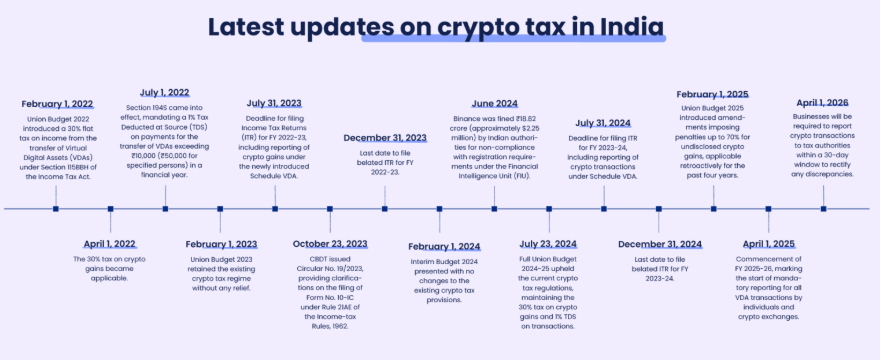
Table of Contents
Latest updates on crypto tax in India
Any NRI or resident holding cryptocurrency in India should Maintain complete transaction records, Report all Virtual Digital Asset transactions in Income Tax Return, Ensure Tax Deducted at Source compliance where applicable, Disclose foreign and domestic crypto holdings. Ensure compliance with Tax Deducted at Source requirements. Properly disclose domestic and overseas crypto holdings. Monitor evolving reporting obligations and penalty provisions and avoid non-compliance and litigation.
Major developments cryptocurrency transactions taxation in india
It summarizes major developments in India’s taxation and regulatory treatment of cryptocurrency transactions from February 2022 to April 2026. Key Milestones Shown in the Timeline
- February 1, 2022; Union Budget 2022 introduced a 30% flat tax on income from transfer of Virtual Digital Assets u/s 115BBH of the Income-tax Act.
- April 1, 2022: The 30% tax on crypto gains became applicable.
- July 1, 2022; Section 194S came into effect, requiring 1% Tax Deducted at Source on specified crypto transfers exceeding prescribed limits.
- February 1, 2023; Union Budget 2023 retained the existing crypto tax regime without providing any relief.
- July 31, 2023: Due date for filing Income Tax Return for Financial Year 2022-23, including reporting of crypto gains under the newly introduced Schedule Virtual Digital Asset.
- October 23, 2023: Central Board of Direct Taxes issued Circular No. 19/2023, clarifying provisions relating to Form 10-IF under Rule 21ACA of the Income-tax Rules, 1962.
- December 31, 2023: Last date to file the belated Income Tax Return for Financial Year 2022-23.
- February 1, 2024: Interim Budget 2024 made no changes to existing crypto taxation provisions.
- June 2024: Binance was fined approximately INR 18.82 crore by Indian authorities for non-compliance with Financial Intelligence Unit requirements.
- July 23, 2024: Union Budget 2024-25 upheld the current crypto taxation framework: 30% tax on gains, 1% Tax Deducted at Source on transactions
- July 31, 2024: Due date for filing Income Tax Return for Financial Year 2023-24, including reporting of crypto transactions under Schedule Virtual Digital Asset.
- December 31, 2024: Last date for filing belated Income Tax Return for Financial Year 2023-24.
- February 1, 2025: Union Budget 2025 introduced amendments imposing Penalties up to 70%. Disclosure requirements for undisclosed crypto gains and Retrospective applicability for certain past years
- April 1, 2025; Commencement of Financial Year 2025-26. Start of mandatory reporting of Virtual Digital Asset transactions by individuals and crypto exchanges.
- April 1, 2026: Businesses required to report cryptocurrency transactions to tax authorities within a 30-day window to rectify discrepancies.
Major Crypto Tax Rules Highlighted
India has one of the world’s most comprehensive tax and compliance frameworks for virtual digital assets, including cryptocurrencies and NFTs. The government continues to maintain the existing taxation structure while significantly strengthening reporting and disclosure requirements.
Overall, India’s crypto tax regime has evolved from a simple taxation framework introduced in 2022 into a robust compliance-focused system emphasizing transparency, reporting, and enforcement. Key Highlights related with Virtual Digital Assets in India taxation.
- 30% Tax on Crypto Gains: Profits arising from the sale, exchange, or spending of cryptocurrencies and other Virtual Digital Assets are taxed at a flat 30% rate u/s 115BBH, along with applicable surcharge and 4% cess. No deduction allowed except acquisition cost.
- Limited Deductions: Only the cost of acquisition is allowed as a deduction. No other expenses or losses can be claimed.
- 1% Tax Deducted at Source on Crypto Transfers: U/s 194S, a 1% tax deducted at source applies to specified crypto transactions above prescribed limits.
- Loss Set-off Restrictions: Crypto losses cannot be set off against other income, and losses from one crypto asset generally cannot be adjusted against gains from another asset.
- Mandatory Income Tax Returns Reporting: Taxpayers must disclose crypto transactions in Schedule Virtual Digital Assets while filing their income tax returns. Crypto transactions must be reported in Schedule Virtual Digital Asset of the income tax return.
- Enhanced Compliance Measures: The government has introduced stricter disclosure requirements, increased exchange-level reporting obligations, and stronger enforcement mechanisms to curb tax evasion.
- Exchange Reporting Requirements: From April 1, 2026, crypto exchanges are required to share transaction data directly with the Income Tax Department, increasing transparency and scrutiny.
- GST on Platform Service Fees: From July 7, 2025, GST applies to crypto platform service charges, increasing the overall cost of trading.
- International Reporting Framework: India is expected to adopt the Organization for Economic Co-operation and Development (OECD) Crypto-Asset Reporting Framework by April 2027, facilitating automatic exchange of information regarding offshore crypto holdings and transactions.
- Budget 2026-27: No change has been made to the existing 30% crypto tax and 1% tax deducted at source regime; however, the government continues to focus on stronger compliance and reporting requirements. The timeline reflects a gradual shift toward greater transaction reporting, Enhanced disclosure requirements, Financial Intelligence Unit (a national government agency that combats money laundering) compliance, Stronger enforcement and penalties.
Can You Avoid the 30% Crypto Tax in India?
No. There is no legal way to avoid the 30% tax on taxable crypto gains in India. Any profit earned from the transfer of Virtual Digital Assets, including cryptocurrencies, is taxable u/s 115BBH of the Income Tax Act. Instead of trying to avoid tax, investors should focus on proper tax planning and compliance by:
- Maintaining complete records of all crypto transactions.
- Reporting all crypto gains and losses in the Income Tax Return (Schedule VDA).
- Ensuring compliance with the 1% TDS provisions under Section 194S.
- Preserving supporting documents from exchanges and wallets.
- Filing income tax returns within the prescribed due dates.
With increasing reporting requirements, exchange-level disclosures, Schedule VDA reporting, TDS tracking, and enhanced scrutiny by tax authorities, crypto transactions are becoming more transparent than ever. Therefore, the safest and most prudent approach is to declare all crypto income accurately, pay applicable taxes, and remain fully compliant with tax laws.
In summary, crypto taxability of Various Transactions in India
Under the Indian crypto tax regime, profits from Virtual Digital Assets (VDAs) are generally taxed at 30% (plus applicable surcharge and 4% cess), with additional reporting and TDS requirements.
-
Crypto to INR (Sale of Cryptocurrency)
-
- Selling Crypto: Profit earned on selling cryptocurrency for INR is taxable at 30%.
- Buying Crypto: No tax is payable when purchasing cryptocurrency using INR.
-
Crypto-to-Crypto Transactions
-
- Trading/Swapping Crypto: Exchanging one cryptocurrency for another is treated as a transfer of a virtual digital asset and is subject to 30% tax on gains.
- The transaction remains taxable even if no INR is received.
-
Crypto Gifts
-
- Cryptocurrency received as a gift may be taxable if the value exceeds ₹50,000, subject to provisions relating to gifts under the Income-tax Act.
- Subsequent sale of such crypto may also attract 30% tax on gains.
-
Crypto Airdrops
-
- Airdrops are generally treated similarly to gifts and may become taxable depending on the value and circumstances.
- Any future gain arising from the sale of airdropped tokens is taxable at 30%.
-
DeFi Income (Staking, Yield Farming, Liquidity Rewards, etc.)
-
- Tokens received through DeFi activities may be taxable upon receipt according to the applicable income tax provisions.
- Any subsequent sale, exchange, or spending of such tokens may attract 30% tax on gains.
-
HODLing (Holding Crypto Assets)
-
- Merely holding cryptocurrency without selling, swapping, or transferring it does not trigger any tax liability.
-
Wallet-to-Wallet Transfers
-
- Transferring cryptocurrency between wallets owned by the same person generally does not attract tax, provided there is no change in beneficial ownership.
Quick review on Crypto Taxability of Various Transactions in India
| Transaction Type | Tax Implication |
| Buy Crypto with INR | No Tax |
| Sell Crypto for INR | 30% Tax on Gains |
| Crypto-to-Crypto Trade | 30% Tax on Gains |
| Crypto Gifts (subject to conditions) | Taxable if applicable thresholds are crossed |
| Crypto Airdrops | Taxable as per applicable provisions |
| DeFi Income | Taxable subject to nature of income |
| Hold Crypto (HODL) | No Tax |
| Transfer Between Own Wallets | No Tax |
In addition to the above, 1% TDS under Section 194S may apply on specified crypto transfers exceeding prescribed thresholds, and all reportable crypto transactions must be disclosed in Schedule VDA in the Income Tax Return.
Higher TDS for Non-Filers under Section 206AB and Applicability of Crypto TDS
As per the provisions of the Income Tax Act, 1961, taxpayers dealing in Virtual Digital Assets (VDAs), including cryptocurrencies, should be aware of the following:
Higher TDS for Specified Non-Filers:
If a taxpayer has failed to file income tax returns within the prescribed period and falls under the category of a specified non-filer under the Income Tax Act, tax may be deducted at a higher rate instead of the standard rate applicable to crypto transactions. Accordingly, where the prescribed conditions are met, TDS on crypto-related transactions may be deducted at 5% rather than the normal 1% TDS u/s 194S.
Applicability of TDS on Transactions Executed on or after July 1, 2022:
The TDS provisions u/s 194S became effective from July 1, 2022. Therefore, even if a buy or sell order was placed before July 1, 2022, TDS may still apply if the actual transfer or execution of the cryptocurrency transaction occurred on or after July 1, 2022.
Consequences of Crypto Tax Evasion
Failure to comply with crypto tax provisions may result in:
- Under-reporting or misreporting of income: Penalty ranging from 50% to 200% of the tax sought to be evaded, along with possible prosecution in serious cases.
- Late filing of Income Tax Return: Interest on unpaid taxes, late filing fees, and other penal consequences under the Income-tax Act.
- Non-compliance with TDS provisions: Interest, penalties, and recovery proceedings for failure to deduct or deposit TDS.
- Failure to file TDS returns: Late filing fee of ₹200 per day subject to prescribed limits.
**********************************************************
If this article has helped you in any way, i would appreciate if you could share/like it or leave a comment. Thank you for visiting my blog.
Legal Disclaimer:
The information / articles & any relies to the comments on this blog are provided purely for informational and educational purposes only & are purely based on my understanding / knowledge. They do noy constitute legal advice or legal opinions. The information / articles and any replies to the comments are intended but not promised or guaranteed to be current, complete, or up-to-date and should in no way be taken as a legal advice or an indication of future results. Therefore, i can not take any responsibility for the results or consequences of any attempt to use or adopt any of the information presented on this blog. You are advised not to act or rely on any information / articles contained without first seeking the advice of a practicing professional.