GST TDS vs GST TCS: Complete Guide for Businesses
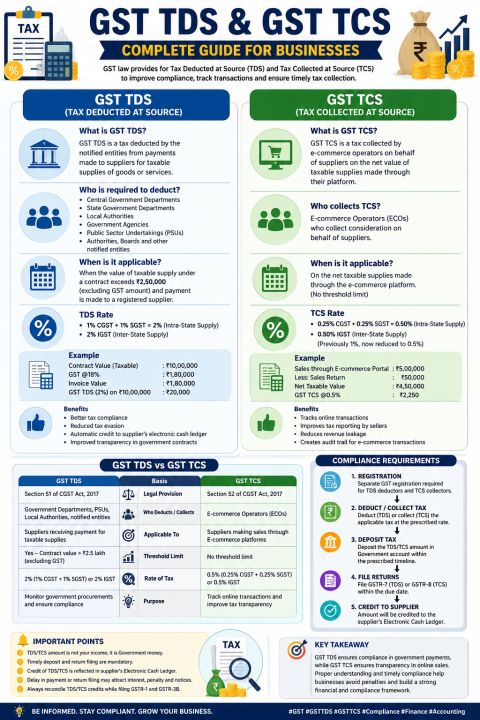
Table of Contents
GST TDS vs GST TCS: Complete Guide for Businesses
Many taxpayers, accountants, and business owners often confuse GST TDS (Tax Deducted at Source) with GST TCS (Tax Collected at Source) because both involve deduction or collection of tax at the source and subsequent deposit with the government. However, these provisions operate in entirely different scenarios and serve different objectives under the GST regime.
Understanding the distinction between GST TDS and GST TCS is essential for ensuring compliance, avoiding penalties, and maintaining accurate GST records.
GST TDS (Tax Deducted at Source) is governed by Section 51 of the CGST Act, 2017. :
- Under this provision, specified entities are required to deduct tax while making payment to suppliers for taxable goods or services. The objective of GST TDS is to Monitor large government procurements, Ensure tax compliance by suppliers, Create a trail of transactions, Facilitate timely tax collection.
Who is required to deduct GST TDS?
- The following entities are required to deduct GST TDS: Government Bodies Central Government Departments, State Government Departments, Local Authorities, Municipal Corporations, Municipal Councils, Panchayats, Statutory Bodies, Government Agencies, Public Sector Undertakings (PSUs), Notified Persons or Entities. Entities notified by the government under GST provisions.
- GST TDS is applicable when the value of taxable supply under a contract exceeds INR 2.5 lakh (excluding GST).
What is GST TCS?
- GST TCS (Tax Collected at Source) is governed by Section 52 of the CGST Act, 2017. Under this provision, E-Commerce Operators (ECOs) are required to collect tax on supplies made through theiE-commerceplatforms.
- The purpose is to track online transactions, improve transparency in e-commerce, and ensure reporting of sellers operating through online marketplaces.
Who Collects GST TCS?
- GST/TCS is collected by e-commerce operators (ECOs) Examples: Amazon, Flipkart, Meesho, Myntra, JioMart, Other online marketplaces. The operator collects the applicable amount from payments due to sellers and deposits it with the government.
When is GST/TCS applicable?
GST TCS apply to net taxable supplies made through the e-commerce operator’s platform.
Net Taxable Supplies : Net Taxable Supplies = Taxable Supplies − Sales Returns
Major Differences Between GST TDS and GST TCS
| Particulars | GST TDS | GST TCS |
| Legal Provision | Section 51 | Section 52 |
| Applicable On | Government Procurement | E-Commerce Transactions |
| Who Deducts/Collects? | Government Departments & Notified Entities | E-Commerce Operators |
| Threshold | Contract Value exceeding INR 2.5 lakh | No threshold |
| Purpose | Ensure tax compliance in procurement | Track e-commerce transactions |
| Rate | 2% | 0.50% |
| Return Form | GSTR-7 | GSTR-8 |
| Certificate | TDS Certificate | Reflected in Electronic Cash Ledger |
| Beneficiary | The supplier receives TDS credit | The seller receives TCS credit |
Credit of TDS and TCS
A common feature of both GST TDS and GST TCS is that the amount deposited with the government is credited to the supplier’s electronic cash ledger.
Benefits to Supplier
The supplier can use such credit for GST payment, interest payment, penalty payment, and output tax liability. Thus, Tax Deducted at Source and Tax Collected at Source acts as taxes already deposited on the supplier’s behalf.
Returns and Compliance Requirements
GST TDS Compliance
- Registration: Entities liable to deduct GST TDS must obtain: GST TDS Registration
- GSR TDS Return Filing: Form: GSTR-7
- Due Date: 10th of the succeeding month
- Certificate : TDS certificate is issued to suppliers.
GST TCS Compliance
- Registration: E-Commerce Operators must obtain GST and TCS Registration
- GST TCS Return Filing: Form: GSTR-8
- Due Date: 10th of the succeeding month
Consequences of Non-Compliance:
- Failure to comply with GST TDS or GST TCS provisions may attract interest liability for delayed payment of TDS/TCS.
- Late Fees: For delayed filing of returns.
- Penalties: For Failure to deduct, Failure to collect, Short deduction, short collection, and Non-deposit of tax
- GST Notices: Non-reconciliation of transactions may result in scrutiny and departmental notices.
Practical Examples
Example 1: GST TDS
A state government department purchases software services worth INR 12 lakh.
- Contract Value: INR 12 lakh
- GST: INR 2.16 lakh
Since the contract value exceeds INR 2.5 lakh, GST TDS @ 2% applies.
TDS = INR 24,000
Example 2: GST TCS
A seller sells products worth INR 8 lakh through Amazon.
- Sales = INR 8 lakh
- Returns = INR 1 lakh
Net Taxable Supplies = INR 7 lakh
TCS @ 0.50%
TCS = INR 3,500
Amazon collects INR 3,500 and deposits it with the government.
Key Takeaways of GST TDS vs GST TCS: Complete Guide for Businesses
In simple terms, GST TDS ensures compliance in government procurements, whereas GST TCS helps the GST department monitor and verify transactions conducted through online marketplaces. Both provisions strengthen tax transparency and improve GST compliance across the economy.
- GST TDS apply mainly to government departments, PSUs, local authorities, and notified entities.
- GST-TCS applies to e-commerce operators facilitating online sales.
- GST TDS is deducted by the buyer, whereas GST TCS is collected by the e-commerce platform.
- TDS rate is 2% while TCS rate is 0.5%.
- The deducted or collected amount is credited to the supplier’s Electronic Cash Ledger.
- Timely registration, tax deposit, return filing, and reconciliation are critical to avoid interest, penalties, and GST notices.
**********************************************************
If this article has helped you in any way, i would appreciate if you could share/like it or leave a comment. Thank you for visiting my blog.
Legal Disclaimer:
The information / articles & any relies to the comments on this blog are provided purely for informational and educational purposes only & are purely based on my understanding / knowledge. They do noy constitute legal advice or legal opinions. The information / articles and any replies to the comments are intended but not promised or guaranteed to be current, complete, or up-to-date and should in no way be taken as a legal advice or an indication of future results. Therefore, i can not take any responsibility for the results or consequences of any attempt to use or adopt any of the information presented on this blog. You are advised not to act or rely on any information / articles contained without first seeking the advice of a practicing professional.