Income Tax Implications for NRIs Receiving Gifts in India
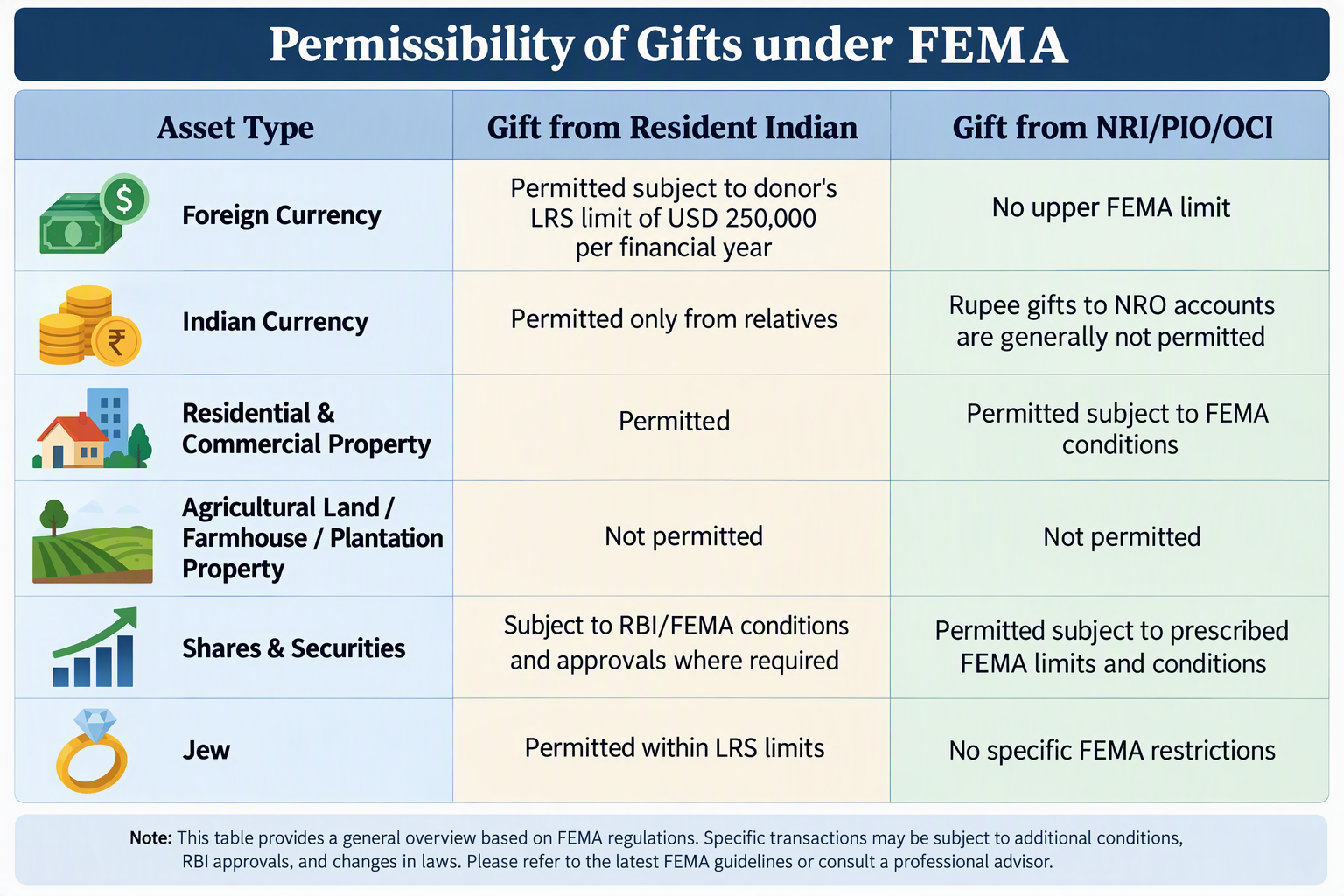
Table of Contents
Tax Implications for NRIs Receiving Gifts in India
Understand what qualifies as a gift under Indian law. Know the FEMA regulations, monetary limits, and income tax implications applicable to gifts received by NRIs, whether from India or abroad.
Understanding Gifts
The receipt of gifts by Non-Resident Indians (NRIs) is governed by:
- Foreign Exchange Management Act, 1999 (FEMA) for regulatory compliance.
- Income-tax Act, 1961 for taxation purposes.
A gift refers to any money or asset received without consideration, meaning the recipient is not required to provide any payment, service, or compensation in return.
Gifts may include Cash or bank transfers, Immovable property, Shares and securities, Interest in a Limited Liability Partnership (LLP) and Jewellery, bullion, paintings, sculptures, artefacts, and other valuable assets
FEMA Limits and Regulations for NRIs
NRIs, Persons of Indian Origin (PIOs), and Overseas Citizens of India (OCIs) can receive gifts from Resident Indians, NRIs, PIOs and OCIs. Under the Liberalised Remittance Scheme (LRS), a resident Indian may gift up to USD 250,000 per financial year (April to March) to an NRI.
Permissibility of Gifts under FEMA
| Asset Type | Gift from Resident Indian | Gift from NRI/PIO/OCI |
| Foreign Currency | Permitted subject to donor’s LRS limit of USD 250,000 per financial year | No upper FEMA limit |
| Indian Currency | Permitted only from relatives | Rupee gifts to NRO accounts are generally not permitted |
| Residential & Commercial Property | Permitted | Permitted subject to FEMA conditions |
| Agricultural Land / Farmhouse / Plantation Property | Not permitted | Not permitted |
| Shares & Securities | Subject to RBI/FEMA conditions and approvals where required | Permitted subject to prescribed FEMA limits and conditions |
| Jew | Permitted within LRS limits | No specific FEMA restrictions |
Gifts of Immovable Property
- Permitted Properties : An NRI can receive the following properties as a gift Residential property and Commercial property
- Restricted Properties : The following cannot generally be gifted to an NRI Agricultural land, Plantation property and Farmhouse. For gifts from another NRI/PIO/OCI, gifting of residential and commercial property is generally permitted only in accordance with FEMA provisions and eligible relationship requirements.
Gifts of Shares and Securities
NRIs may receive shares and securities as gifts from relatives subject to FEMA conditions, including:
- Compliance with RBI and FEMA regulations.
- Transfer limits prescribed under FEMA.
- Aggregate value restrictions in certain cases.
- Prior Government approval, where the investee company operates in sectors requiring Government approval.
Taxation of Gifts in India
Although the Gift Tax Act was abolished in 1998, gifts may still be taxable in the hands of the recipient under Section 56(2)(x) of the Income-tax Act, 1961.
Gifts Exempt from Tax
The following gifts are fully exempt Gifts received from specified relatives, Gifts received on marriage, Gifts received under a Will, Gifts received through inheritance and Gifts received in contemplation of the donor’s death
Tax Treatment of Gifts from Non-Relatives
Cash Gifts
| Particulars | Tax Treatment |
| Aggregate gifts up to INR 50,000 | Not Taxable |
| Aggregate gifts exceeding INR 50,000 | Entire amount becomes taxable |
Example: If an NRI receives INR 55,000 from non-relatives, the entire INR 55,000 is taxable.
Immovable Property
| Type of Receipt | Tax Implication |
| Property received without consideration and Stamp Duty Value exceeds INR 50,000 | Entire Stamp Duty Value becomes taxable |
| Property received for inadequate consideration | Difference between Stamp Duty Value and consideration may be taxable, subject to prescribed conditions |
Movable Property
(Including shares, jewellery, paintings, securities, bullion, etc.)
| Type of Receipt | Tax Implication |
| Received free of cost and FMV exceeds INR 50,000 | Entire FMV taxable |
| Received at a discounted value | Difference between FMV and amount paid may become taxable if threshold conditions are met |
Repatriation of Gifted Assets
If an NRI subsequently sells a gifted asset:
- Sale proceeds are normally credited to the NRO account.
- Up to USD 1 million per financial year may be repatriated abroad, subject to FEMA documentation and compliance requirements.
Tax on Income Generated from Gifted Assets
Immovable Property
| Asset | Tax Impact |
| Self-occupied property | Generally no tax on notional rent, subject to applicable provisions |
| Let-out property | Rental income taxable after eligible deductions |
Financial Assets
The following income is taxable:
- Dividend income on gifted shares or mutual funds
- Interest from gifted fixed deposits
- Interest from gifted bonds or debentures
Such income is generally taxable under the head Income from Other Sources.
Sale of Gifted Assets
Gifted Immovable Property
- Property held for more than 24 months is generally treated as a long-term capital asset.
- The recipient inherits the previous owner’s holding period.
- Cost of acquisition is generally taken as the previous owner’s cost under Section 49(1).
Gifted Shares and Securities
| Asset | Long-Term Holding Period |
| Listed shares and equity-oriented units | More than 12 months |
| Unlisted shares and most other assets | More than 24 months |
The previous owner’s holding period and acquisition cost are generally considered while calculating capital gains. Key Takeaways
- NRIs can receive gifts from resident Indians, NRIs, PIOs, and OCIs, subject to FEMA regulations.
- Resident Indians can gift up to USD 250,000 per financial year under the LRS framework.
- Gifts from specified relatives are generally tax-free.
- Gifts from non-relatives exceeding prescribed thresholds may become taxable.
- Agricultural land, plantation property, and farmhouses are subject to FEMA restrictions.
- Income generated from gifted assets may be taxable even when the gift itself is exempt.
- Sale of gifted assets can result in capital gains taxation.
- NRIs should also review tax obligations in their country of residence and evaluate applicable DTAA benefits.
Permissibility of Gifts Received by an NRI under FEMA
Under the Foreign Exchange Management Act (FEMA), NRIs, PIOs, and OCIs are permitted to receive gifts from resident Indians as well as from other NRIs/PIOs/OCIs, subject to prescribed conditions. While FEMA does not generally impose any overall monetary cap on gifts of Indian assets received from another NRI/PIO/OCI, certain restrictions apply regarding the nature of assets that may be gifted and the repatriation of funds arising from such assets.
The eligibility to receive a gift depends on the category of asset involved, such as money, immovable property, shares, securities, jewellery, or other movable assets.
Repatriation Rules for Gifted Assets
Where an NRI subsequently sells a gifted asset, the sale proceeds are generally required to be credited to the NRO account. An NRI may repatriate up to USD 1 million per financial year from balances held in the NRO account, including proceeds from the sale of gifted assets, subject to compliance with FEMA regulations, prescribed documentation, and applicable tax requirements.
Taxation of Gifts Received by NRIs
India abolished Gift Tax in 1998. Consequently, the receipt of a gift itself is no longer subject to gift tax. However, taxation may arise u/s 56(2)(x) of the Income-tax Act, 1961.
Gifts Exempt from Tax
The following gifts are fully exempt from income tax:
- Gifts received from specified relatives.
- the Gifts received on the occasion of marriage.
- Gifts received under a Will.
- the Gifts received by inheritance.
- Gifts received in contemplation of the donor’s death.
Gifts Received from Non-Relatives
Where gifts are received from persons who do not fall within the definition of “relative” under the Income-tax Act, the taxability depends upon the nature and value of the gift.
- Cash gifts exceeding INR 50,000 in aggregate during a financial year become fully taxable.
- Immovable property received without consideration may be taxable based on its stamp duty value.
- Shares, securities, jewellery, paintings, and other specified movable properties may be taxable based on their fair market value (FMV) if prescribed thresholds are exceeded.
Illustration
Suppose Manoj receives the following gifts from his friends:
- Cash gift of INR 30,000 from Paresh.
- the Cash gift of INR 25,000 from Jyoti.
- Artwork having a Fair Market Value (FMV) of INR 70,000 from Paresh.
Tax Implications
| Particulars | Amount (INR ) | Taxability |
| Cash Gifts (INR 30,000 + INR 25,000) | 55,000 | Entire amount taxable as aggregate exceeds INR 50,000 |
| Artwork Received | 70,000 | Entire FMV taxable as it exceeds INR 50,000 |
| Total Taxable Amount | 1,25,000 | Taxable under Income-tax Act |
Accordingly, Manoj will be liable to pay tax on INR 1,25,000, subject to the applicable income-tax slab rates and tax regime chosen by him.
Taxability of Income Generated from Gifted Assets
A distinction must be made between Taxability of the gift itself; and Taxability of income subsequently earned from the gifted asset. Further, under the clubbing provisions of the Income-tax Act, income arising from assets gifted to Spouse, Minor children and Son’s wife may be taxable in the hands of the donor and not the recipient.
Income from Gifted Immovable Property
Self-Occupied Property
- No income tax liability arises on a self-occupied property, subject to applicable provisions.
- A taxpayer may claim up to two residential properties as self-occupied during a financial year.
Let-Out Property
Where the gifted property is rented out Rental income is taxable in India. And Municipal taxes and permissible deductions can be claimed while computing taxable income.
Income from Other Gifted Assets
The following incomes are generally taxable under the head “Income from Other Sources”:
- Dividends received on gifted shares and mutual fund units.
- Interest earned on gifted fixed deposits.
- Interest from gifted bonds and debentures.
Such income is taxable according to the applicable slab rate of the recipient.
Tax Implications on Sale of Gifted Assets
Sale of Gifted Immovable Property
An immovable property held for more than 24 months is generally treated as a long-term capital asset. Important provisions include:
- The previous owner’s holding period is also considered while determining whether the gain is long-term or short-term.
- In many cases, the sale of gifted property results in Long-Term Capital Gains (LTCG).
- Under Section 49(1), the recipient inherits the previous owner’s cost of acquisition.
- For assets acquired before 1 April 2001, the fair market value as on 1 April 2001 may be considered, subject to prescribed restrictions.
Sale of Gifted Listed Shares and Securities
At the Time of Receipt
| Situation | Tax Consequence |
| Gift received from a relative | No tax implication |
| Gift received from a non-relative | FMV may be taxable under Section 56(2)(x) |
At the Time of Sale
- Listed shares held for more than 12 months generally qualify as long-term capital assets.
- Long-term capital gains exceeding the prescribed exemption threshold may be taxable under Section 112A.
- Grandfathering provisions may apply for certain assets acquired before 1 February 2018.
For such investments, the cost of acquisition may be determined based on specific grandfathering rules involving Actual purchase cost, Fair Market Value as on 31 January 2018, and Sale consideration.
Sale of Other Gifted Assets (Including Unlisted Shares)
Where an asset is held for more than 24 months, it is generally regarded as a long-term capital asset. Key points:
- Previous owner’s holding period is considered. Cost of acquisition is determined in accordance with Section 49(1). Cost may be based on:
- Actual acquisition cost of the previous owner; or
- Fair Market Value as on 1 April 2001, wherever applicable.
DTAA Considerations for NRIs
NRIs should not restrict their analysis only to Indian tax laws. The tax treatment in the country of residence must also be examined. Where India has entered into a Double Taxation Avoidance Agreement with the country of residence, relief may be available to avoid double taxation and claim foreign tax credits, subject to fulfillment of prescribed conditions.
Key Takeaway Income Tax Implications for NRIs Receiving Gifts in India
While FEMA broadly permits NRIs to receive gifts of money, property, and other assets, both FEMA and Income-tax provisions must be examined carefully before accepting a gift. Particular attention should be given to:
- The relationship between donor and recipient,
- The nature of the asset gifted,
- Repatriation restrictions,
- Future income generated from the gifted asset, and
- Capital gains implications on subsequent sale.
A proper review of FEMA, Income-tax Act provisions, and DTAA benefits can help NRIs structure gifts efficiently while remaining fully compliant with Indian regulations.
Conclusion
NRIs, PIOs, and OCIs can receive various forms of gifts, including money, property, and investments, subject to FEMA and Income-tax provisions. While gifts from relatives often enjoy complete tax exemption, gifts from non-relatives may attract taxation depending on their value and nature. Understanding both FEMA compliance and tax consequences is essential before accepting or transferring gifted assets.
NRIs/PIOs/OCIs can receive gifted assets permitted as per the prevailing FEMA regulations as well as the rules under the IT Act, 1961. While no restrictions apply to gifts received from other NRIs/PIOs/OCIs, you can receive gifts up to USD 250,000 from a resident Indian. The tax implications associated with such gifts vary depending on the type of asset and the relationship between you and the individual who has gifted the asset. You should consult an expert to understand the tax implications of receiving gifts as an NRI.
Disclaimer: This article is intended for informational purposes only and should not be construed as professional tax, legal, or financial advice. Readers should consult qualified advisors before taking any action.
**********************************************************
If this article has helped you in any way, i would appreciate if you could share/like it or leave a comment. Thank you for visiting my blog.
Legal Disclaimer:
The information / articles & any relies to the comments on this blog are provided purely for informational and educational purposes only & are purely based on my understanding / knowledge. They do noy constitute legal advice or legal opinions. The information / articles and any replies to the comments are intended but not promised or guaranteed to be current, complete, or up-to-date and should in no way be taken as a legal advice or an indication of future results. Therefore, i can not take any responsibility for the results or consequences of any attempt to use or adopt any of the information presented on this blog. You are advised not to act or rely on any information / articles contained without first seeking the advice of a practicing professional.