Overlooked responsibility of Tax Auditor on TP compliance
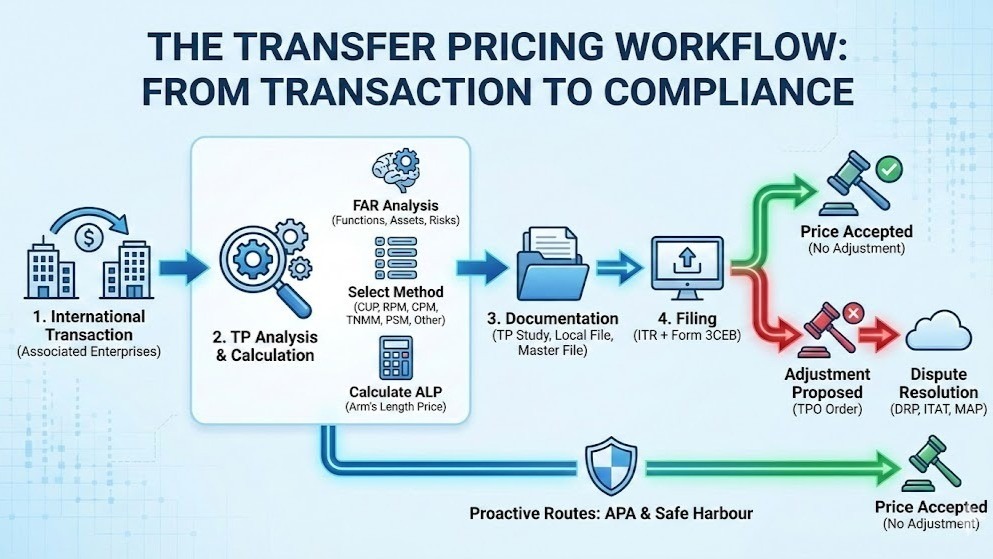
Table of Contents
Overlooked responsibility of the tax auditor regarding transfer pricing compliance.
Here is Highlights an important but often overlooked responsibility of the Tax Auditor regarding Transfer Pricing (TP) compliance. If management is unaware that Form 3CEAA may be applicable, must be filed by the entity itself, and carries substantial penalty exposure for non-compliance, the organisation may already be facing a governance risk even where all other transfer pricing reports have been filed correctly. The message is that TP applicability should not be ignored merely because the assessee has not informed the auditor.
The Hidden Governance Risk Behind Form 3CEAA and Master File Compliance
One of the most common misconceptions in transfer pricing compliance is the belief that “our CA will handle everything.” In reality, this assumption can create significant compliance exposure.
While a CA is responsible for certifying certain transfer pricing reports, the responsibility for several critical transfer pricing disclosures rests squarely with the taxpayer entity itself. Consequently, any failure in these disclosures can result in penalties on the company, irrespective of whether management was aware of the requirement.
Understanding the Two-Tier Compliance Framework
Indian transfer pricing regulations deliberately distinguish between professional certification and management disclosures.
Section 92E read with Rule 10E
- Requires filing of Income Tax Form 3CEB
- The form is certified by a Chartered Accountant
- Focuses on reporting international and specified domestic transactions
Section 92D read with Rules 10DA and 10DB
- Requires filing of the Master File (Form 3CEAA) and related Country-by-Country Reporting (CbCR) compliances
- These filings must be made by the entity itself
- Responsibility rests with management and not the auditor
This distinction is intentional. The law treats arm’s length pricing as a professional certification matter, whereas group structure, ownership of intangibles, cross-border arrangements, and value creation are considered management-level disclosures.
Why Responsibility Ultimately Lies with the Board and Management?
India’s Master File and Country-by-Country Reporting framework is based on the OECD BEPS Action 13 recommendations. The information sought under these provisions goes far beyond accounting records and includes:
- Group structure
- Ownership of intangibles
- Financing arrangements
- DEMPE functions relating to intellectual property
- Value creation within the multinational group
Because such information is strategic and operational in nature, the law presumes that management and the board possess the necessary knowledge and oversight.
A CA can verify pricing methodologies and certify Income Tax Form 3CEB. However, only management can accurately disclose group-wide facts and business arrangements.
Common Reasons for Non-Compliance
In practice, Master File defaults frequently occur because:
- The CFO assumes turnover thresholds automatically remove filing requirements
- Management is unaware that even a single international transaction may trigger specific reporting obligations
- Directors mistakenly believe Income Tax Form 3CEB covers all transfer pricing compliances
- Cost allocations and reimbursements are not treated as international transactions
- No individual within the organisation is assigned ownership of Form 3CEAA compliance
These are governance failures rather than tax computation errors.
What is the TP Reporting gap?
- The document explains a situation where An Indian entity has transactions with a foreign group company (Associated Enterprise or AE), The transaction may involve goods, services, loans, interest, royalty, guarantees, etc, The transaction is not identified during the tax audit, Consequently, neither proper disclosure in Form 3CD nor filing of Income Tax Form 3CEB takes place. This creates a “reporting gap” and may expose both the assessee and the reporting professional to consequences.
What If the Due Date Has Already Been Missed?
Although there is no automatic condonation mechanism, exposure may be reduced through prompt corrective actions. Recommended steps include:
- Filing any pending Form 3CEAA immediately, preferably before detection by the tax authorities
- Maintaining evidence demonstrating bona fide conduct
- Evaluating the possibility of a reasonable-cause defence where genuinely exceptional circumstances exist
- Responding comprehensively to any penalty notices
- Demonstrating that no inaccurate information was furnished
Once a notice is issued, the focus generally shifts from compliance to damage control.
When does Transfer Pricing apply?
The document emphasizes that TP applicability may arise whenever There is an Associated Enterprise (AE) relationship, One of the parties is a non-resident. And There is an international transaction affecting profits, income, losses, or assets. For Examples
- Sale of goods to foreign group company.
- Purchase of services from foreign parent.
- Inter-company loan.
- Royalty payment.
- Corporate guarantee.
- Shared management services.
Even where the transaction appears routine, TP provisions may still apply.
Why should a Tax Auditor be careful?
- Before signing the tax audit report, the auditor should examine Foreign shareholding patterns, Related party disclosures, Cross-border payments, Common management and control and Group company relationships.
- The document specifically warns that missing any of the following can create risk of Deemed AE relationships, Loans and financing arrangements, Royalty transactions. And Corporate guarantees.
Liability of the Assessee :
If TP provisions are applicable but Income Tax Form 3CEB is not furnished, the assessee may be exposed to penalty under Section 271BA. a penalty of INR 1,00,000 for failure to furnish Income Tax Form 3CEB.
Liability of the Tax Auditor/Accountant:
The document further highlights that where incorrect information is reported in the audit report or certificate, exposure may arise under Section 271J. The infographic refers to a penalty of INR 10,000 per report or certificate and also mentions possible ICAI disciplinary proceedings in professional misconduct situations.
Practical Guidance for Tax Auditors:
Before signing Form 3CD, the auditor should Identify whether any AE relationship exists, Check foreign shareholding and control, Review all cross-border transactions., Confirm whether Income Tax Form 3CEB is required, Reconcile disclosures in Form 3CD with TP documentation and Report any non-compliance or limitation instead of giving a clean report.
What do Benchmarking Report, TP Study Report, Income Tax Form 3CEB and Valuation Report mean?
- Benchmarking Report : A study comparing the taxpayer’s international transactions with similar independent transactions to determine the Arm’s Length Price (ALP).
- TP Study Report : Comprehensive transfer pricing documentation containing Functional analysis (FAR), Industry analysis, Selection of TP method, Benchmarking and Conclusion on arm’s length nature of transactions
- Income Tax Form 3CEB : An accountant’s report prescribed under Section 92E containing details of international and specified domestic transactions.
- Valuation Report : Required in specific cases such as Share issue to non-residents, Business restructuring, FEMA compliance, Transfer of shares or intangibles, Key Takeaway
Governance Measures Every Organisation Should Adopt
To reduce transfer pricing risk, organisations should establish:
- Automatic TP Review Mechanism : Every foreign payment or cross-border arrangement should trigger a transfer pricing review.
- Clear Internal Ownership : A designated officer should be responsible for Master File and CbCR compliance.
- Periodic Board Reporting : Transfer pricing compliance should form part of regular governance reviews rather than an annual year-end exercise.
- Management Accountability : Professional advisors provide guidance, but accountability cannot be outsourced.
Why Ignorance Is Not a Defence
A major point often overlooked is that Form 3CEAA is not a CA-certified document. The Master File:
- Is filed electronically by the taxpayer
- Is authenticated using the entity’s PAN and Digital Signature Certificate (DSC)
- Does not require certification by a Chartered Accountant
- Represents a declaration by management regarding the multinational group’s structure and operations
In essence, Form 3CEAA is a governance disclosure rather than an audit report.
Who Is Responsible?
- Board of Directors : Overall statutory responsibility
- CEO : Accuracy of group structure and governance disclosures
- CFO / Finance Head : Identification of reportable transactions and compliance filings
- CA : Certification responsibilities under Section 92E and Income Tax Form 3CEB
While a professional advisor may assist in preparing Form 3CEAA, the legal responsibility for filing and accuracy remains with the taxpayer entity.
Penalties Can Be Severe
The law prescribes stringent consequences for non-compliance relating to Master File reporting. Penalties may arise for:
- Failure to furnish Form 3CEAA
- Furnishing inaccurate or incomplete information
- Failure to provide information within the prescribed timeline
- Non-compliance with notices seeking additional information
Transfer pricing is not only the assessee’s concern. A tax auditor should actively examine whether any international transaction with an associated enterprise exists. If TP applicability is overlooked and Income Tax Form 3CEB is missed, the assessee may face penalties under Section 271BA and the reporting professional may also face consequences for incorrect reporting. Therefore, a TP applicability review should form part of every tax audit where foreign ownership, foreign group entities, or cross-border transactions are present. The penalty framework includes:
- INR 5,00,000 for failure to furnish the Master File
- Rs 5,000 per day for failure to provide information or documents when required
- INR 50,000 per day for continued default after receipt of a notice
- Rs 5,00,000 for furnishing inaccurate information
These penalties are often system-driven and may be triggered years later during assessment proceedings, risk assessments, or transfer pricing reviews.
Final Takeaway
Transfer pricing compliance is no longer merely a tax reporting exercise. It has evolved into a corporate governance responsibility. An organisation may have correctly obtained and filed Income Tax Form 3CEB, yet still face substantial exposure if Form 3CEAA or other Master File obligations are overlooked. Directors, CEOs, and CFOs must therefore understand that transfer pricing compliance extends beyond certification by a CA and requires active management oversight, documentation, and timely reporting.
**********************************************************
If this article has helped you in any way, i would appreciate if you could share/like it or leave a comment. Thank you for visiting my blog.
Legal Disclaimer:
The information / articles & any relies to the comments on this blog are provided purely for informational and educational purposes only & are purely based on my understanding / knowledge. They do noy constitute legal advice or legal opinions. The information / articles and any replies to the comments are intended but not promised or guaranteed to be current, complete, or up-to-date and should in no way be taken as a legal advice or an indication of future results. Therefore, i can not take any responsibility for the results or consequences of any attempt to use or adopt any of the information presented on this blog. You are advised not to act or rely on any information / articles contained without first seeking the advice of a practicing professional.