Overview about Income Tax Form 10IE & Form 10IEA:

Table of Contents
Overview about Income Tax Form 10IE & Form 10IEA:
Income Tax Form 10IE & Form 10IEA are related to the option of choosing between the old and new tax regimes in India.
Income Tax Form 10IE:
- Form 10IE: This form is indeed required to be filed when an assessee (taxpayer) wants to shift from the old tax regime to the new tax regime. Income Tax Form 10IE is a form which is required to be filed when an assessee wants to shift from old tax regime to new tax regime. The new tax regime typically offers lower tax rates but fewer deductions and exemptions compared to the old regime. So, taxpayers need to evaluate which regime is more beneficial for them based on their individual circumstances.
- This form allows taxpayers to make a formal declaration of their choice to opt for the new tax regime, which typically offers lower tax rates but fewer Income tax deductions & exemptions compared to the old regime.
- It’s an important step for individuals to take if they decide that the new tax regime is more beneficial for their financial situation.
Income Tax Form 10IEA:
Income Tax Department enabled the Form 10IEA for AY 2024-25 for filing on the income tax e-filing portal
- Form 10IEA: This form seems to be a hypothetical addition. There isn’t any official mention or documentation regarding Form 10IEA as of my last update. However, if it were to exist, based on your description,
- it would likely serve as a means for taxpayers to opt for the old tax regime, given that the new regime became the default option in last year’s budget. Taxpayers who prefer the old regime would need to actively choose it via this form.
- In last year’s budget, the new tax regime was made the default regime, due to which the taxpayers automatically moved to the new tax regime, that is, for opting of the old tax regime, they will have to choose it separately through Income Tax form 10IEA.
- Your statement reflects a hypothetical scenario rather than current tax regulations. As of my last update, the new tax regime introduced in the budget did not automatically become the default regime. Taxpayers still have the option to choose between the old and new tax regimes based on their individual preferences and financial situations.
- However, if the Government were to make such a change where the new tax regime becomes the default, then yes, taxpayers who wish to opt for the old tax regime would likely need to choose it separately through a form similar to your hypothetical Income Tax Form 10IEA. This would ensure that taxpayers actively select the old regime if they prefer it over the new one.
- It’s essential to stay updated with any changes in tax laws and regulations as they may impact your tax planning and filing requirements.
Form 10IEA for FY 2025-26 is now available for filing on the income tax portal.
All taxpayers opting for old tax regime in FY 2025-26 need to file Form 10IEA before due date of ITR Filing, New Income Tax Form 10IEA to Fill for Opting Old Tax Regime
- Applicability: While both forms are indeed related to tax regime options, it’s not just professionals and business owners who need to file them. Any individual taxpayer who wants to switch between tax regimes would need to file these forms.
- Filing Deadline: It’s accurate that both forms should be filed before the last date of filing the income tax return. Both the Income Tax Form 10IEA & Form 10IE should be filed before the last date of filing of the income tax return. & above both forms have to be filed by professionals & business owners.
Contents of Form 10-IEA
Form 10-IEA (similar to the earlier Form 10-IE) is used by eligible taxpayers to opt out of or re-enter the New Tax Regime. The Form 10-IEA requires basic details such as the name, address, and Permanent Account Number of the individual or Hindu Undivided Family, the FY for which the option is being exercised, & whether the taxpayer is opting out of the New Tax Regime or re-entering it. In cases of re-entry, details of the earlier option exercised, including the date of exercise and the first AY for which it was applicable, must be provided. The form also contains a declaration by the individual, Karta of the Hindu Undivided Family, or authorized representative. There have been no changes in Budget 2025 or Budget 2026 regarding the option to choose between the Old and new tax regimes.
Form 10-IEA Requirement at a Glance – Detailed Guide
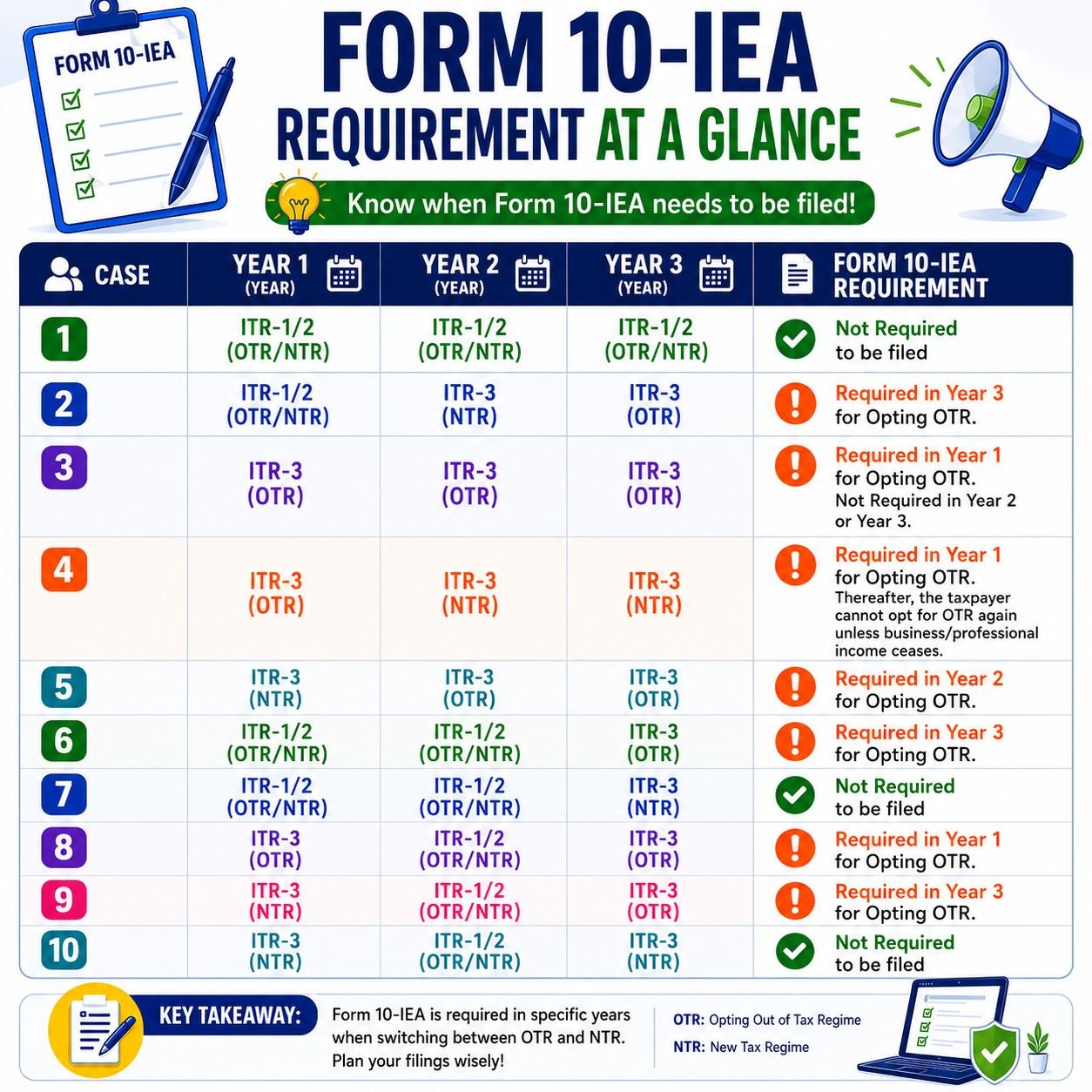
What is Form 10-IEA?
Form 10-IEA is filed by individuals, HUFs, AOPs (other than co-operative societies), BOIs, and artificial juridical persons having business or professional income who wish to Opt out of the New Tax Regime (NTR) and choose the Old Tax Regime (OTR); or In certain cases, withdraw a previously exercised option. Key Terms
- OTR = Old Tax Regime
- NTR = New Tax Regime
Important Rule
Taxpayers Filing ITR-1 or ITR-2
Generally, salaried taxpayers and those without business/professional income can choose between old and new regimes directly in the ITR. Form 10-IEA is generally not required for taxpayers filing only ITR-1 or ITR-2.
Taxpayers Filing ITR-3:
Where a taxpayer has business or professional income and files ITR-3, Form 10-IEA becomes important for opting into the Old Tax Regime. Cases Explained
Case 1
| Year 1 | Year 2 | Year 3 |
|---|---|---|
| ITR-1/2 (OTR/NTR) | ITR-1/2 (OTR/NTR) | ITR-1/2 (OTR/NTR) |
Form 10-IEA : Not Required : Reason: No business or professional income; regime can be selected in the return itself.
Case 2
| Year 1 | Year 2 | Year 3 |
|---|---|---|
| ITR-1/2 | ITR-3 (NTR) | ITR-3 (OTR) |
Form 10-IEA : Required in Year 3 : Reason: Taxpayer moves from New Regime to Old Regime while filing ITR-3.
Case 3
| Year 1 | Year 2 | Year 3 |
|---|---|---|
| ITR-3 (OTR) | ITR-3 (OTR) | ITR-3 (OTR) |
Form 10-IEA : Required only in Year 1 : Reason: Once the option for Old Regime is exercised, it continues. No need to file again in subsequent years.
Case 4
| Year 1 | Year 2 | Year 3 |
|---|---|---|
| ITR-3 (OTR) | ITR-3 (NTR) | ITR-3 (NTR) |
Form 10-IEA : Required in Year 1 : After switching to the new tax regime, taxpayer generally cannot again opt for Old Regime unless business/professional income ceases.
Case 5
| Year 1 | Year 2 | Year 3 |
|---|---|---|
| ITR-3 (NTR) | ITR-3 (OTR) | ITR-3 (OTR) |
Form 10-IEA : Required in Year 2 : Reason: Old Regime is being chosen for the first time.
Case 6
| Year 1 | Year 2 | Year 3 |
|---|---|---|
| ITR-1/2 | ITR-1/2 | ITR-3 (OTR) |
Form 10-IEA : Required in Year 3 : Reason: Business income begins and taxpayer opts for Old Regime.
Case 7
| Year 1 | Year 2 | Year 3 |
|---|---|---|
| ITR-1/2 | ITR-1/2 | ITR-3 (NTR) |
Form 10-IEA: Not Required: Reason: The Taxpayer remains under the new tax regime.
Case 8
| Year 1 | Year 2 | Year 3 |
|---|---|---|
| ITR-3 (OTR) | ITR-1/2 | ITR-3 (OTR) |
Form 10-IEA : Required in Year 1 and Reason: The Old Regime option was already exercised in Year 1.
Case 9
| Year 1 | Year 2 | Year 3 |
|---|---|---|
| ITR-3 (NTR) | ITR-1/2 | ITR-3 (OTR) |
Form 10-IEA Required in Year 3 : Reason: Opting for Old Regime while filing ITR-3.
Case 10
| Year 1 | Year 2 | Year 3 |
|---|---|---|
| ITR-3 (NTR) | ITR-1/2 | ITR-3 (NTR) |
Form 10-IEA: Not Required. Reason: Taxpayer continues under the new tax regime.
Key Takeaways related to Filling of Form 10-IEA
- ITR-1 and ITR-2 taxpayers generally do not need Form 10-IEA.
- ITR-3 taxpayers opting for the Old Tax Regime usually need Form 10-IEA.
- Once a taxpayer with business/professional income opts out of the New Tax Regime and chooses the Old Tax Regime, the option has long-term implications.
- Switching back to the New Tax Regime may restrict future movement to the Old Tax Regime.
- Taxpayers having business or professional income should review the tax regime choice carefully before filing Form 10-IEA.
- Practical Rule
No Business Income (ITR-1/ITR-2) → Usually No Form 10-IEA
Business/Professional Income (ITR-3) + Opting for Old Tax Regime → Form 10-IEA generally required.
Question: ITR 3 – Switching to Old Tax Regime – Submission of Form 10IEA – Can it be cancelled after the Form 10IEA has been submitted? Please note that ITR 3 is yet to be submitted.
Ans: Form 10IEA cannot be cancelled.
Quick Decision Guide: Old vs New Tax Regime & Form 10-IEA
| Particulars | AY 2026-27 | Tax Year 2026-27 |
|---|---|---|
| Income Period | 1 April 2025 to 31 March 2026 | 1 April 2026 to 31 March 2027 |
| Governing Law | Income-tax Act, 1961 | Income Tax Act, 2025 |
| New Tax Regime Provision | Section 115BAC | Section 202 |
| New Regime as Default? | Yes | Yes |
| No Business/Professional Income | Choose Old Regime directly in the income tax return | Exercise option in Tax Year Return |
| Business/Professional Income | File Form 10-IEA within due date u/s 139(1) | Exercise or withdraw option in return under Rule 136 |
| Separate Form 10-IEA Required? | Yes, for business/professional income cases | No separate Form 10-IEA prescribed |
| Employer Declaration | Relevant only for salary TDS | Relevant only for salary TDS |
| Return Filing Period | During 2026 | During 2027 |
Common Mistakes Taxpayers Make Regarding Form 10-IEA
- Filing Form 10-IEA despite having only salary income, even though the Old Tax Regime can be selected directly in the income tax return.
- Treating the employer’s tax regime declaration as final, whereas it only affects TDS and does not replace the tax regime choice in the return.
- Filing Form 10-IEA after due date, which may result in losing the option to opt for the Old Tax Regime in business/professional income cases.
- Selecting the wrong AY or tax year, leading to incorrect compliance.
- Refiling Form 10-IEA every year unnecessarily, even though a valid option generally continues for business-income taxpayers.
- Assuming Form 10-IEA applies under the Income Tax Act, 2025, whereas the tax regime option is exercised directly in the return under Rule 136.
Summary
Under the I Tax Act, 1961, taxpayers with business or professional income must file Form 10-IEA by the deadline specified in Section 139(1) in order to opt out of the default new tax regime for AY 2026–2027. In contrast, taxpayers without business or professional income may choose the old tax regime directly when filing their income tax return. However, Form 10-IEA is no longer the required method for Tax Year 2026–2027, which is controlled by the Tax Act, 2025; instead, taxpayers exercise or withdraw the tax regime choice directly in the return under Section 202 read with Rule 136. Additionally, any statement made to an employer only affects the TDS calculation on salary; it does not take the place of the taxpayer’s statutory choice of tax regime when submitting an ITR.
Link: https://www.incometax.gov.in/iec/foportal/downloads/income-tax-returns
**********************************************************
If this article has helped you in any way, i would appreciate if you could share/like it or leave a comment. Thank you for visiting my blog.
Legal Disclaimer:
The information / articles & any relies to the comments on this blog are provided purely for informational and educational purposes only & are purely based on my understanding / knowledge. They do noy constitute legal advice or legal opinions. The information / articles and any replies to the comments are intended but not promised or guaranteed to be current, complete, or up-to-date and should in no way be taken as a legal advice or an indication of future results. Therefore, i can not take any responsibility for the results or consequences of any attempt to use or adopt any of the information presented on this blog. You are advised not to act or rely on any information / articles contained without first seeking the advice of a practicing professional.