Moving to UAE? Tax Residency Depends on Days, Not Document
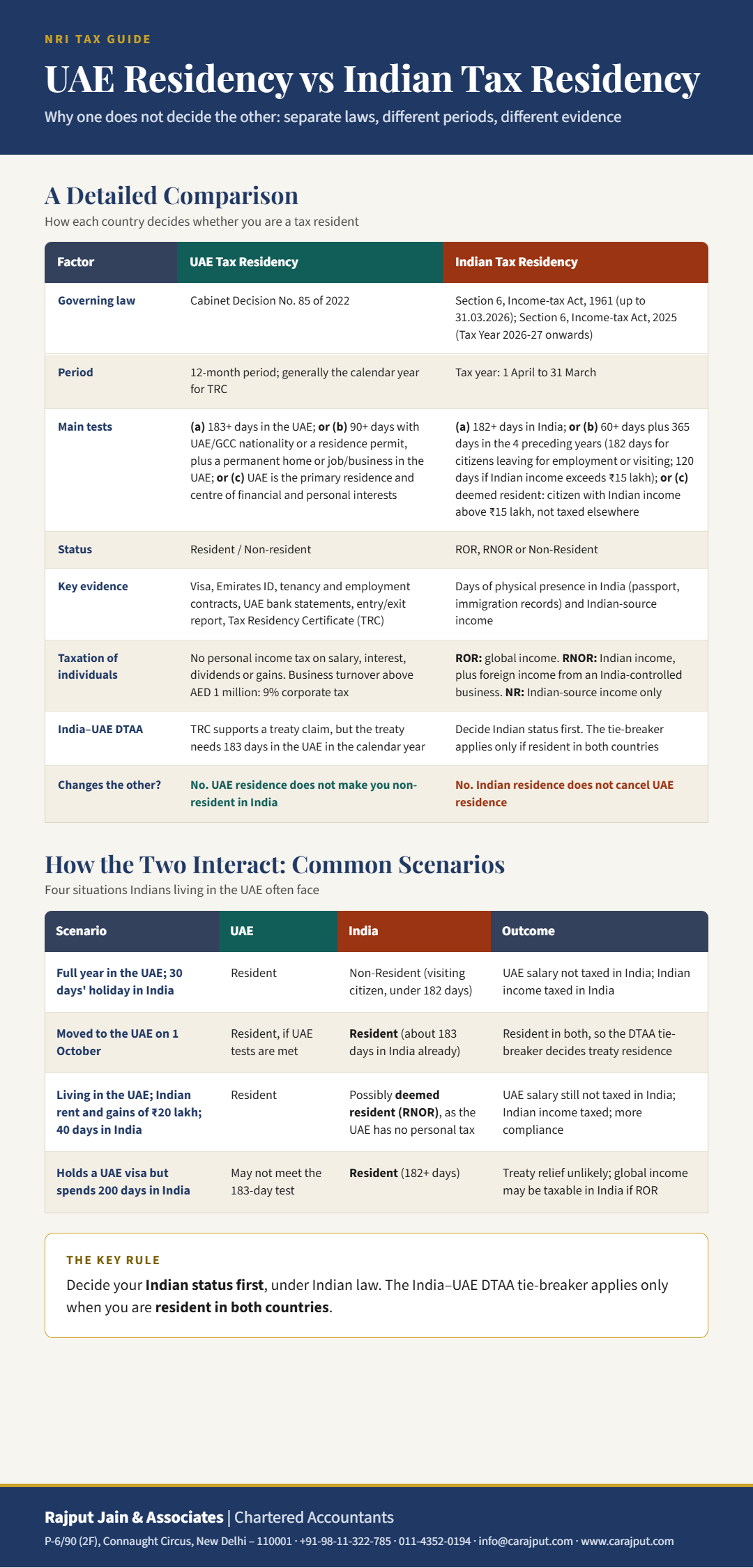
Table of Contents
Moving to the UAE? Your Indian Tax Residency Depends on Days, Not Documents
Many Indians moving to the UAE assume that obtaining a residence visa, Emirates ID, tenancy contract, or opening a UAE bank account automatically makes them a non-resident for Indian tax purposes. However, these documents only establish where you live. They do not determine your residential status under Indian income tax law.
Under Indian tax law, residential status is determined primarily by the number of days you are physically present in India during a particular financial year. The calculation is performed separately every year, meaning a person may qualify as a non-resident in one year and become a resident in another, regardless of the documents they hold.
Understanding the Basic Residence Tests
Residential status is governed by Section 6 of the Income-tax Act. An individual is treated as a resident in India if either of the following conditions is satisfied:
- The individual stays in India for 182 days or more during the relevant financial year; or
- The individual stays in India for 60 days or more during the year and 365 days or more during the four preceding financial years.
Anyone who does not satisfy either condition is generally treated as a non-resident.
The Year You Leave India: Timing Matters
For Indian citizens leaving India for employment abroad, special relief is available in the year of departure. In such cases, the 60-day test does not apply. The individual becomes a resident only if their stay in India during that financial year is 182 days or more.
This makes the departure date extremely important.
For example, if an individual relocates to Dubai on 1 October, they would have already spent approximately 183 days in India since the financial year began on 1 April. As a result, they would still qualify as an Indian resident for that year despite taking up genuine employment in the UAE.
UAE Residency vs Indian Tax Residency: Why One Does Not Decide the Other
Moving to the UAE and getting a residence visa is an important step in an expatriate’s tax position, but it does not by itself make you a non-resident in India. The two countries test residence under separate laws, on different time periods and with different evidence. Each must be determined on its own terms.
-
UAE Residency vs Indian Tax Residency: A Detailed Comparison
| Factor | UAE Tax Residency | Indian Tax Residency |
| Governing law | UAE Cabinet Decision No. 85 of 2022 (tax residency rules) | Section 6 of the Income-tax Act, 1961 (years up to 31 March 2026); Section 6 of the Income-tax Act, 2025 (Tax Year 2026-27 onwards) |
| Period of measurement | A 12-month period; generally the calendar year for TRC purposes | Tax year (1 April to 31 March) |
| Main tests | (a) 183 days or more in the UAE in a 12-month period; or (b) 90 days or more plus UAE/GCC nationality or a valid UAE residence permit, and a permanent place of residence or employment/business in the UAE; or (c) the UAE is the usual or primary place of residence and centre of financial and personal interests | (a) 182 days or more in India; or (b) 60 days or more in the year plus 365 days in the four preceding years (this limb is relaxed to 182 days for citizens leaving for employment and for visiting citizens/PIOs, and to 120 days for visitors with Indian income above ₹15 lakh); or (c) deemed residence for Indian citizens with Indian income above ₹15 lakh who are not liable to tax elsewhere |
| Categories of status | Resident / non-resident | Resident and Ordinarily Resident (ROR), Resident but Not Ordinarily Resident (RNOR), or Non-Resident (NR) |
| Key evidence | Residence visa, Emirates ID, tenancy contract, employment contract, UAE bank statements, entry/exit report, Tax Residency Certificate (TRC) from the Federal Tax Authority | Number of days of physical presence in India (passport stamps, immigration records), Indian-source income, and the conditions above |
| Taxation of individuals | No personal income tax on salary, interest, dividends or capital gains. Individuals carrying on a business with turnover above AED 1 million come under UAE corporate tax (9%) | ROR: global income taxed. RNOR: Indian income, plus foreign income from a business controlled or profession set up in India. NR: only income received, accruing or arising in India |
| Relevance under the India–UAE DTAA | A TRC supports a claim to treaty residence, but the treaty itself requires 183 days in the UAE in the calendar year for individuals | Indian status must be determined first under Section 6. The treaty’s tie-breaker applies only if the person is resident in both countries |
| Does it automatically change the other? | No. UAE residence does not make a person non-resident in India | No. Indian residence does not cancel UAE residence |
-
How the Two Interact: Common Scenarios
| Scenario | UAE Position | Indian Position | Outcome |
| Full year in the UAE; 30 days’ holiday in India | Resident | Non-Resident (visiting citizen; below 182 days) | UAE salary not taxed in India; Indian income taxed in India |
| Moved to the UAE on 1 October | Resident (if the UAE tests are met) | Resident (already about 183 days in India that year) | Resident in both countries, so the DTAA tie-breaker decides treaty residence |
| Living in the UAE; Indian rent and capital gains of ₹20 lakh; 40 days in India | Resident | Possibly deemed resident (RNOR), as there is no UAE personal tax | UAE salary still not taxed in India; Indian income taxed; compliance obligations increase |
| Holds a UAE visa but spends 200 days in India | May not meet the 183-day test | Resident (182+ days) | Treaty relief is unlikely; global income may be taxable in India if ROR |
-
Quick Compliance Checklist: Review Before Filing Your Indian Return
| S. No. | Item to Review | Why It Matters | Supporting Documents |
| 1 | Days spent in India (1 April – 31 March) | Primary basis of Indian residential status | Passport stamps, immigration movement record, travel tickets |
| 2 | Days spent in India in the four preceding years | Needed for the 60-day and 120-day tests and for RNOR classification | Past travel records, earlier computations |
| 3 | Days spent in the UAE (calendar year) | Treaty residence requires 183 days in the UAE | UAE entry/exit report |
| 4 | UAE residence status | Establishes residence under UAE law | Residence visa, Emirates ID, tenancy contract |
| 5 | UAE Tax Residency Certificate | Supports a claim to treaty benefits in India | TRC issued by the UAE Federal Tax Authority |
| 6 | Indian income above ₹15 lakh? | Triggers the 120-day rule and the deemed-residence risk | Computation of Indian-source income |
| 7 | Indian salary or business income | Taxable in India irrespective of status | Form 16, books of account |
| 8 | Indian rental income | Taxable in India; TDS at non-resident rates | Rent agreement, TDS certificates |
| 9 | Interest on Indian bank accounts | NRO interest is taxable; NRE interest is exempt only while the person is a non-resident | Bank interest certificates |
| 10 | Capital gains on Indian assets | Taxable in India; higher TDS for non-residents | Sale deeds, broker statements, TDS certificates |
| 11 | Foreign bank and investment accounts | Must be reported in Schedule FA if ROR | Foreign account statements |
| 12 | Applicable DTAA provisions | Tie-breaker, lower withholding rates, relief from double taxation | India–UAE DTAA, TRC, Form 10F |
| 13 | Foreign tax paid, if any | Credit available for foreign taxes paid (rarely relevant for UAE salary, which is untaxed) | Foreign tax payment proofs, Form 67 or its equivalent under the new Rules |
| 14 | Residential status determination for the year | Decides which income is taxable and which ITR schedules apply | Year-wise computation with supporting records |
-
Transition Note: Which Indian Law Applies?
| Period | Governing Law | Terminology |
| Up to 31 March 2026 | Income-tax Act, 1961 | Financial Year / Assessment Year |
| From 1 April 2026 | Income-tax Act, 2025 | Tax Year (e.g., Tax Year 2026-27) |
The residence tests are substantially the same under both Acts, but section references and forms in returns and correspondence should follow the law applicable to the relevant year.
Practical Tip
Before relocating, carefully calculate your day count using:
- Passport entry and exit stamps
- Travel itineraries
- Bureau of Immigration movement records
Generally, both the arrival date and departure date are counted as days spent in India.
Returning to India for Visits
Indian citizens and Persons of Indian Origin (PIOs) residing abroad enjoy a relaxation when visiting India.
For such individuals, the normal 60-day threshold is replaced by a 182-day threshold. Therefore, they generally become residents only if they stay in India for 182 days or more during the financial year.
Additionally:
- Time spent in India during earlier years alone cannot make them residents.
- The concession applies only to those visiting India.
- Individuals returning to India for employment or permanent residence are subject to the standard residency rules.
The ₹15 Lakh Income Rules
-
High-Income Visiting NRIs and the 120-Day Rule
For an Indian citizen or PIO visiting India whose Indian income exceeds ₹15 lakh (excluding foreign-source income), the residency threshold may reduce from 182 days to 120 days, provided they have spent 365 days or more in India during the preceding four years.
Individuals becoming residents under this rule are generally classified as Resident but Not Ordinarily Resident (RNOR) rather than ordinary residents.
-
Deemed Residency Provisions
An Indian citizen may be treated as a deemed resident in India if:
- Indian income exceeds ₹15 lakh; and
- The person is not liable to tax in any other country by reason of residence, domicile, or similar criteria.
This provision is especially relevant for individuals residing in the UAE because the UAE does not levy personal income tax on employment income.
Therefore, Indian citizens living in the UAE who earn substantial Indian-source income, such as:
- Rental income
- Interest income
- Dividends
- Capital gains
should carefully evaluate potential deemed residency exposure.
The Relief Available
Even if a person is classified as a deemed resident, their status is generally limited to RNOR.
As an RNOR:
- UAE salary normally remains outside the Indian tax net.
- Other foreign income generally remains exempt from Indian taxation.
- However, income from a business controlled from India or a profession set up in India may still be taxable.
Although foreign income may remain protected, the RNOR classification impacts tax compliance, disclosure obligations, and treaty positions.
India-UAE DTAA: When Treaty Rules Differ
The India-UAE Double Taxation Avoidance Agreement (DTAA) contains a separate set of residency rules.
Under Article 4 of the treaty, an individual generally needs to be present in the UAE for at least 183 days during the calendar year to qualify as a UAE resident for treaty purposes.
By contrast, UAE domestic tax residency rules can be more liberal. Under Cabinet Decision No. 85 of 2022, an individual may qualify as a UAE tax resident with only 90 days of presence, subject to additional conditions such as residence permits, employment, business activity, or permanent accommodation.
Why This Difference Matters
- A UAE Tax Residency Certificate obtained under the 90-day domestic rule may not automatically secure treaty benefits in India.
- The DTAA follows the calendar year (January to December), whereas Indian tax residency follows the financial year (April to March).
- Individuals must separately analyze both periods.
- Treaty tie-breaker provisions apply only when residence exists under the domestic laws of both countries.
Income That Continues to Be Taxable in India
Becoming a non-resident does not eliminate Indian tax liability.
The following Indian-source income generally remains taxable in India:
- Rent from Indian properties
- Interest on NRO accounts
- Interest on loans and bonds
- Dividends from Indian companies
- Capital gains from Indian shares, mutual funds, and real estate
In many cases, tax is deducted at source (TDS) at higher rates for non-residents. Filing an Indian tax return may still be necessary to claim refunds or report taxable income.
Is UAE Salary Taxable in India?
For a non-resident, salary earned for services rendered in the UAE is generally not taxable in India if:
- The services are performed outside India; and
- The salary is first received in the UAE.
Subsequent remittance of those funds to an Indian bank account does not make the income taxable in India.
However, taxpayers should retain supporting documentation such as:
- Salary slips
- Employment contracts
- UAE payroll account statements
Salary attributable to services performed in India remains taxable in India irrespective of where it is paid.
UAE Companies Managed from India: The POEM Risk
Many entrepreneurs relocate to Dubai while continuing to manage their businesses from India.
A company incorporated in the UAE may still qualify as an Indian tax resident if its Place of Effective Management (POEM) is located in India. This occurs when key management and commercial decisions are effectively made from India.
Founders, directors, and promoters operating UAE entities should ensure that management control and strategic decision-making genuinely occur outside India to avoid adverse tax consequences.
Keep Evidence Ready from Day One
Tax residency is determined based on facts and must be reviewed every year. The strongest defence is proper documentation maintained contemporaneously rather than assembled after receiving a tax notice.
Maintain copies of:
- Passport pages, travel itineraries, and immigration records
- UAE employment contracts and salary slips
- The UAE tenancy agreements and utility bills
- UAE bank statements, Emirates ID, and residence visa
- The UAE Tax Residency Certificate, wherever available
Conclusion – Final Takeaway
Moving to the UAE does not automatically make you a non-resident under Indian tax law. What matters most is your physical presence in India, your Indian-source income, and how residency provisions apply to your specific circumstances. Careful planning of your departure date, accurate tracking of travel days, and maintaining strong documentation can make the difference between a smooth tax position and a costly tax dispute.
UAE residence is an essential part of an expatriate’s tax position, but it is not decisive for Indian tax purposes. An Indian citizen moving to the UAE should take these steps in order:
- Determine residential status under Indian law for each year, based on days in India, Indian income and the relevant tests.
- Identify which income is taxable in India for that status.
- Apply the India–UAE DTAA where there is dual residence or a need for treaty relief, supported by a TRC and the 183-day treaty test.
- Maintain contemporaneous records of travel, employment, accommodation and banking.
The safest approach is to consider days of presence, source of income, residential status, treaty provisions and documentation together, not to rely on UAE residency alone.
**********************************************************
If this article has helped you in any way, i would appreciate if you could share/like it or leave a comment. Thank you for visiting my blog.
Legal Disclaimer:
The information / articles & any relies to the comments on this blog are provided purely for informational and educational purposes only & are purely based on my understanding / knowledge. They do noy constitute legal advice or legal opinions. The information / articles and any replies to the comments are intended but not promised or guaranteed to be current, complete, or up-to-date and should in no way be taken as a legal advice or an indication of future results. Therefore, i can not take any responsibility for the results or consequences of any attempt to use or adopt any of the information presented on this blog. You are advised not to act or rely on any information / articles contained without first seeking the advice of a practicing professional.