Guide on F&O Turnover Calculation for ITR Filing
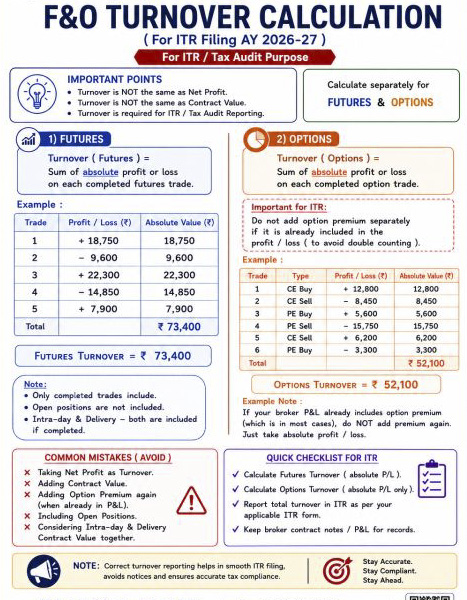
Table of Contents
Guide on F&O Turnover Calculation for ITR Filing (AY 2026–27)
One of the most misunderstood aspects of income tax compliance for traders is the calculation of futures & options turnover. Many traders incorrectly assume that turnover means the total value of contracts purchased or sold. However, for income tax and tax audit purposes, turnover is calculated differently. A wrong turnover calculation may lead to incorrect income tax return filing, incorrect determination of tax audit applicability, incorrect reporting of business income, and notices from the Income Tax Dept.
Why are Futures & Options Income Treated as Business Income?
Income arising from trading in futures and options on recognized stock exchanges is generally considered non-speculative business income under the Income Tax Act. Therefore, traders must Compute turnover correctly, Calculate profit/loss accurately, Determine audit applicability under Section 44AB and Choose the correct income tax return form. following is an important principle:
- Turnover is NOT Net Profit
- If Turnover is NOT Contract Value
- Turnover is based on Absolute Profit and Absolute Loss
The ICAI Guidance Note for Tax Audit purposes considers turnover in derivatives as the aggregate of favorable and unfavorable differences.
Difference Between Speculative and Non-Speculative Business Income
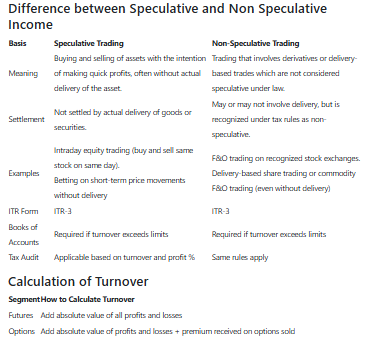
Here we explain the distinction between speculative business and non-speculative business under the Income Tax Act. This classification is crucial because it affects ITR filing, tax audit applicability, and set-off/carry-forward of losses.
Speculative Business
A speculative transaction is one where a contract for purchase or sale of shares, securities, or commodities is settled otherwise than by actual delivery. In simple terms:
- Profit is earned from price movements.
- No actual delivery of shares is taken.
- Transactions are settled by squaring off positions.
Examples: Intraday equity trading, same-day buy and sell transactions in shares.
Non-Speculative Business
These are transactions specifically excluded from the definition of “speculative transactions” under the Income Tax Act. Examples:
- Futures & Options (F&O) trading on recognized stock exchanges
- Commodity derivatives on recognized exchanges
- Certain delivery-based trading activities treated as business income
Key Difference Between Speculative and Non-Speculative Business Income
| Particulars | Speculative Business | Non-Speculative Business |
| Nature | Trading without actual delivery | Recognized business activity |
| Delivery | No delivery | May or may not involve delivery |
| Common Example | Intraday Equity Trading | F&O Trading |
| Income Head | Speculative Business Income | Non-Speculative Business Income |
| ITR Form | Generally ITR-3 | Generally ITR-3 |
| Loss Carry Forward | 4 Years | 8 Years |
| Loss Set-Off | Only against speculative profits | Against eligible business income as per tax provisions |
How to Calculate Futures Turnover
For Futures Trading: Turnover = Sum of Absolute Profit and Absolute Loss on all completed trades. “Absolute” means ignoring the plus (+) or minus (−) sign. Example
| Trade | Profit/Loss (INR ) | Absolute Value (INR ) |
| 1 | +18,750 | 18,750 |
| 2 | -9,600 | 9,600 |
| 3 | +22,300 | 22,300 |
| 4 | -14,850 | 14,850 |
| 5 | +7,900 | 7,900 |
Futures Turnover = 18,750 + 9,600 + 22,300 + 14,850 + 7,900 = INR 73,400
Note
- Only completed trades are considered.
- Open positions at year-end are ignored.
- Both profit and loss transactions are included.
- Sign (+/-) is ignored.
How to Calculate Options Turnover
For Options Trading: Turnover = Sum of Absolute Profit and Absolute Loss on completed option trades. Example
| Trade | Profit/Loss (INR ) | Absolute Value (INR ) |
| CE Buy | +12,800 | 12,800 |
| CE Sell | -8,450 | 8,450 |
| PE Buy | +5,600 | 5,600 |
| PE Sell | -15,750 | 15,750 |
| CE Sell | +6,200 | 6,200 |
| PE Buy | -3,300 | 3,300 |
Options Turnover : = 12,800 + 8,450 + 5,600 + 15,750 + 6,200 + 3,300 = INR 52,100
What About Option Premium?
This is where many taxpayers make mistakes. If your broker’s P&L statement already includes option premium. Do not add option premium again.
If option premium is not reflected separately
Premium received on sale of options may be included as per turnover calculation principles. In practice, most brokers issue a consolidated P&L statement, and therefore Use the broker’s profit/loss figures and avoid adding option premium twice.
Treatment of Open Positions
- A very common error includes open contracts. Example : Suppose on 31 March: One Nifty Future remains open. And One Bank Nifty Option remains open. These positions are not squared off.
- Treatment: Do not include open trades in turnover. Only completed or settled contracts are considered for turnover calculation.
Common Mistakes Traders Should Avoid
Considering Net Profit as Turnover
- Wrong: Profit = INR 50,000 and Assuming turnover = INR 50,000
- Correct: Turnover is based on total absolute profit and loss.
- Turnover could be INR 8 lakh even if net profit is only INR 50,000.
Taking Contract Value as Turnover
- Wrong: 50 trades worth INR 5 crore. Assuming turnover = INR 5 crore
- Correct: Contract value is irrelevant for turnover calculation.
- Only absolute profit and loss should be considered.
Adding Option Premium Twice
- Wrong: Taking broker P&L and Adding premium separately This inflates turnover.
- Correct check broker statement first. Including Open Positions
- Wrong: Including unrealized profits and losses.
- Correct: Only completed trades count.
Mixing Delivery Trades and Futures & Options Contract Values
Delivery-based equity turnover is computed differently. Futures & options turnover should be calculated separately from investment transactions.
Tax Audit Applicability (Section 44AB)
Correct turnover directly impacts tax audit requirements. Generally, audit applicability depends on turnover limits prescribed u/s 44AB, profit declaration, presumptive taxation provisions, and cash receipts and payments thresholds. An incorrect turnover figure may wrongly trigger or avoid audit requirements. Therefore, proper turnover computation is critical. The following are tax audit implications, which are mentioned below: Correct classification is important for determining
- Tax Audit under Section 44AB
- Applicability of presumptive taxation
- Maintenance of books of account
- Correct disclosure in ITR
Loss Treatment
- Speculative Loss: Can be set off only against speculative profits. Example: Intraday loss cannot normally be adjusted against F&O profit. Carry Forward: 4 Assessment Years
- Non-Speculative Loss: Can generally be adjusted against eligible business income subject to tax provisions. Carry Forward: 8 Assessment Years.
Which ITR Form Should Futures & Options Traders Use?
Generally:
- ITR-3 : Applicable for Individuals and HUFs having business income from Futures trading, Options trading, intraday trading, and Proprietary business
- ITR-4: The taxpayer may be applicable where presumptive taxation provisions are valid and conditions are satisfied. Most active futures & options traders typically file ITR-3.
Practical Classification for Traders
| Activity | Tax Treatment |
| Intraday Equity Trading | Speculative Business |
| Nifty Futures Trading | Non-Speculative Business |
| Stock Futures Trading | Non-Speculative Business |
| Index Options Trading | Non-Speculative Business |
| Stock Options Trading | Non-Speculative Business |
| Delivery-Based Investment | Capital Gains (generally) |
| Delivery-Based Trading as Business | Non-Speculative Business |
Documents Required for Futures & Options Income tax return Filing
For futures & options trading, turnover is not the contract value and not the net profit. It is generally calculated as the aggregate of absolute profits and absolute losses from completed futures and options trades. Correct turnover calculation helps determine tax audit applicability, proper business income reporting, and the correct income tax return filing position, ensuring smooth compliance and reducing the likelihood of tax notices.
Taxpayers must keep the following ready for futures & options: ITR filing:
- Trading Documents: Broker P&L Report, Trade Book, Ledger Statement, Contract Notes, and Annual Transaction Statement.
- Tax Documents: PAN, Aadhaar, Form 26AS, AIS, and TIS
- Banking Records: Bank statements and Interest certificates
- Investment Documents: Dividend statements, Capital gains reports and Mutual fund statements
The most important takeaway under the above difference is:
- Intraday Equity Trading = Speculative Business
- Futures & Options Trading = Non-Speculative Business
- Speculative losses can be carried forward for 4 years
- Non-speculative business losses can be carried forward for 8 years
- Correct classification helps determine turnover, tax audit applicability, and proper ITR reporting, thereby reducing the risk of tax notices.
Quick Compliance Checklist: F&O Turnover Calculation for ITR Filing
- Calculate Futures Turnover using absolute P&L
- Calculate Options Turnover using absolute P&L
- Consider only completed trades
- Verify turnover with broker statement
- Check tax audit applicability
- Use correct Income tax return form
- Reconcile figures with AIS and Form 26AS
- Maintain contract notes and records
- Report business income accurately
- File Income tax return before the due date
**********************************************************
If this article has helped you in any way, i would appreciate if you could share/like it or leave a comment. Thank you for visiting my blog.
Legal Disclaimer:
The information / articles & any relies to the comments on this blog are provided purely for informational and educational purposes only & are purely based on my understanding / knowledge. They do noy constitute legal advice or legal opinions. The information / articles and any replies to the comments are intended but not promised or guaranteed to be current, complete, or up-to-date and should in no way be taken as a legal advice or an indication of future results. Therefore, i can not take any responsibility for the results or consequences of any attempt to use or adopt any of the information presented on this blog. You are advised not to act or rely on any information / articles contained without first seeking the advice of a practicing professional.